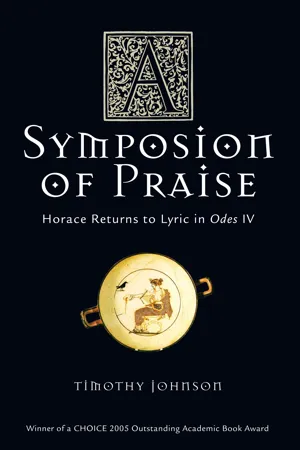
Ten years after publishing his first collection of lyric poetry, Odes I-III, Horace (65 B.C.-8 B.C.) returned to lyric and published another book of fifteen odes, Odes IV. These later lyrics, which praise Augustus, the imperial family, and other political insiders, have often been treated more as propaganda than art. But in A Symposion of Praise, Timothy Johnson examines the richly textured ambiguities of Odes IV that engage the audience in the communal or "sympotic" formulation of Horace's praise. Surpassing propaganda, Odes IV reflects the finely nuanced and imaginative poetry of Callimachus rather than the traditions of Aristotelian and Ciceronian rhetoric, which advise that praise should present commonly admitted virtues and vices. In this way, Johnson demonstrates that Horace's application of competing perspectives establishes him as Pindar's rival.
Johnson shows the Horatian panegyrist is more than a dependent poet representing only the desires of his patrons. The poet forges the panegyric agenda, setting out the character of the praise (its mode, lyric, and content both positive and negative), and calls together a community to join in the creation and adaptation of Roman identities and civic ideologies. With this insightful reading, A Symposion of Praise will be of interest to historians of the Augustan period and its literature, and to scholars interested in the dynamics between personal expression and political power.
- 348 pages
- English
- PDF
- Available on iOS & Android
eBook - PDF
About this book
Information
Publisher
University of Wisconsin PressYear
2005Print ISBN
9780299207441
9780299207403
eBook ISBN
9780299207434
Table of contents
- Contents
- Acknowledgments
- Abbreviations
- Introduction
- 1. Sympotic Horace
- 2. Encomia Nobilium and Horace’s Panegyric Praxis
- 3. Encomia Augusti, “Take One”
- 4. Songs of Mo(u)rning
- 5. Encomia Augusti, “Take Two”
- Notes
- Works Cited
- General Index
- Index Locorum
Trusted by 375,005 students
Access to over 1.5 million titles for a fair monthly price.
Study more efficiently using our study tools.
Frequently asked questions
Yes, you can cancel anytime from the Subscription tab in your account settings on the Perlego website. Your subscription will stay active until the end of your current billing period. Learn how to cancel your subscription
No, books cannot be downloaded as external files, such as PDFs, for use outside of Perlego. However, you can download books within the Perlego app for offline reading on mobile or tablet. Learn how to download books offline
Perlego offers two plans: Essential and Complete
- Essential is ideal for learners and professionals who enjoy exploring a wide range of subjects. Access the Essential Library with 800,000+ trusted titles and best-sellers across business, personal growth, and the humanities. Includes unlimited reading time and Standard Read Aloud voice.
- Complete: Perfect for advanced learners and researchers needing full, unrestricted access. Unlock 1.5M+ books across hundreds of subjects, including academic and specialized titles. The Complete Plan also includes advanced features like Premium Read Aloud and Research Assistant.
We are an online textbook subscription service, where you can get access to an entire online library for less than the price of a single book per month. With over 1.5 million books across 990+ topics, we’ve got you covered! Learn about our mission
Look out for the read-aloud symbol on your next book to see if you can listen to it. The read-aloud tool reads text aloud for you, highlighting the text as it is being read. You can pause it, speed it up and slow it down. Learn more about Read Aloud
Yes! You can use the Perlego app on both iOS and Android devices to read anytime, anywhere — even offline. Perfect for commutes or when you’re on the go.
Please note we cannot support devices running on iOS 13 and Android 7 or earlier. Learn more about using the app
Please note we cannot support devices running on iOS 13 and Android 7 or earlier. Learn more about using the app
Yes, you can access A Symposion of Praise by Timothy Johnson in PDF and/or ePUB format, as well as other popular books in Literature & Ancient & Classical Literary Criticism. We have over 1.5 million books available in our catalogue for you to explore.