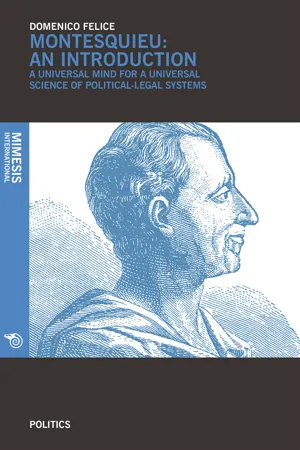
What can Montesquieu still teach us today? Montesquieu was the first political writer who first formulated the principles of separation of powers and the independence of justice. He was the first to scientifically study human institutions, both ancient and modern, Asiatic and European, African and American. Again, he was the first thinker to theorize Federal Democracy, systematically tracking down the root causes of human events in its environmental, cultural, historical, and geographical aspects. Analysing several aspects of Montesquieu's philosophical and political thought, this volume highlights his stoicism, realism, anti-despotism as well as his staunch defence of human dignity. Introducing one of the sharpest thinkers of modernity, this book offers fundamental tools to understand the very ground of our contemporary times.
eBook - ePub
Montesquieu: an introduction
A universal mind for a universal science of political-legal systems
- English
- ePUB (mobile friendly)
- Available on iOS & Android
eBook - ePub
Montesquieu: an introduction
A universal mind for a universal science of political-legal systems
About this book
Information
Subtopic
PoliticsTable of contents
- Chronological Table of Major Events in Montesquieu’s Life
- Acknowledgements
- Abbreviations
- Montesquieu: An Introduction
- 1. Travelling the World
- 2. Oppression and Liberty: The irreducible dualism of human societies and institutions
- 3. The Persian Letters: a philosophical-political treatise in the form of an epistolary novel
- 4. The Turning-point: The Treatise on Duties or Montesquieu’s Stoicism
- 5. The Real Voyage
- 6. Civilizations «Are Mortal»189: Decline and Fall of the «Wisest People Upon Earth»
- 7. It concerns and affects us all: Essay on the causes that may affect men’s minds and characters
- 8. The Spirit of the Laws: the foundation of a universal science of the political-social systems
- 9. Conclusions
- Bibliography of the writings
Trusted by 375,005 students
Access to over 1.5 million titles for a fair monthly price.
Study more efficiently using our study tools.
Frequently asked questions
Yes, you can cancel anytime from the Subscription tab in your account settings on the Perlego website. Your subscription will stay active until the end of your current billing period. Learn how to cancel your subscription
No, books cannot be downloaded as external files, such as PDFs, for use outside of Perlego. However, you can download books within the Perlego app for offline reading on mobile or tablet. Learn how to download books offline
Perlego offers two plans: Essential and Complete
- Essential is ideal for learners and professionals who enjoy exploring a wide range of subjects. Access the Essential Library with 800,000+ trusted titles and best-sellers across business, personal growth, and the humanities. Includes unlimited reading time and Standard Read Aloud voice.
- Complete: Perfect for advanced learners and researchers needing full, unrestricted access. Unlock 1.5M+ books across hundreds of subjects, including academic and specialized titles. The Complete Plan also includes advanced features like Premium Read Aloud and Research Assistant.
We are an online textbook subscription service, where you can get access to an entire online library for less than the price of a single book per month. With over 1.5 million books across 990+ topics, we’ve got you covered! Learn about our mission
Look out for the read-aloud symbol on your next book to see if you can listen to it. The read-aloud tool reads text aloud for you, highlighting the text as it is being read. You can pause it, speed it up and slow it down. Learn more about Read Aloud
Yes! You can use the Perlego app on both iOS and Android devices to read anytime, anywhere — even offline. Perfect for commutes or when you’re on the go.
Please note we cannot support devices running on iOS 13 and Android 7 or earlier. Learn more about using the app
Please note we cannot support devices running on iOS 13 and Android 7 or earlier. Learn more about using the app
Yes, you can access Montesquieu: an introduction by Domenico Felice in PDF and/or ePUB format, as well as other popular books in Politics & International Relations & Politics. We have over 1.5 million books available in our catalogue for you to explore.