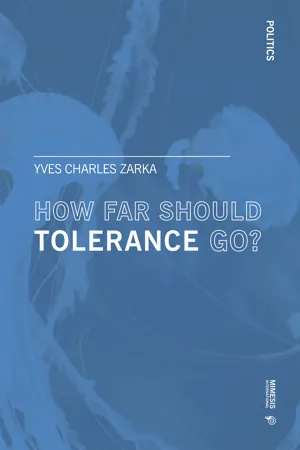
What are the limits of tolerance in constitutional or liberal democracies today? This is a crucial question, for if there were no limits to tolerance, it would ultimately destroy itself by accepting the intolerable. The concept of tolerance has to be assessed from a political point of view, thus questioning to what extent its potential achievement does not suppose any moral mutation in humanity. For instance, if people were all already 'virtuous' according to a commonly held moral framework, there would be simply no need to speak of tolerance. Conversely, if it were the case that people could be made 'virtuous', then tolerance would be the matter of an improbable utopia. Ultimately, we need to consider how tolerance can be conceptualised in a way that is relevant to people and their societies as they actually are. In a time when a growing amount of political demands touches on themes of cultural identity and rights, and while we witness a mounting wave of religious fundamentalism, what should democracies accept and what should they refuse?
- English
- ePUB (mobile friendly)
- Available on iOS & Android
eBook - ePub
How far Should Tolerance go?
About this book
Information
Topic
PhilosophySubtopic
Philosophy History & TheoryTable of contents
- Preface
- Introduction How to think of coexistence in a torn-apart world?
- 1. Tolerance is an issue for our times
- 2. Tolerance-structure
- 3. A torn-apart world
- 4. Recognition without reconciliation
- 5. The mechanisms of tolerance-structure
- 6. State neutrality
- 7. State neutrality and secularism
- 8. State neutrality and the limits of state action
- 9. Return to tolerance-structure: the “state neutrality” mechanism
- 10. From religious tolerance to cultural tolerance
- 11. Neutrality of justice and plurality of conceptions of the good
- 12. Principles of justice: political values or procedural liberalism?
- 13. Reasonable pluralism and consensus by crosschecking
- 14. The two tyrannies
- 15. How far can the state remain neutral?
- 16. Return to tolerance-structure: “fundamental values and rights”
- 17. Human dignity
- 18. Fundamental rights
- 19. Return to tolerance-structure: the third mechanism
- 20. Minorities and cultural rights
- 21. Critique of the concept of multicultural citizenship
- 22. Who is the subject of collective rights?
- 23. Do cultural differences need protecting?
- 24. Which cultural rights should tolerance-structure guarantee?
- 25. The fiction of single identity: we are all mixed-race
- 26. Education in memory and freedom
- 27. Subjective rights and the theory of connections
- 28. Critique of community
- 29. Tolerance-structure and the transformation of political society
Trusted by 375,005 students
Access to over 1.5 million titles for a fair monthly price.
Study more efficiently using our study tools.
Frequently asked questions
Yes, you can cancel anytime from the Subscription tab in your account settings on the Perlego website. Your subscription will stay active until the end of your current billing period. Learn how to cancel your subscription
No, books cannot be downloaded as external files, such as PDFs, for use outside of Perlego. However, you can download books within the Perlego app for offline reading on mobile or tablet. Learn how to download books offline
Perlego offers two plans: Essential and Complete
- Essential is ideal for learners and professionals who enjoy exploring a wide range of subjects. Access the Essential Library with 800,000+ trusted titles and best-sellers across business, personal growth, and the humanities. Includes unlimited reading time and Standard Read Aloud voice.
- Complete: Perfect for advanced learners and researchers needing full, unrestricted access. Unlock 1.5M+ books across hundreds of subjects, including academic and specialized titles. The Complete Plan also includes advanced features like Premium Read Aloud and Research Assistant.
We are an online textbook subscription service, where you can get access to an entire online library for less than the price of a single book per month. With over 1.5 million books across 990+ topics, we’ve got you covered! Learn about our mission
Look out for the read-aloud symbol on your next book to see if you can listen to it. The read-aloud tool reads text aloud for you, highlighting the text as it is being read. You can pause it, speed it up and slow it down. Learn more about Read Aloud
Yes! You can use the Perlego app on both iOS and Android devices to read anytime, anywhere — even offline. Perfect for commutes or when you’re on the go.
Please note we cannot support devices running on iOS 13 and Android 7 or earlier. Learn more about using the app
Please note we cannot support devices running on iOS 13 and Android 7 or earlier. Learn more about using the app
Yes, you can access How far Should Tolerance go? by Yves Charles Zarka in PDF and/or ePUB format, as well as other popular books in Philosophy & Philosophy History & Theory. We have over 1.5 million books available in our catalogue for you to explore.