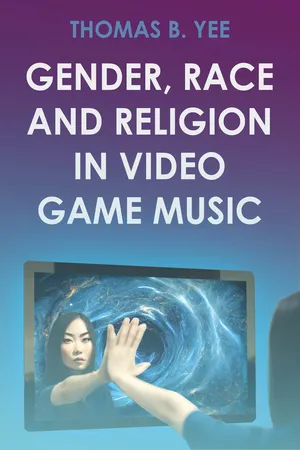
This book provides semiotically-focused analyses and interpretations of video game music, focusing specifically on musical representation of three demographic diversity traits. Adopting a narratologist orientation to supplement existing ludological scholarship, these analyses apply music semiotics to crucial modern-day issues such as representation of gender, race, and religion in video games.
An original and welcome contribution to the field, it considers musical meaning in relation to the aspects of gender, race, and religion. This book will help readers to develop language and context in which to consider video game music in terms of society and representation and will encourage future research in these critical areas.
Yee analyses music's contributions to video games' narrative and thematic meanings, specifically concerning three master categories of identity – gender, race and religion. Containing twenty-five detailed analytical case studies of musical representation in video game music, it sets out theoretical and conceptual frameworks beneficial for interpreting musical meaning from video game soundtracks. Though players and commentators may be tempted to view a game's soundtrack as mere 'background music', this research demonstrates video game music's social relevance as a major factor impacting players' cultural attitudes, values, and beliefs.
Part I explores immersion, interactivity and interpretation in video game music, proposing a theory of 'interpretative interactivity' to account for players' semiotic agency in dialogue with their ludic agency. Part II explores gender representation in a trajectory from conventional gender construction, alternative femininities/masculinities and potential for non-binary representational possibilities. Part III explores musical representation of nationality, culture and race, proposing the concept of 'racialised fantasy' and applying frameworks from race scholarship to connect media representations of race to real world racial justice movements. Part IV examines religion, introducing the concept of 'sonic iconography' to connect theological
meanings to the use of sacred music in video game music.
- 296 pages
- English
- ePUB (mobile friendly)
- Available on iOS & Android
eBook - ePub
Gender, Race and Religion in Video Game Music
About this book
Information
Subtopic
MusicTable of contents
- Cover
- Title
- Copyright
- Contents
- List of Figures and Tables
- Introduction: Enter the Virtual
- PART I: NARRATIVE AND PLAY
- PART II: GENDER
- PART III: RACE
- PART IV: RELIGION
- Conclusion: Enter the Real
- Appendix: Audiovisual Media
- References
- About the Author
- Index
- Back Cover
Trusted by 375,005 students
Access to over 1.5 million titles for a fair monthly price.
Study more efficiently using our study tools.
Frequently asked questions
Yes, you can cancel anytime from the Subscription tab in your account settings on the Perlego website. Your subscription will stay active until the end of your current billing period. Learn how to cancel your subscription
No, books cannot be downloaded as external files, such as PDFs, for use outside of Perlego. However, you can download books within the Perlego app for offline reading on mobile or tablet. Learn how to download books offline
Perlego offers two plans: Essential and Complete
- Essential is ideal for learners and professionals who enjoy exploring a wide range of subjects. Access the Essential Library with 800,000+ trusted titles and best-sellers across business, personal growth, and the humanities. Includes unlimited reading time and Standard Read Aloud voice.
- Complete: Perfect for advanced learners and researchers needing full, unrestricted access. Unlock 1.5M+ books across hundreds of subjects, including academic and specialized titles. The Complete Plan also includes advanced features like Premium Read Aloud and Research Assistant.
We are an online textbook subscription service, where you can get access to an entire online library for less than the price of a single book per month. With over 1.5 million books across 990+ topics, we’ve got you covered! Learn about our mission
Look out for the read-aloud symbol on your next book to see if you can listen to it. The read-aloud tool reads text aloud for you, highlighting the text as it is being read. You can pause it, speed it up and slow it down. Learn more about Read Aloud
Yes! You can use the Perlego app on both iOS and Android devices to read anytime, anywhere — even offline. Perfect for commutes or when you’re on the go.
Please note we cannot support devices running on iOS 13 and Android 7 or earlier. Learn more about using the app
Please note we cannot support devices running on iOS 13 and Android 7 or earlier. Learn more about using the app
Yes, you can access Gender, Race and Religion in Video Game Music by Thomas B. Yee in PDF and/or ePUB format, as well as other popular books in Media & Performing Arts & Music. We have over 1.5 million books available in our catalogue for you to explore.