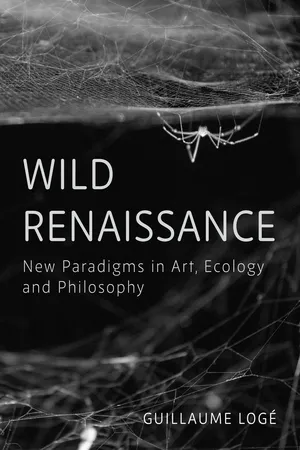
A Renaissance is underway. It can be seen as a response to environmental, societal and ethical issues so acute that human survival is in question. Artistic, philosophical and political, it builds on the scientific revolutions of the last decades and positions itself in relation to technoscientific and transhumanist promises. Within this Wild Renaissance, man no longer positions himself as master and owner, imposing his will on a passive and purposeless nature. He makes ready to listen to a new partner: the world around him. He discovers the potential of its forces, which he both harnesses and engages with, joining them with his own. A new era is taking shape, restoring man to his "wild" dignity and giving his existence meaning, joy and ambition. An art is emerging that is redefining the paradigms of creation. Its work is in the vanguard of this societal project.
There is a major tendency in contemporary art and design, and perhaps the most innovative one, that is putting in place new ways of working and producing works which represent a significant break with the principles that have guided modernity up to the present. We are witnessing the beginnings of a renaissance that can be described as "wild." Powerfully ambitious, it stands as a response to the acute environmental, societal and ethical questions raised in today's world and, at their heart, the very survival of the human species as we enter the Anthropocene era. It bears witness to massive shifts in consciousness, and echoes a call for a change that is becoming increasingly audible. Nature, or, more precisely, a new way of being "wild" – that is to say, of thinking and acting on the Earth, is the key reference around which the contents of an alternative common destiny are being articulated. The "Wild Renaissance" is supplanting both the modernity that placed man at the center of the world, assigning him the vocation of becoming the master and owner of nature, and postmodernity, which put an end to the great narratives and left only an absolute relativism incapable of supporting new sustainable models.
The word "renaissance" is not used lightly. It stems from a philosophical and ecological analysis of the turn of the 15th and 16th centuries in Italy. This upheaval did not come out of nowhere. Today, as back then, a period of some hundred and fifty yeas paved the way for its emergence. The proto-Wild Renaissance goes from the mid-19th century to the early 21st century. The evolution and convergence of art, philosophy and the sciences of the environment can be observed there in relation to key historical and political moments that have repeatedly raised the question of the continuing habitability of the Earth.
The Wild Renaissance is articulated around a renewed vision of humankind and nature. Humankind no longer aspires to impose its will on a passive, purposeless nature. Instead, it is beginning to listen to a new partner: the world around it. Humanity is discovering the potential of these forces and entering into a relation with them, allying them with its own. Humanity is going from from master to collaborator, assuming an ecological responsibility that goes hand in hand with a revived dignity and an existence that is all the more exciting for all that. Already-established figures in contemporary art and design together with emerging creators are at the forefront of this new movement. The works and practices analyzed here are shown in a new light, with a fresh understanding of their historical grounding, conceptual underpinnings and significance for the present.
Previously published in French by Presses Universitaires de France (PUF).