- 280 pages
- English
- ePUB (mobile friendly)
- Available on iOS & Android
eBook - ePub
About this book
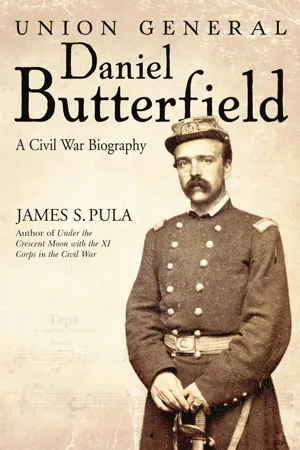
This book explores the complex legacy of Union General Daniel Butterfield, from his battlefield heroics and Medal of Honor to controversies and innovations that shaped the Civil War. James S. Pula unravels this enigmatic figure's life in this meticulously researched and long-awaited biography. Dan Butterfield played a pivotal role during the Civil War. He led troops in the field at the brigade, division, and corps level, wrote an 1862 Army field manual, was awarded a Medal of Honor, composed "Taps," and served as the chief-of-staff for Joe Hooker in the Army of the Potomac. He introduced a custom that remains in the U.S. Army today: the use of a distinctive hat or shoulder patch to denote the soldier's unit. Butterfield was also controversial, not well-liked by some, and tainted by politics. Award-winning author James S. Pula unspools fact from fiction to offer the first detailed and long overdue treatment of the man and the officer in Union General Daniel Butterfield: A Civil War Biography. Butterfield was born into a wealthy New York family whose father co-founded American Express. He was one of the war's early volunteers and made an important contribution with his manual Camp and Outpost Duty for Infantry (1862). He gained praise leading a brigade on the Virginia Peninsula and was wounded at Gaines' Mill, where his heroism would earn him the Medal of Honor in 1892. It was in the solemnity of camp following the Seven Days' Battles that he gained lasting fame for composing "Taps." When its commander went missing, Butterfield took command of a division at Second Bull Run and did so with steadiness and intelligence. His abilities bumped him up to lead the Fifth Corps during the bloodbath at Fredericksburg, where he was charged with managing the dangerous withdrawal across the Rappahannock River. Shocked and hurt when he was supplanted as the head of the Fifth Corps, he received another chance to shine when General Hooker named him chief-of-staff of the Army of the Potomac. In this capacity Butterfield was largely responsible for several innovations. He used insignia he designed himself to identify each corps, streamlined the supply system, and improved communications between commands. He played a pivotal role during the Chancellorsville and Gettysburg campaigns in managing logistics, communications, and movements, only to be discarded while home recuperating from a Gettysburg wound. Politics and his testimony before the Committee on the Conduct of the War tainted his rising star. When Hooker was sent west, Butterfield went along as chief-of-staff and earned positive comments from Hooker and Gens. George Thomas, William T. Sherman, and U. S. Grant. Butterfield led a division in the XX Corps during the Atlanta Campaign with conspicuous ability at Resaca before a recurring illness forced him from the field. Pula's absorbing prose, meticulous research into primary source material, and evenhanded treatment of this important Civil War figure will be welcomed by historians and casual readers alike. Union General Daniel Butterfield: A Civil War Biography is a study long overdue.
Information
Subtopic
Military BiographiesIndex
HistoryTable of contents
- Cover
- Title
- Copyright
- Contents
- Acknowledgments
- List of Abbreviations
- Introduction
- Chapter 1: “A Plain Duty to Prepare” Life Before the War
- Chapter 2: “I Have Sworn to Obey the Constitution” The Defense of Washington and Northern Virginia
- Chapter 3: “A Splendid Commander and a Good Model” The Peninsula Campaign
- Chapter 4: “Strong Qualities as a Soldier and a Commander” Second Bull Run and Fredericksburg
- Chapter 5: “A Model of Neatness and Dispatch” Chancellorsville
- Chapter 6: “I Hardly Know How I Should Have Gotten Through” Gettysburg
- Chapter 7: “We Cannot Well Spare You” The Tennessee and Georgia Campaigns
- Chapter 8: “Gallant and Distinguished Services“ Peace and Retrospection
- Chapter 9: “Unexcelled Devotion and Tireless Energy” The Postwar Years
- Bibliography
- About the Author
Trusted by 375,005 students
Access to over 1.5 million titles for a fair monthly price.
Study more efficiently using our study tools.
Frequently asked questions
Yes, you can cancel anytime from the Subscription tab in your account settings on the Perlego website. Your subscription will stay active until the end of your current billing period. Learn how to cancel your subscription
No, books cannot be downloaded as external files, such as PDFs, for use outside of Perlego. However, you can download books within the Perlego app for offline reading on mobile or tablet. Learn how to download books offline
Perlego offers two plans: Essential and Complete
- Essential is ideal for learners and professionals who enjoy exploring a wide range of subjects. Access the Essential Library with 800,000+ trusted titles and best-sellers across business, personal growth, and the humanities. Includes unlimited reading time and Standard Read Aloud voice.
- Complete: Perfect for advanced learners and researchers needing full, unrestricted access. Unlock 1.5M+ books across hundreds of subjects, including academic and specialized titles. The Complete Plan also includes advanced features like Premium Read Aloud and Research Assistant.
We are an online textbook subscription service, where you can get access to an entire online library for less than the price of a single book per month. With over 1.5 million books across 990+ topics, we’ve got you covered! Learn about our mission
Look out for the read-aloud symbol on your next book to see if you can listen to it. The read-aloud tool reads text aloud for you, highlighting the text as it is being read. You can pause it, speed it up and slow it down. Learn more about Read Aloud
Yes! You can use the Perlego app on both iOS and Android devices to read anytime, anywhere — even offline. Perfect for commutes or when you’re on the go.
Please note we cannot support devices running on iOS 13 and Android 7 or earlier. Learn more about using the app
Please note we cannot support devices running on iOS 13 and Android 7 or earlier. Learn more about using the app
Yes, you can access Union General Daniel Butterfield by James S. Pula in PDF and/or ePUB format, as well as other popular books in History & Military Biographies. We have over 1.5 million books available in our catalogue for you to explore.