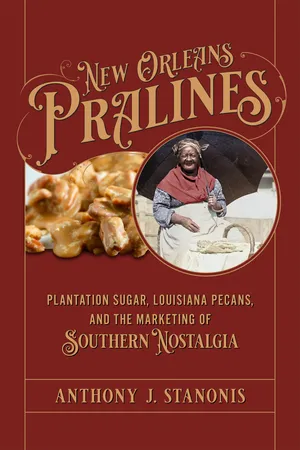
New Orleans Pralines
eBook - ePub

New Orleans Pralines

Plantation Sugar, Louisiana Pecans, and the Marketing of Southern Nostalgia

  1. 248 pages
  2. English
  3. ePUB (mobile friendly)
  4. Available on iOS & Android
eBook - ePub

New Orleans Pralines

Plantation Sugar, Louisiana Pecans, and the Marketing of Southern Nostalgia

About this book

Winner of the Gulf South Historical Association's Michael V.R. Thomason Book Award

The Creole praline arrived in New Orleans with the migration of formerly enslaved people fleeing Louisiana plantations after the Civil War. Black women street vendors made a livelihood by selling a range of homemade foods, including pralines, to Black dockworkers and passersby. The praline offered a path to financial independence, and even its ingredients spoke of a history of Black ingenuity: an enslaved horticulturist played a key role in domesticating the pecan and creating the grafted tree that would form the basis of Louisiana's pecan orchards.

By the 1880s, however, white New Orleans writers such as Grace King and Henry Castellanos had begun to recast the history of the praline in a nostalgic mode that harkened back to the prewar South. In their telling, the praline was brought to New Orleans by an aristocratic refugee of the French Revolution. Black street vendors were depicted not as innovative entrepreneurs but as loyal servants still faithful to their former enslavers. The rise of cultivated, shelled, and cheaply bought pecans—as opposed to the foraged pecans that early praline sellers had depended on—allowed better-resourced white women to move into the praline-selling market, especially as tourism emerged as a key New Orleans industry after the 1910s.

Indeed, the praline became central to the marketing of New Orleans. Conventions often hired Black women to play the "praline mammy" role for out-of-towners, while stores sold pralines with mammy imagery, in boxes designed to look like cotton bales. After World War II, pralines went national with items like praline-flavored ice cream (1950s) and praline liqueur (1980s). Yet as the civil rights struggle persisted, the imagery of the praline mammy was recognized as an offensive caricature.

As it uncovers the history of a sweet dessert made of sugar and pecans, New Orleans Pralines tells a fascinating story of Black entrepreneurship, toxic white nostalgia, and the rise of tourism in the Crescent City.

Frequently asked questions

Yes, you can cancel anytime from the Subscription tab in your account settings on the Perlego website. Your subscription will stay active until the end of your current billing period. Learn how to cancel your subscription.
No, books cannot be downloaded as external files, such as PDFs, for use outside of Perlego. However, you can download books within the Perlego app for offline reading on mobile or tablet. Learn more here.
Perlego offers two plans: Essential and Complete
  • Essential is ideal for learners and professionals who enjoy exploring a wide range of subjects. Access the Essential Library with 800,000+ trusted titles and best-sellers across business, personal growth, and the humanities. Includes unlimited reading time and Standard Read Aloud voice.
  • Complete: Perfect for advanced learners and researchers needing full, unrestricted access. Unlock 1.4M+ books across hundreds of subjects, including academic and specialized titles. The Complete Plan also includes advanced features like Premium Read Aloud and Research Assistant.
Both plans are available with monthly, semester, or annual billing cycles.
We are an online textbook subscription service, where you can get access to an entire online library for less than the price of a single book per month. With over 1 million books across 1000+ topics, we’ve got you covered! Learn more here.
Look out for the read-aloud symbol on your next book to see if you can listen to it. The read-aloud tool reads text aloud for you, highlighting the text as it is being read. You can pause it, speed it up and slow it down. Learn more here.
Yes! You can use the Perlego app on both iOS or Android devices to read anytime, anywhere — even offline. Perfect for commutes or when you’re on the go.
Please note we cannot support devices running on iOS 13 and Android 7 or earlier. Learn more about using the app.
Yes, you can access New Orleans Pralines by Anthony J. Stanonis in PDF and/or ePUB format, as well as other popular books in Politics & International Relations & Hospitality, Travel & Tourism Industry. We have over one million books available in our catalogue for you to explore.

Table of contents

  1. Cover
  2. Title Page
  3. Copyright Page
  4. Dedication
  5. CONTENTS
  6. ACKNOWLEDGMENTS
  7. INTRODUCTION: The Praline City
  8. 1. PRALINES, MADAME?: Emancipation, Free Enterprise, and the Praline Seller
  9. 2. WHY DO YOU TASTE SO GOOD?: Louisiana Sugar Plantations and the Decline of an Old South Crop
  10. 3. WHAT SHALL WE DO?: The Praline Mammy, Memory, and Old New Orleans
  11. 4. WHY PECANS?: Louisiana Pecans and the Birth of a New South Industry
  12. 5. LIKE A DISNEYLAND OF PRALINES?: Marketing Pralines and Modern Tourism
  13. EPILOGUE
  14. APPENDIX: Early Praline Recipes from New Orleans Newspapers
  15. NOTES
  16. BIBLIOGRAPHY
  17. INDEX