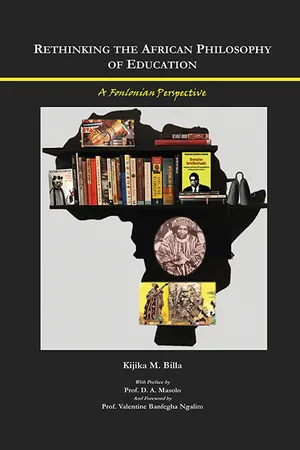
The African Union (AU) declared 2024 the year of Education, with the motto: "Educate an Africanfit for the 21 st Century: Building resilient education systems for increased access to inclusive, lifelong, quality, and relevant learning in Africa." In response, this book delves into issues plaguing African education, and proposes some solutions. The book attempts to attune African education towards the integration of African cultural values with contemporary societal demands. It draws inspiration from the writings and teachings of the late Professor Bernard Nsokika Fonlon, a foremost Cameroonian philosopher, literary luminary and public intellectual to explore the foundational features of African philosophy of education, outlining the four-fold dimensions of education from a Fonlonian perspective. Topics covered include the physical, aesthetic, intellectual and moral dimensions, as well as judicious conservative-progressivism in African education. Through an eclectic approach, the book constructively brings into conversation African conceptions of education with other philosophical foundations of education to make a case for genuine education as a revolutionary tool for a better and dynamic African community."In this book Kijika Billa argues that Afropessimism can be defeated. It takes courage, first expressedby Fonlon in what I have learned from reading this book to be his visionary works, and now laid out by Billa himself herein, that there is only one way any society lifts itself up from grim levels of societal decay, and that is through carefully defined educational system with clear goals which become the goals of the overall national aspiration and objective around which everything else coalesces."D. A. Masolo (PhD), Professor of Philosophy, distinguished University Scholar at the University of Louisville"This book accentuates significant themes of integrating philosophy of education with Africaneducation systems from a Fonlonian perspective. Bernard Nsokika Fonlon's advocacy for a holistic, morally integrous, and culturally rich education is presented as a visionary framework for transcending current educational limitations, aiming to cultivate wise, ethical, and engaged citizens. Kijika Billa offers a brilliant integrated approach which calls for a reimagined, resilient education system that deeply reflects African values and aspirations, preparing individuals for meaningful contributions to the continent's development."Yusef Waghid (DEd, PhD, DPhil), Emeritus Professor of Philosophy of Education, Stellenbosch University"This book constitutes a springboard in the direction of proper African cultural context of educationor Africanization of educational values."Remi Prospero Fonka (PhD), Senior Lecturer, Catholic University of Cameroon, Bamenda"It is gratifying to see Kijika Billa, a young and emerging scholar, take up Fonlon's challenge on theneed for genuine intellectuals steeped in African cultural philosophies of education as dynamic products of a world in perpetual motion. Fonlon could have wished for no better in intergenerational intellectual conversations."Francis B. Nyamnjoh, Professor of Social Anthropology, University of Cape Town
- 166 pages
- English
- PDF
- Available on iOS & Android
eBook - PDF
About this book
Information
Topic
PhilosophySubtopic
Philosophy History & TheoryTable of contents
- Front cover
- Title page
- Copyright
- Dedication
- Additional Praise for this Book
- Acknowledgements
- Table of Contents
- Foreword
- Preface
- Introduction
- Chapter 1 Foundational Features of African Philosophy of Education
- Chapter 2 Physical and Aesthetic Dimensions of African Education
- Chapter 3 Intellectual Dimensions of African Education: Towards a More Cultural Orientation
- Chapter 4 Moral Dimensions of African Education in an Increasingly Relativistic Society
- Chapter 5 Judicious Conservative-Progressivism of African Education
- Chapter 6 Genuine Education as a Revolutionary Tool for a Better African Society
- Conclusion
- Bibliography
- Back cover
Trusted by 375,005 students
Access to over 1.5 million titles for a fair monthly price.
Study more efficiently using our study tools.
Frequently asked questions
Yes, you can cancel anytime from the Subscription tab in your account settings on the Perlego website. Your subscription will stay active until the end of your current billing period. Learn how to cancel your subscription
No, books cannot be downloaded as external files, such as PDFs, for use outside of Perlego. However, you can download books within the Perlego app for offline reading on mobile or tablet. Learn how to download books offline
Perlego offers two plans: Essential and Complete
- Essential is ideal for learners and professionals who enjoy exploring a wide range of subjects. Access the Essential Library with 800,000+ trusted titles and best-sellers across business, personal growth, and the humanities. Includes unlimited reading time and Standard Read Aloud voice.
- Complete: Perfect for advanced learners and researchers needing full, unrestricted access. Unlock 1.5M+ books across hundreds of subjects, including academic and specialized titles. The Complete Plan also includes advanced features like Premium Read Aloud and Research Assistant.
We are an online textbook subscription service, where you can get access to an entire online library for less than the price of a single book per month. With over 1.5 million books across 990+ topics, we’ve got you covered! Learn about our mission
Look out for the read-aloud symbol on your next book to see if you can listen to it. The read-aloud tool reads text aloud for you, highlighting the text as it is being read. You can pause it, speed it up and slow it down. Learn more about Read Aloud
Yes! You can use the Perlego app on both iOS and Android devices to read anytime, anywhere — even offline. Perfect for commutes or when you’re on the go.
Please note we cannot support devices running on iOS 13 and Android 7 or earlier. Learn more about using the app
Please note we cannot support devices running on iOS 13 and Android 7 or earlier. Learn more about using the app
Yes, you can access Rethinking the African Philosophy of Education by Kijika M Billa in PDF and/or ePUB format, as well as other popular books in Philosophy & Philosophy History & Theory. We have over 1.5 million books available in our catalogue for you to explore.