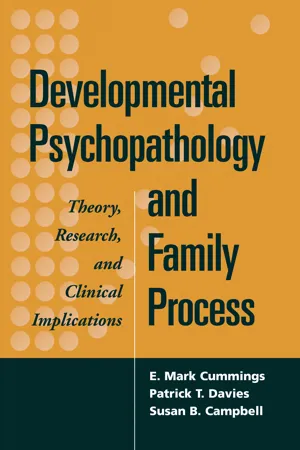
Developmental psychopathology seeks to unravel the complex connections among biological, psychological, and social-contextual aspects of normal and abnormal development. This volume presents the core and cutting-edge principles of the field in an integrative, accessible manner. The investigatory lens is focused on the primary context in which children develop--the family. Reviewing current research in such areas as attachment and parenting styles, marital functioning, and parental depression, the volume examines how these variables may influence developmental processes across a range of domains and, in turn, predict the emergence of clinical problems. Illuminated are the interplay of risk and protective factors, biological and contextual influences, and continuous and discontinuous patterns of development in childhood and adolescence. Also considered in depth are the ways in which the developmental psychopathology perspective points to new directions in diagnosis, prevention, and treatment of child emotional and behavioral disorders. Featuring a wealth of figures, tables, and illustrative vignettes, this is a valuable source book for practititioners, scholars, and other professionals in mental health and related disciplines. It will also serve as a text in graduate-level courses on developmental psychopathology and clinical child psychology.
eBook - PDF
No longer available
Developmental Psychopathology and Family Process
Theory, Research, and Clinical Implications
This book isn’t in the library right now, search for another
- 515 pages
- English
- PDF
- Available on iOS & Android
eBook - PDF
No longer available
Developmental Psychopathology and Family Process
Theory, Research, and Clinical Implications
About this book
Information
Table of contents
- Cover
- Half-title page
- Title page
- Copyright page
- Dedication
- About the Authors
- Foreword
- Contents
- Introduction
- Part I. Theory
- Part II. Research
- Part III. Clinical Implications
- Epilogue
- References
- Index
Trusted by 375,005 students
Access to over 1.5 million titles for a fair monthly price.
Study more efficiently using our study tools.
Frequently asked questions
Yes, you can cancel anytime from the Subscription tab in your account settings on the Perlego website. Your subscription will stay active until the end of your current billing period. Learn how to cancel your subscription
No, books cannot be downloaded as external files, such as PDFs, for use outside of Perlego. However, you can download books within the Perlego app for offline reading on mobile or tablet. Learn how to download books offline
Perlego offers two plans: Essential and Complete
- Essential is ideal for learners and professionals who enjoy exploring a wide range of subjects. Access the Essential Library with 800,000+ trusted titles and best-sellers across business, personal growth, and the humanities. Includes unlimited reading time and Standard Read Aloud voice.
- Complete: Perfect for advanced learners and researchers needing full, unrestricted access. Unlock 1.5M+ books across hundreds of subjects, including academic and specialized titles. The Complete Plan also includes advanced features like Premium Read Aloud and Research Assistant.
We are an online textbook subscription service, where you can get access to an entire online library for less than the price of a single book per month. With over 1.5 million books across 990+ topics, we’ve got you covered! Learn about our mission
Look out for the read-aloud symbol on your next book to see if you can listen to it. The read-aloud tool reads text aloud for you, highlighting the text as it is being read. You can pause it, speed it up and slow it down. Learn more about Read Aloud
Yes! You can use the Perlego app on both iOS and Android devices to read anytime, anywhere — even offline. Perfect for commutes or when you’re on the go.
Please note we cannot support devices running on iOS 13 and Android 7 or earlier. Learn more about using the app
Please note we cannot support devices running on iOS 13 and Android 7 or earlier. Learn more about using the app
Yes, you can access Developmental Psychopathology and Family Process by E. Mark Cummings,Patrick T. Davies,Susan B. Campbell in PDF and/or ePUB format, as well as other popular books in Psychology & Psychiatry & Mental Health. We have over 1.5 million books available in our catalogue for you to explore.