Oral history is a particularly useful way to capture ordinary people's lived experiences. This innovative book introduces the full array of oral history research methods and invites students and qualitative researchers to try them out in their own work. Using choreography as an organizing metaphor, the author presents creative strategies for collecting, representing, analyzing, and interpreting oral history data. Instructive exercises and activities help readers develop specific skills, such as nonparticipant observation, interviewing, and writing, with a special section on creating found data poems from interview transcripts. Also covered are uses of journals, court transcripts, and other documents; Internet resources, such as social networking sites; and photography and video. Emphasizing a social justice perspective, the book includes excerpts of oral histories from 9/11 and Hurricane Katrina, among other detailed case examples.
eBook - ePub
No longer available
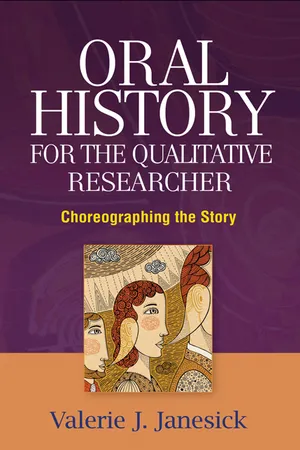
Oral History for the Qualitative Researcher
Choreographing the Story
This book isn’t in the library right now, search for another
- 271 pages
- English
- ePUB (mobile friendly)
- Available on iOS & Android
eBook - ePub
No longer available
About this book
Trusted by 375,005 students
Access to over 1.5 million titles for a fair monthly price.
Study more efficiently using our study tools.
Information
Topic
EducationSubtopic
Research in EducationTable of contents
- Cover
- Title Page
- Copyright
- Preface
- Acknowledgments
- Contents
- PART I - Order: Reinventing Oral History for the Qualitative Researcher
- PART II - Design and Tension: The Tools of the Oral Historian: The Choreography of Techniques and Issues
- PART III - Balance and Composition: Becoming an Oral Historian
- Part IV - Harmony: The Art of Making Sense of Oral History Projects with a Choreography of Social Justice
- Appendix A - Selected Electronic Resources: Websites and Listservs for the Oral Historian
- Appendix B - Selected Oral History Centers, Archives, and Collections
- Appendix C - Selected Journals That Publish Oral Histories and Related Issues
- Appendix D - Sample Consent Form for Project Undergoing IRB Review
- Appendix E - Basic Contract (Sample)
- Appendix F - Federal Statement on Oral History
- Appendix G - Statement on IRBs from the American Historical Association (Edited)
- Appendix H - List of Choreographers Used for Surnames of Participants
- Appendix I - Practicing the Techniques of Oral History: Strategies and Activities to Sharpen Your Writing Skills
- Appendix J - Excerpt from an Oral History of a 9/11 Firefighter
- Appendix K - Excerpt from an Oral History of Hurricane Katrina Survivors
- Appendix L - Example of a Nonparticipant Observation Assignment to Develop Observation Skills
- Appendix M - A Sample Rubric Assessing Writing
- Appendix N - Interview Project Assignment
- Appendix O - Example of a Qualitative Research Methods Syllabus
- Appendix P - An Excerpt of a Transcript (Edited) from an Interview with Jane A. de Mille
- Appendix Q - Digital Equipment for the Oral Historian
- References
- Index
- About The Author
- About Guilford Publications
- From the Publisher
Frequently asked questions
Yes, you can cancel anytime from the Subscription tab in your account settings on the Perlego website. Your subscription will stay active until the end of your current billing period. Learn how to cancel your subscription
No, books cannot be downloaded as external files, such as PDFs, for use outside of Perlego. However, you can download books within the Perlego app for offline reading on mobile or tablet. Learn how to download books offline
Perlego offers two plans: Essential and Complete
- Essential is ideal for learners and professionals who enjoy exploring a wide range of subjects. Access the Essential Library with 800,000+ trusted titles and best-sellers across business, personal growth, and the humanities. Includes unlimited reading time and Standard Read Aloud voice.
- Complete: Perfect for advanced learners and researchers needing full, unrestricted access. Unlock 1.5M+ books across hundreds of subjects, including academic and specialized titles. The Complete Plan also includes advanced features like Premium Read Aloud and Research Assistant.
We are an online textbook subscription service, where you can get access to an entire online library for less than the price of a single book per month. With over 1.5 million books across 990+ topics, we’ve got you covered! Learn about our mission
Look out for the read-aloud symbol on your next book to see if you can listen to it. The read-aloud tool reads text aloud for you, highlighting the text as it is being read. You can pause it, speed it up and slow it down. Learn more about Read Aloud
Yes! You can use the Perlego app on both iOS and Android devices to read anytime, anywhere — even offline. Perfect for commutes or when you’re on the go.
Please note we cannot support devices running on iOS 13 and Android 7 or earlier. Learn more about using the app
Please note we cannot support devices running on iOS 13 and Android 7 or earlier. Learn more about using the app
Yes, you can access Oral History for the Qualitative Researcher by Valerie J. Janesick in PDF and/or ePUB format, as well as other popular books in Education & Research in Education. We have over 1.5 million books available in our catalogue for you to explore.