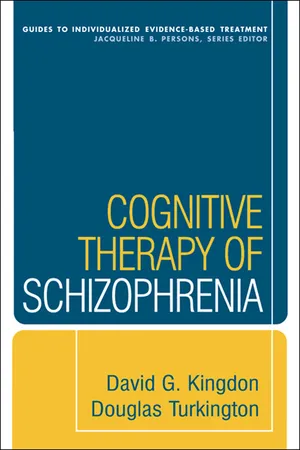
Drawing on the authors' decades of influential work in the field, this highly practical volume presents an evidence-based cognitive therapy approach for clients with schizophrenia. Guidelines are provided for collaborative assessment and case formulation that enable the clinician to build a strong therapeutic relationship, establish reasonable goals, and tailor treatment to each client's needs. Described in thorough, step-by-step detail are effective techniques for working with delusional beliefs, voices, visions, thought disorders, and negative symptoms; integrating cognitive therapy with other forms of treatment; reducing relapse risks; and enhancing client motivation. Special features include reproducible client handouts and assessment tools.
eBook - ePub
No longer available
Cognitive Therapy of Schizophrenia
This book isn’t in the library right now, search for another
- 219 pages
- English
- ePUB (mobile friendly)
- Available on iOS & Android
eBook - ePub
No longer available
Cognitive Therapy of Schizophrenia
About this book
Information
Topic
PsicologíaTable of contents
- Cover
- Guide to Individualized Evidence Based Treatment Series
- Title Page
- Copyright
- About the Authors
- Series Editor’s Note
- Preface
- Acknowledgments
- Contents
- Chapter One: What is Schizophrenia?
- Chapter Two: Evidence for Effective Treatments in Schizophrenia
- Chapter Three: Early Intervention
- Chapter Four: The Therapeutic Relationship
- Chapter Five: Assessment
- Chapter Six: Individualized Case Formulation and Treatment Planning
- Chapter Seven: Orienting the Client to Treatment
- Chapter Eight: Psychoeducation and Normalization
- Chapter Nine: Case Formulation and Intervening with Delusions
- Chapter Ten: Case Formulation and Intervening with Hallucinations
- Chapter Eleven: Thought Interference, Passivity Phenomena, and Formal Thought Disorder
- Chapter Twelve: Negative Symptoms
- Chapter Thirteen: Comorbid Conditions
- Chapter Fourteen: Relapse Prevention and Finishing Therapy
- Chapter Fifteen: Difficulties in Therapy
- Appendix 1: Health of the Nation Rating Scales
- Appendix 2: Psychotic Symptom Rating Scales
- Appendix 3: Theory of Psychosis Rating Scale
- Appendix 4: Informational Handouts
- Appendix 5: Formulation Sheet and Diaries
- References
- Further Readings
- Index
- About Guilford Publications
- From the Publisher
Trusted by 375,005 students
Access to over 1.5 million titles for a fair monthly price.
Study more efficiently using our study tools.
Frequently asked questions
Yes, you can cancel anytime from the Subscription tab in your account settings on the Perlego website. Your subscription will stay active until the end of your current billing period. Learn how to cancel your subscription
No, books cannot be downloaded as external files, such as PDFs, for use outside of Perlego. However, you can download books within the Perlego app for offline reading on mobile or tablet. Learn how to download books offline
Perlego offers two plans: Essential and Complete
- Essential is ideal for learners and professionals who enjoy exploring a wide range of subjects. Access the Essential Library with 800,000+ trusted titles and best-sellers across business, personal growth, and the humanities. Includes unlimited reading time and Standard Read Aloud voice.
- Complete: Perfect for advanced learners and researchers needing full, unrestricted access. Unlock 1.5M+ books across hundreds of subjects, including academic and specialized titles. The Complete Plan also includes advanced features like Premium Read Aloud and Research Assistant.
We are an online textbook subscription service, where you can get access to an entire online library for less than the price of a single book per month. With over 1.5 million books across 990+ topics, we’ve got you covered! Learn about our mission
Look out for the read-aloud symbol on your next book to see if you can listen to it. The read-aloud tool reads text aloud for you, highlighting the text as it is being read. You can pause it, speed it up and slow it down. Learn more about Read Aloud
Yes! You can use the Perlego app on both iOS and Android devices to read anytime, anywhere — even offline. Perfect for commutes or when you’re on the go.
Please note we cannot support devices running on iOS 13 and Android 7 or earlier. Learn more about using the app
Please note we cannot support devices running on iOS 13 and Android 7 or earlier. Learn more about using the app
Yes, you can access Cognitive Therapy of Schizophrenia by David G. Kingdon,Douglas Turkington in PDF and/or ePUB format, as well as other popular books in Psicología & Enfermería psiquiátrica y de salud mental. We have over 1.5 million books available in our catalogue for you to explore.