In the second decade of the twenty-first century, an increasing number of children from El Salvador, Honduras, and Guatemala began arriving without parents at the U.S.-Mexico border. In many cases, the parents had left for the United States years earlier to earn money that they could send back home. In Reunited sociologists Ernesto Castañeda and Daniel Jenks explain the reasons for Central American youths' migration, describe the journey, and document how the young migrants experience separation from and subsequent reunification with their families.
In interviews with Central American youth, their sponsors, and social services practitioners in and around Washington, D.C., Castañeda and Jenks find that Central American minors migrate on their own mainly for three reasons: gang violence, lack of educational and economic opportunity, and a longing for family reunification. The authors note that youth who feel comfortable leaving and have feelings of belonging upon arrival integrate quickly and easily while those who experience trauma in their home countries and on their way to the United States face more challenges.
Castañeda and Jenks recount these young migrants' journey from Central America to the U.S. border, detailing the youths' difficulties passing through Mexico, proving to U.S. Customs and Border Protection officials that they have a legitimate fear of returning or are victims of trafficking, and staying in shelters while their sponsorship, placement, and departure are arranged. The authors also describe the tensions the youth face when they reunite with family members they may view as strangers. Despite their biological, emotional, and financial bonds to these relatives, the youth must learn how to relate to new authority figures and decide whether or how to follow their rules.
The experience of migrating can have a lasting effect on the mental health of young migrants, Castañeda and Jenks note. Although the authors find that Central American youths' mental health improves after migrating to the United States, the young migrants remain at risk of further problems. They are likely to have lived through traumatizing experiences that inhibit their integration. Difficulty integrating, in turn, creates new stressors that exacerbate PTSD, depression, and anxiety. Consequently, schools and social service organizations are critical, the authors argue, for enhancing youth migrants' sense of belonging and their integration into their new communities. Bilingual programs, Spanish-speaking PTA groups, message boards, mentoring of immigrant children, and after-school programs for members of reunited families are all integral in supporting immigrant youth as they learn English, finish high school, apply to college, and find jobs.
Offering a complex exploration of youth migration and family reunification, Reunited provides a moving account of how young Central American migrants make the journey north and ultimately reintegrate with their families in the United States.
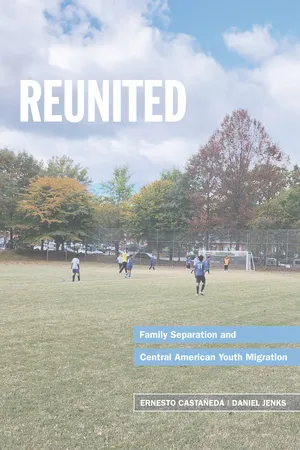
eBook - ePub
Reunited
Family Separation and Central American Youth Migration
- 311 pages
- English
- ePUB (mobile friendly)
- Available on iOS & Android
eBook - ePub
About this book
Information
Table of contents
- Cover Page
- Title Page
- Copyright Page
- Dedication
- Contents
- List of Illustrations
- Glossary
- About the Authors
- Preface
- Acknowledgments
- Introduction
- Chapter 1. What We Know and What We Set Out to Find
- Chapter 2. A Brief History of El Salvador, Honduras, and Guatemala: Historical Contexts and Drivers of Migration
- Chapter 3. Reasons to Emigrate
- Chapter 4. Central Americans and Their Passage through Mexico to the United States
- Chapter 5. Legal Uncertainty, Family Reunification, and Learning a New Life
- Chapter 6. Mental Health and Immigration: Symptoms of PTSD and Depression
- Chapter 7. Immigrant Integration into School Environments
- Chapter 8. Family-Propelled Migration and Immigrant Integration
- Appendix: Notes on Methods and Instruments
- Notes
- References
- Index
Trusted by 375,005 students
Access to over 1.5 million titles for a fair monthly price.
Study more efficiently using our study tools.
Frequently asked questions
Yes, you can cancel anytime from the Subscription tab in your account settings on the Perlego website. Your subscription will stay active until the end of your current billing period. Learn how to cancel your subscription
No, books cannot be downloaded as external files, such as PDFs, for use outside of Perlego. However, you can download books within the Perlego app for offline reading on mobile or tablet. Learn how to download books offline
Perlego offers two plans: Essential and Complete
- Essential is ideal for learners and professionals who enjoy exploring a wide range of subjects. Access the Essential Library with 800,000+ trusted titles and best-sellers across business, personal growth, and the humanities. Includes unlimited reading time and Standard Read Aloud voice.
- Complete: Perfect for advanced learners and researchers needing full, unrestricted access. Unlock 1.5M+ books across hundreds of subjects, including academic and specialized titles. The Complete Plan also includes advanced features like Premium Read Aloud and Research Assistant.
We are an online textbook subscription service, where you can get access to an entire online library for less than the price of a single book per month. With over 1.5 million books across 990+ topics, we’ve got you covered! Learn about our mission
Look out for the read-aloud symbol on your next book to see if you can listen to it. The read-aloud tool reads text aloud for you, highlighting the text as it is being read. You can pause it, speed it up and slow it down. Learn more about Read Aloud
Yes! You can use the Perlego app on both iOS and Android devices to read anytime, anywhere — even offline. Perfect for commutes or when you’re on the go.
Please note we cannot support devices running on iOS 13 and Android 7 or earlier. Learn more about using the app
Please note we cannot support devices running on iOS 13 and Android 7 or earlier. Learn more about using the app
Yes, you can access Reunited by Ernesto Castañeda,Daniel Jenks in PDF and/or ePUB format, as well as other popular books in Social Sciences & Emigration & Immigration. We have over 1.5 million books available in our catalogue for you to explore.