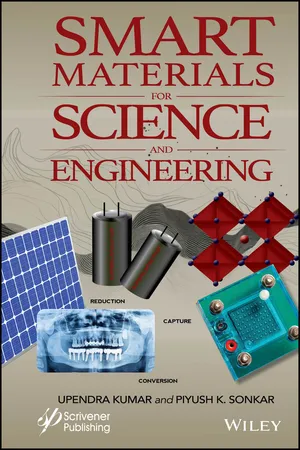
Smart Materials for Science and Engineering
eBook - ePub

Smart Materials for Science and Engineering

  1. English
  2. ePUB (mobile friendly)
  3. Available on iOS & Android
eBook - ePub

Smart Materials for Science and Engineering

About this book

SMART MATERIALS FOR SCIENCE AND ENGINEERING

Smart materials, also known as advanced or creative materials, are described as advanced materials that react intuitively to environmental changes or as materials that can return to their original shape in response to certain stimuli. Smart materials are classified as either active or passive based on their characteristics. There are two types of active materials. The first kind cannot change its characteristics when subjected to outside stimuli, for example photochromatic spectacles that only alter their color when exposed to sunlight. The other, which includes piezoelectric materials, can change one sort of energy (thermal, electrical, chemical, mechanical, or optical) into another. When subjected to external pressure, it can generate an electric charge. As an example, optical fibers can transmit electromagnetic waves. In contrast, passive smart materials can transmit a specific sort of energy. They have some amazing qualities that set them apart from other materials, such as transiency, meaning they can react to different kinds of external stimuli immediately, self-actuation or the capacity to change their appearance and shape, selectivity where the response is divided and expected, directness when the response is limited to the activating event, shape-changing where the material can change its shape to external stimuli, their ability to determine their own health, also known as self-diagnosis, and their ability to self-heal.

The ability to synthesize novel materials has substantially progressed thanks to science and technology over the past 20 years. They fall mostly into the following four categories: polymers, ceramics, metals, and smart materials. Among these, smart materials are gaining popularity since they have more uses than conventional materials. Smart materials are unusual substances that have the ability to alter their properties, such as those that can immediately change their phase when placed near a magnet or their shape simply by applying heat. Humanity will be significantly impacted by this new era of smart materials. For instance, some of them can adapt their properties to the environment, some have sensory capabilities, some can repair themselves automatically, and some can degrade themselves. These extraordinary properties of smart materials will have an effect on all facets of civilization. There are many different types of intelligent materials, including magnetorheological materials, electro-rheostat materials, shape memory alloys, piezoelectric materials, and more.

This book describes many forms of smart materials and their possible uses in various fields. A literature survey discusses the different types of smart materials, such as based ceramics, polymers, and organic compounds and their needs, advantages, disadvantages, and applications will be comprehensively discussed. A discussion of well-established smart materials including piezoelectric, magnetostrictive, shape memory alloy, electro-rheological fluid, and magnetorheological fluid materials will be discussed with their present prospects.

Frequently asked questions

Yes, you can cancel anytime from the Subscription tab in your account settings on the Perlego website. Your subscription will stay active until the end of your current billing period. Learn how to cancel your subscription.
No, books cannot be downloaded as external files, such as PDFs, for use outside of Perlego. However, you can download books within the Perlego app for offline reading on mobile or tablet. Learn more here.
Perlego offers two plans: Essential and Complete
  • Essential is ideal for learners and professionals who enjoy exploring a wide range of subjects. Access the Essential Library with 800,000+ trusted titles and best-sellers across business, personal growth, and the humanities. Includes unlimited reading time and Standard Read Aloud voice.
  • Complete: Perfect for advanced learners and researchers needing full, unrestricted access. Unlock 1.4M+ books across hundreds of subjects, including academic and specialized titles. The Complete Plan also includes advanced features like Premium Read Aloud and Research Assistant.
Both plans are available with monthly, semester, or annual billing cycles.
We are an online textbook subscription service, where you can get access to an entire online library for less than the price of a single book per month. With over 1 million books across 1000+ topics, we’ve got you covered! Learn more here.
Look out for the read-aloud symbol on your next book to see if you can listen to it. The read-aloud tool reads text aloud for you, highlighting the text as it is being read. You can pause it, speed it up and slow it down. Learn more here.
Yes! You can use the Perlego app on both iOS or Android devices to read anytime, anywhere — even offline. Perfect for commutes or when you’re on the go.
Please note we cannot support devices running on iOS 13 and Android 7 or earlier. Learn more about using the app.
Yes, you can access Smart Materials for Science and Engineering by Upendra Kumar,Piyush Kumar Sonkar in PDF and/or ePUB format, as well as other popular books in Technology & Engineering & Materials Science. We have over one million books available in our catalogue for you to explore.

Table of contents

  1. Cover
  2. Table of Contents
  3. Series Page
  4. Title Page
  5. Copyright Page
  6. Dedication Page
  7. Preface
  8. Acknowledgements
  9. Scope of the Book
  10. 1 Introduction: Historical Overview, Current and Future Perspective
  11. 2 Fabrication and Characterization Tools for Organic Semiconductors as Smart Materials in Optoelectronic Device Applications
  12. 3 Smart Scaffold Constructs for Regenerative Medicine and Tissue Engineering
  13. 4 Application of Smart Materials in Dental Sciences
  14. 5 Graphene-Related Smart Material (GRSM): Synthesis, Characterization, and Application in Optoelectronics Devices
  15. 6 Synthesis and Characterization of Mechanical and Microstructural Properties of Fly-Ash-Reinforced Aluminum-Based Metal Matrix Composite
  16. 7 Organic Smart Materials: Synthesis, Characterization, and Application
  17. 8 Magnetostrictive Material-Based Smart Materials, Synthesis, Properties, and Applications
  18. 9 Materials Development of Supercapacitors—Promising Device for Future Energy Storage Applications
  19. 10 Smart Solid Electrolyte Materials in Energy Storage Devices: Batteries
  20. 11 Smart Materials in Energy Storage Devices: Solar Cells
  21. 12 Mixed-Dimensional 2D–3D Perovskite Solar Cells: Origin, Development, and Applications
  22. 13 Advanced Materials in Energy Conversion Devices: Fuel Cells and Biofuel Cells
  23. 14 Smart Materials in Energy Storage Devices: Fuel Cells and Biofuel Cells
  24. 15 Role of Smart Materials in Environmental Remediation: CO2 Capture and CO2 Reduction
  25. 16 Soft Perovskite Semiconductors for Future Optical Electronics
  26. 17 Band Gap Engineering and Nanopatterning of Muscovite Mica by Low-Energy Ion Beams Applicable for Futuristic Microelectronics
  27. About the Editors
  28. Index
  29. Also of Interest
  30. End User License Agreement