- 136 pages
- English
- ePUB (mobile friendly)
- Available on iOS & Android
eBook - ePub
About this book
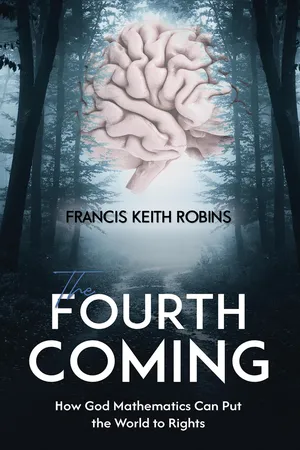
In a time of dire need, as climate change, conflict, and economic upheaval imperil our existence and our mental well-being deteriorates from not utilising our minds as God intended, Francis Keith Robins introduces a groundbreaking approach to saving humanity – reshaping our thought processes through mathematics. In his book, The Fourth Coming, Robins provides a detailed, step-by-step guide to unlocking our inherent mathematical potential. His vision is to create a society that is inclusive, equal, and peaceful – one that aligns with God's desire for us. He advocates for a paradigm shift where shared mathematical models and systematic thinking supplant the ineffective classes of governments and institutions currently jeopardizing our planet. This revolutionary approach aims to alter the trajectory of human history in a manner that aligns with divine intentions. Robins' theories, described as a work of mathematical brilliance, offer a refreshingly simple yet profound solution to consciousness – which, as noted by 'New Scientist', remains one of the most elusive and significant mysteries in science and philosophy. Furthermore, he concludes that the introduction of religion by God was a response to humanity's failure to use their brains as He intended.
Information
Subtopic
Educational PsychologyIndex
MathematicsTable of contents
- Cover
- Title Page
- About the Author
- Dedication
- Copyright Information ©
- Acknowledgement
- Introduction
- What is God Mathematics?
- A New Way of Thinking
- Lesson One: Do not Seek Reality
- Lesson Two: Apply Set Thinking
- Lesson Three: When to Seek Reality, And How
- Teaching Children Set Thinking
- Reorganising Society
- Conclusion
- Bibliography
Trusted by 375,005 students
Access to over 1.5 million titles for a fair monthly price.
Study more efficiently using our study tools.
Frequently asked questions
Yes, you can cancel anytime from the Subscription tab in your account settings on the Perlego website. Your subscription will stay active until the end of your current billing period. Learn how to cancel your subscription
No, books cannot be downloaded as external files, such as PDFs, for use outside of Perlego. However, you can download books within the Perlego app for offline reading on mobile or tablet. Learn how to download books offline
Perlego offers two plans: Essential and Complete
- Essential is ideal for learners and professionals who enjoy exploring a wide range of subjects. Access the Essential Library with 800,000+ trusted titles and best-sellers across business, personal growth, and the humanities. Includes unlimited reading time and Standard Read Aloud voice.
- Complete: Perfect for advanced learners and researchers needing full, unrestricted access. Unlock 1.5M+ books across hundreds of subjects, including academic and specialized titles. The Complete Plan also includes advanced features like Premium Read Aloud and Research Assistant.
We are an online textbook subscription service, where you can get access to an entire online library for less than the price of a single book per month. With over 1.5 million books across 990+ topics, we’ve got you covered! Learn about our mission
Look out for the read-aloud symbol on your next book to see if you can listen to it. The read-aloud tool reads text aloud for you, highlighting the text as it is being read. You can pause it, speed it up and slow it down. Learn more about Read Aloud
Yes! You can use the Perlego app on both iOS and Android devices to read anytime, anywhere — even offline. Perfect for commutes or when you’re on the go.
Please note we cannot support devices running on iOS 13 and Android 7 or earlier. Learn more about using the app
Please note we cannot support devices running on iOS 13 and Android 7 or earlier. Learn more about using the app
Yes, you can access The Fourth Coming by Francis Keith Robins in PDF and/or ePUB format, as well as other popular books in Mathematics & Educational Psychology. We have over 1.5 million books available in our catalogue for you to explore.