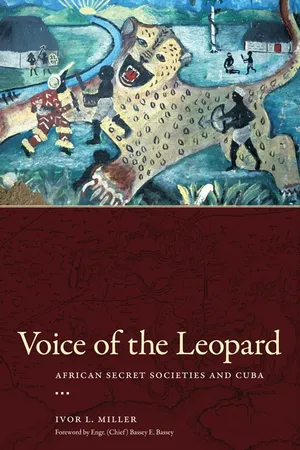
In Voice of the Leopard: African Secret Societies and Cuba, Ivor L. Miller shows how African migrants and their political fraternities played a formative role in the history of Cuba. During the eighteenth and nineteenth centuries, no large kingdoms controlled Nigeria and Cameroon's multilingual Cross River basin. Instead, each settlement had its own lodge of the initiation society called Ékpè, or "leopard, " which was the highest indigenous authority. Ékpè lodges ruled local communities while also managing regional and long-distance trade. Cross River Africans, enslaved and forcibly brought to colonial Cuba, reorganized their Ékpè clubs covertly in Havana and Matanzas into a mutual-aid society called Abakuá, which became foundational to Cuba's urban life and music. Miller's extensive fieldwork in Cuba and West Africa documents ritual languages and practices that survived the Middle Passage and evolved into a unifying charter for transplanted slaves and their successors. To gain deeper understanding of the material, Miller underwent Ékpè initiation rites in Nigeria after ten years' collaboration with Abakuá initiates in Cuba and the United States. He argues that Cuban music, art, and even politics rely on complexities of these African-inspired codes of conduct and leadership. Voice of the Leopard is an unprecedented tracing of an African title-society to its Caribbean incarnation, which has deeply influenced Cuba's creative energy and popular consciousness.
- 432 pages
- English
- ePUB (mobile friendly)
- Available on iOS & Android
eBook - ePub
About this book
Information
Table of contents
- Cover Page
- Title Page
- Copyright Page
- Dedication
- Contents
- Acknowledgments
- A Note on the Typography and Word Usage
- Foreword by Engineer Bassey Efiong Bassey
- Introduction
- 1. Arrival
- 2. The Fortified City
- 3. Planting Abakuá in Cuba, 1830s to 1860s
- 4. From Creole to Carabalí
- 5. Dispersal: Abakuá Exiled to Florida and Spanish Africa
- 6. Disintegration of the Spanish Empire
- 7. Havana Is the Key: Abakuá in Cuban Music
- 8. Conclusions
- Epilogue. Cubans in Calabar: Ékpè Has One Voice
- Appendix 1. Cuban Lodges Founded from 1871 to 1917
- Appendix 2. Comparing Ékpè and Abakuá Masks and Their Symbols
- Appendix 3. Abakuá Chants and Their Interpretations in Cross River Languages
- Glossary
- Notes
- References
- Index
Trusted by 375,005 students
Access to over 1.5 million titles for a fair monthly price.
Study more efficiently using our study tools.
Frequently asked questions
Yes, you can cancel anytime from the Subscription tab in your account settings on the Perlego website. Your subscription will stay active until the end of your current billing period. Learn how to cancel your subscription
No, books cannot be downloaded as external files, such as PDFs, for use outside of Perlego. However, you can download books within the Perlego app for offline reading on mobile or tablet. Learn how to download books offline
We are an online textbook subscription service, where you can get access to an entire online library for less than the price of a single book per month. With over 1.5 million books across 990+ topics, we’ve got you covered! Learn about our mission
Look out for the read-aloud symbol on your next book to see if you can listen to it. The read-aloud tool reads text aloud for you, highlighting the text as it is being read. You can pause it, speed it up and slow it down. Learn more about Read Aloud
Yes! You can use the Perlego app on both iOS and Android devices to read anytime, anywhere — even offline. Perfect for commutes or when you’re on the go.
Please note we cannot support devices running on iOS 13 and Android 7 or earlier. Learn more about using the app
Please note we cannot support devices running on iOS 13 and Android 7 or earlier. Learn more about using the app
Yes, you can access Voice of the Leopard by Ivor L. Miller in PDF and/or ePUB format, as well as other popular books in History & Latin American & Caribbean History. We have over 1.5 million books available in our catalogue for you to explore.