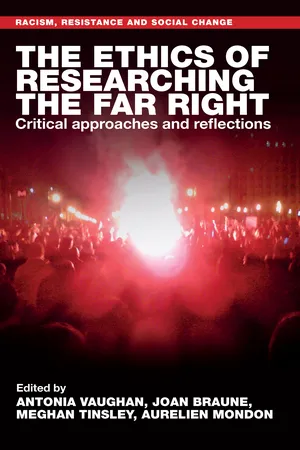
At a time when far, radical, and extreme-right politics are becoming increasingly mainstream globally – sometimes with deadly consequences – research in these fields is essential to understand the most effective ways to combat these dangerous ideologies. Yet engaging with texts and movements that do physical and verbal violence raises a number of urgent ethical issues. Until recently, this has remained understudied, as scholarship on the far right rarely delves explicitly and critically into the ethics of research.
This book seeks to remedy this significant gap in an otherwise extensive and growing literature. Originating from a workshop series in 2020, in which an international group of academics at various career stages shared the ethical challenges and best practices they had developed in their research, this edited collection draws together insights from these ongoing conversations, offering urgent critical reflections on key ethical issues.
eBook - ePub
The ethics of researching the far right
Critical approaches and reflections
- 401 pages
- English
- ePUB (mobile friendly)
- Available on iOS & Android
eBook - ePub
The ethics of researching the far right
Critical approaches and reflections
About this book
Information
Table of contents
- Cover
- Half-Title
- Series
- Title
- Copyright
- Contents
- List of contributors
- Series editors’ foreword
- Introduction
- Part I: What’s in a name
- 1 What the far right is(n’t)
- 2 Race, racism, and the far right: critical reflections for the field
- 3 When racism seems to be the hardest word: critical reflections from studying the Lega (Nord)
- 4 When the far right experiences violence: our ethical duty to the othered
- 5 Ecofascism, far-right ecologism, and neo-Malthusianism
- Part II: Positionality, standpoint, and intersectionality
- 6 ‘Far right studies’ and the unbearable whiteness of being
- 7 Safety and silence: oral history, far right research, and the paradox of the ‘vocal minority’
- 8 On the incompleteness of ethnography: embracing and navigating failure as a principle in research on the far right
- 9 Ethnographic empathy and research ethics as methodological whiteness
- 10 Emotions in methodology: resisting violent ideological structures in the knowledge-production of extremisms
- 11 Reflections on researching armed Nazis as an unarmed left-wing Jew: politics, privilege, and practical concerns
- Part III: The haunting past: memory and far right studies
- 12 Heritage, archaeology, ancestry, and the far right
- 13 Another way to do ethics: uses of the landscape in the far-right cultural milieu and the ethics of researching them
- 14 Researching memory and heritage during a culture war
- 15 Archiving the extreme: ethical challenges in sharing, researching, and teaching
- 16 Researching racism in racist times
- Part IV: Care and safety
- 17 How do you respond when you feel under threat? A reflective exploration into my experience with the far right online
- 18 Community building as a response to care in studying the far right
- 19 Negotiating contradiction in success and safety: a consideration of environmental constraints on risk management
- 20 Spectre: covert research in digital far-right ‘red zones’
- 21 Navigating a feminist ethics of care, ethnographic methods, and academic activism in researching men’s rights and the far right: a researcher’s struggles
- Part V: Complications of engaging far-right participants and formers
- 22 Ethics of listening: between criticism and empathy in oral history interviews and politically charged research contexts
- 23 Harms of the compassion narrative: ethical considerations regarding stories of disengagement from white supremacist movements
- 24 Voices from the past: a psychosocial reflection on interacting with a far-right activist
- 25 Interviewing the ‘unlovable’: on the challenges of conducting feminist research on far-right women
- 26 Examining far-right empowerment experiences using YouTube and Parler data: managing researcher safety and ethical and methodological requirements
- Part VI: Activism and dissemination
- 27 Critically examining the role of the scholar in policymaking on the far right
- 28 Critical reflexivity and research on state responses to the far right
- 29 An anti-racist scholar-activist ethic: working in service to racial justice
- 30 The far right from the underside of history: decolonising far right studies
- 31 How should journalists engage with the far right?
- 32 Researching the far right: towards an ethics of talking ‘about’
- Index
Trusted by 375,005 students
Access to over 1.5 million titles for a fair monthly price.
Study more efficiently using our study tools.
Frequently asked questions
Yes, you can cancel anytime from the Subscription tab in your account settings on the Perlego website. Your subscription will stay active until the end of your current billing period. Learn how to cancel your subscription
No, books cannot be downloaded as external files, such as PDFs, for use outside of Perlego. However, you can download books within the Perlego app for offline reading on mobile or tablet. Learn how to download books offline
Perlego offers two plans: Essential and Complete
- Essential is ideal for learners and professionals who enjoy exploring a wide range of subjects. Access the Essential Library with 800,000+ trusted titles and best-sellers across business, personal growth, and the humanities. Includes unlimited reading time and Standard Read Aloud voice.
- Complete: Perfect for advanced learners and researchers needing full, unrestricted access. Unlock 1.5M+ books across hundreds of subjects, including academic and specialized titles. The Complete Plan also includes advanced features like Premium Read Aloud and Research Assistant.
We are an online textbook subscription service, where you can get access to an entire online library for less than the price of a single book per month. With over 1.5 million books across 990+ topics, we’ve got you covered! Learn about our mission
Look out for the read-aloud symbol on your next book to see if you can listen to it. The read-aloud tool reads text aloud for you, highlighting the text as it is being read. You can pause it, speed it up and slow it down. Learn more about Read Aloud
Yes! You can use the Perlego app on both iOS and Android devices to read anytime, anywhere — even offline. Perfect for commutes or when you’re on the go.
Please note we cannot support devices running on iOS 13 and Android 7 or earlier. Learn more about using the app
Please note we cannot support devices running on iOS 13 and Android 7 or earlier. Learn more about using the app
Yes, you can access The ethics of researching the far right by Antonia Vaughan,Joan Braune,Meghan Tinsley,Aurelien Mondon in PDF and/or ePUB format, as well as other popular books in Social Sciences & Political Ideologies. We have over 1.5 million books available in our catalogue for you to explore.