eBook - ePub
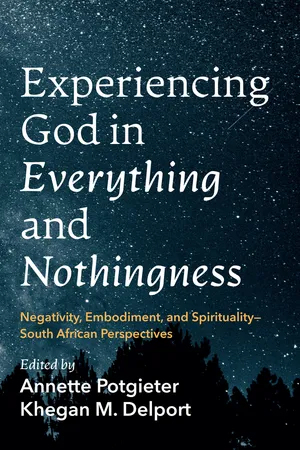
Experiencing God in Everything and Nothingness
Negativity, Embodiment, and Spirituality—South African Perspectives
- 238 pages
- English
- ePUB (mobile friendly)
- Available on iOS & Android
eBook - ePub
Experiencing God in Everything and Nothingness
Negativity, Embodiment, and Spirituality—South African Perspectives
About this book
COVID-19 has impacted the way we see the world and the way we view spirituality; in times of crisis, people turn or return to religion or spirituality. Most of the South African population identifies as Christian. This brings to the fore what is meant by "spirituality" in a country crippled by the remains of apartheid structure, rampant corruption, poverty, and various systemic problems. Overall, there is a lack of scholarship investigating "spirituality" and "spirituality studies" from the global South. This book aims to bridge the gap. New avenues are investigated of thinking about God in difficult circumstances, as ideologies of hope and prosperity are reshaped. This book links text and context, spirituality and material culture, self and society, the analogue and the digital, contemplation and action, saying and unsaying; in short, the question of experiencing God in both everything and nothingness comes under the scope of this book.
Information
Topic
Theology & ReligionSubtopic
Christian TheologyTable of contents
- Title Page
- List of Contributors
- Introduction
- Chapter 1: Navigating Nothingness
- Chapter 2: The Spirituality of Space
- Chapter 3: The Attention Assemblage and the Machines of Acedia
- Chapter 4: Beyond the Totality of Religion
- Chapter 5: “Wash me, and I shall be whiter than snow”
- Chapter 6: Youth and Environmental Consciousness
- Chapter 7: Characterizing Pharaoh’s Self-Destructive Politics alongside the Plagues and Politics of South Africa
- Chapter 8: Spirituality, Poverty, and the Problem of Evil in the Book of Qoheleth
- Chapter 9: The Tension between Experiences of Nothingness and Hope in the Metaphorical Meaning of the Names of the Children (Isa 7–8) from a Perspective of Generational Imprinted Trauma and Resilience503
- Chapter 10: Using Biblical Trauma-Texts to Help Pain-Bearers Find Hope
- Chapter 11: Hope in the Midst of Death?
- Chapter 12: Bible, Spirituality, and Method
Trusted by 375,005 students
Access to over 1.5 million titles for a fair monthly price.
Study more efficiently using our study tools.
Frequently asked questions
Yes, you can cancel anytime from the Subscription tab in your account settings on the Perlego website. Your subscription will stay active until the end of your current billing period. Learn how to cancel your subscription
No, books cannot be downloaded as external files, such as PDFs, for use outside of Perlego. However, you can download books within the Perlego app for offline reading on mobile or tablet. Learn how to download books offline
Perlego offers two plans: Essential and Complete
- Essential is ideal for learners and professionals who enjoy exploring a wide range of subjects. Access the Essential Library with 800,000+ trusted titles and best-sellers across business, personal growth, and the humanities. Includes unlimited reading time and Standard Read Aloud voice.
- Complete: Perfect for advanced learners and researchers needing full, unrestricted access. Unlock 1.5M+ books across hundreds of subjects, including academic and specialized titles. The Complete Plan also includes advanced features like Premium Read Aloud and Research Assistant.
We are an online textbook subscription service, where you can get access to an entire online library for less than the price of a single book per month. With over 1.5 million books across 990+ topics, we’ve got you covered! Learn about our mission
Look out for the read-aloud symbol on your next book to see if you can listen to it. The read-aloud tool reads text aloud for you, highlighting the text as it is being read. You can pause it, speed it up and slow it down. Learn more about Read Aloud
Yes! You can use the Perlego app on both iOS and Android devices to read anytime, anywhere — even offline. Perfect for commutes or when you’re on the go.
Please note we cannot support devices running on iOS 13 and Android 7 or earlier. Learn more about using the app
Please note we cannot support devices running on iOS 13 and Android 7 or earlier. Learn more about using the app
Yes, you can access Experiencing God in Everything and Nothingness by Annette Potgieter,Khegan M. Delport in PDF and/or ePUB format, as well as other popular books in Theology & Religion & Christian Theology. We have over 1.5 million books available in our catalogue for you to explore.