WINNER, 2024 LAWRENCE J. McCAFFREY PRIZE FOR BEST BOOK ON IRISH AMERICA
Challenges conventional narratives of the Civil War era that emphasize Irish Americans' unceasing opposition to Black freedom
Embracing Emancipation tackles a perennial question in scholarship on the Civil War era: Why did Irish Americans, who claimed to have been oppressed in Ireland, so vehemently opposed the antislavery movement in the United States? Challenging conventional answers to this question that focus on the cultural, political, and economic circumstances of the Irish in America, Embracing Emancipation locates the origins of Irish American opposition to antislavery in famine-era Ireland. There, a distinctively Irish critique of abolitionism emerged during the 1840s, one that was adopted and adapted by Irish Americans during the sectional crisis. The Irish critique of abolitionism meshed with Irish Americans' belief that the American Union would uplift Irish people on both sides of the Atlantic—if only it could be saved from the forces of disunion.
Whereas conventional accounts of the Civil War itself emphasize Irish immigrants' involvement in the New York City draft riots as a brutal coda to their unflinching opposition to emancipation, Delahanty uncovers a history of Irish Americans who embraced emancipation. Irish American soldiers realized that aiding Black southerners' attempts at self-liberation would help to subdue the Confederate rebellion. Wartime developments in the United States and Ireland affirmed Irish American Unionists' belief that the perpetuity of their adopted country was vital to the economic and political prospects of current and future immigrants and to their hopes for Ireland's independence. Even as some Irish immigrants evinced their disdain for emancipation by lashing out against Union authorities and African Americans in northern cities, many others argued that their transatlantic interests in restoring the Union now aligned with slavery's demise. While myriad Irish Americans ultimately abandoned their hostility to antislavery, their backgrounds in and continuously renewed connections with Ireland remained consistent influences on how the Irish in America took part in debate over the future of American slavery.
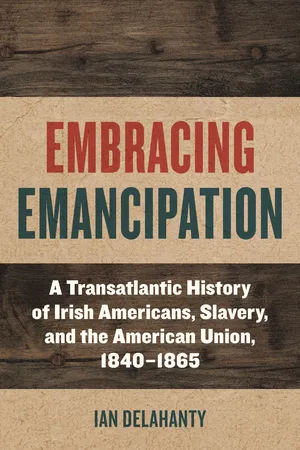
eBook - ePub
Embracing Emancipation
A Transatlantic History of Irish Americans, Slavery, and the American Union, 1840-1865
- 384 pages
- English
- ePUB (mobile friendly)
- Available on iOS & Android
eBook - ePub
Embracing Emancipation
A Transatlantic History of Irish Americans, Slavery, and the American Union, 1840-1865
About this book
Information
Publisher
Fordham University PressYear
2024Print ISBN
9781531506872
9781531506865
Edition
1eBook ISBN
9781531506889
Table of contents
- Cover
- Title Page
- Copyright
- Contents
- Introduction
- 1. “We want no slave lecturing here”: The Irish Critique of Abolitionism
- 2. “Over the broad Atlantic”: Abolitionist Appeals to Emigrants and Immigrants
- 3. Irish-American Unionism and Slavery
- 4. “As if I was a common Irishman”: The Irish-American Critique of Antislavery
- 5. Irish Americans and the Union War
- 6. Unionism and Emancipation on the Home Front and Battlefield
- 7. “All true Republicans”: Irish-American Leaders and Emancipation
- Conclusion: Irish America and Ireland after the Civil War
- Acknowledgments
- Notes
- Bibliography
- Index
Trusted by 375,005 students
Access to over 1.5 million titles for a fair monthly price.
Study more efficiently using our study tools.
Frequently asked questions
Yes, you can cancel anytime from the Subscription tab in your account settings on the Perlego website. Your subscription will stay active until the end of your current billing period. Learn how to cancel your subscription
No, books cannot be downloaded as external files, such as PDFs, for use outside of Perlego. However, you can download books within the Perlego app for offline reading on mobile or tablet. Learn how to download books offline
Perlego offers two plans: Essential and Complete
- Essential is ideal for learners and professionals who enjoy exploring a wide range of subjects. Access the Essential Library with 800,000+ trusted titles and best-sellers across business, personal growth, and the humanities. Includes unlimited reading time and Standard Read Aloud voice.
- Complete: Perfect for advanced learners and researchers needing full, unrestricted access. Unlock 1.5M+ books across hundreds of subjects, including academic and specialized titles. The Complete Plan also includes advanced features like Premium Read Aloud and Research Assistant.
We are an online textbook subscription service, where you can get access to an entire online library for less than the price of a single book per month. With over 1.5 million books across 990+ topics, we’ve got you covered! Learn about our mission
Look out for the read-aloud symbol on your next book to see if you can listen to it. The read-aloud tool reads text aloud for you, highlighting the text as it is being read. You can pause it, speed it up and slow it down. Learn more about Read Aloud
Yes! You can use the Perlego app on both iOS and Android devices to read anytime, anywhere — even offline. Perfect for commutes or when you’re on the go.
Please note we cannot support devices running on iOS 13 and Android 7 or earlier. Learn more about using the app
Please note we cannot support devices running on iOS 13 and Android 7 or earlier. Learn more about using the app
Yes, you can access Embracing Emancipation by Ian Delahanty in PDF and/or ePUB format, as well as other popular books in History & American Civil War History. We have over 1.5 million books available in our catalogue for you to explore.