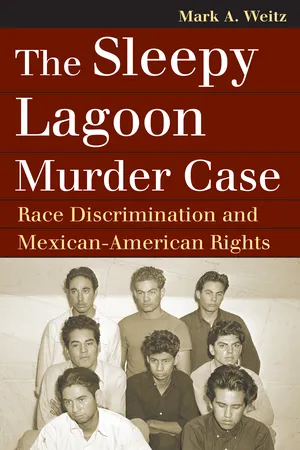
What began as a neighborhood party during the summer of 1942 led to the largest mass murder trial in California’s history. After young Jose Diaz was found murdered near Los Angeles’ Sleepy Lagoon reservoir, 600 Mexican Americans were rounded up by the police, 24 were indicted, and 17 were convicted. But thanks to the efforts of crusading lawyers, Hollywood celebrities, and Mexican Americans throughout the nation, all 17 convictions were thrown out in an appellate decision that cited lack of evidence, coerced testimony, deprivation of the right to counsel, and judicial misconduct.
Mark Weitz chronicles the Sleepy Lagoon case (People v. Zammora) from the streets of the L.A.’s Mexican-American neighborhoods to the criminal courts, through the appeals process, and to the ultimate release of the convicted. In the process, Weitz opens a window on the uneasy world of Hispanic-Anglo relations, which, exacerbated by an influx of Mexican immigrants, had simmered beneath the surface in California for a century and reached the boiling point by 1942. By demonstrating how an environment of hostility and fear had fostered a breakdown in the legal protections that should have been afforded to the Sleepy Lagoon defendants, Weitz also illuminates a vital episode in the evolution of defendants’ rights—including the right to counsel and a fair and impartial trial.
As the case unfolded, the prosecution and local media drew ominous comparisons between the supposed dangers posed by the Mexican-American defendants and the threat allegedly posed by thousands of Japanese Americans, whose sympathies had been called into question after Pearl Harbor. Weitz shows how Zammora demonstrates what it is like to literally be tried in the court of public opinion where the “opinion” has been shaped before the trial even begins.
Now, as Americans once again feel threatened by outsiders—whether Islamic jihadists or illegal immigrants—Zammora provides a mirror showing us how we acted then compared to how we respond now. While much of what occurred in 1942 L.A. was unique to its time and place, Weitz’s compelling narrative shows that many of the social, political, and culture issues that dominated America then are still with us today.