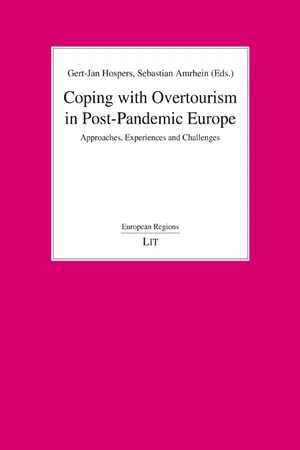
In post-pandemic Europe the topic of 'overtourism' is back on the policy agenda of many cities, towns and villages. How to deal with the negative effects of tourism on places and people? This edited volume brings together inspiring perspectives and detailed case studies from all over Europe to better understand the phenomenon of overtourism. Based on the challenges lying ahead, the book makes a call for tourism policies that are more balanced and argues for more interdisciplinary research.
eBook - PDF
Coping with Overtourism in Post-Pandemic Europe
Approaches, Experiences and Challenges
- 188 pages
- English
- PDF
- Available on iOS & Android
eBook - PDF
Coping with Overtourism in Post-Pandemic Europe
Approaches, Experiences and Challenges
About this book
Information
Table of contents
- Cover
- TABLE OF CONTENTS
- Introduction - The return of overtourism on the policy agenda
- Chapter 1 - Reasons why the term ‘overtourism’ has a right to exist: the social constructionist perspectives of urban citizens
- Chapter 2 - How overtourism feels: conceptualising the atmosphere of overtourism
- Chapter 3 - The overtourism phenomenon in different destination categories
- Chapter 4 - The struggle to manage tourism regrowth in post-pandemic Amsterdam
- Chapter 5 - Tourist city Prague on the way to cultural sustainability
- Chapter 6 - Columbus’ egg or Trojan horse? Assessing the value of Cittaslow-membership to avoid local overtourism
- Chapter 7 - Exploring tourism workers’ perspective on transformational job policies: the case of Barcelona
- Chapter 8 - Who is at Amsterdam’s tourism policy making table?
- Chapter 9 - Challenges to reconciling the interests of residents with those of visitors
- Chapter 10 - Overtourism, dependencies and protests: challenging the ‘support narrative’
- Chapter 11 - Unveiling the implications of digital platforms in platform-mediated overtourism: a call for comprehensive research
- Conclusions - Learning to live with overtourism in Europe?
Trusted by 375,005 students
Access to over 1.5 million titles for a fair monthly price.
Study more efficiently using our study tools.
Frequently asked questions
Yes, you can cancel anytime from the Subscription tab in your account settings on the Perlego website. Your subscription will stay active until the end of your current billing period. Learn how to cancel your subscription
No, books cannot be downloaded as external files, such as PDFs, for use outside of Perlego. However, you can download books within the Perlego app for offline reading on mobile or tablet. Learn how to download books offline
Perlego offers two plans: Essential and Complete
- Essential is ideal for learners and professionals who enjoy exploring a wide range of subjects. Access the Essential Library with 800,000+ trusted titles and best-sellers across business, personal growth, and the humanities. Includes unlimited reading time and Standard Read Aloud voice.
- Complete: Perfect for advanced learners and researchers needing full, unrestricted access. Unlock 1.5M+ books across hundreds of subjects, including academic and specialized titles. The Complete Plan also includes advanced features like Premium Read Aloud and Research Assistant.
We are an online textbook subscription service, where you can get access to an entire online library for less than the price of a single book per month. With over 1.5 million books across 990+ topics, we’ve got you covered! Learn about our mission
Look out for the read-aloud symbol on your next book to see if you can listen to it. The read-aloud tool reads text aloud for you, highlighting the text as it is being read. You can pause it, speed it up and slow it down. Learn more about Read Aloud
Yes! You can use the Perlego app on both iOS and Android devices to read anytime, anywhere — even offline. Perfect for commutes or when you’re on the go.
Please note we cannot support devices running on iOS 13 and Android 7 or earlier. Learn more about using the app
Please note we cannot support devices running on iOS 13 and Android 7 or earlier. Learn more about using the app
Yes, you can access Coping with Overtourism in Post-Pandemic Europe by Gert-Jan Hospers,Sebastian Amrhein in PDF and/or ePUB format, as well as other popular books in Social Sciences & Business General. We have over 1.5 million books available in our catalogue for you to explore.