An Introduction to Universal Artificial Intelligence
eBook - ePub

An Introduction to Universal Artificial Intelligence

  1. 516 pages
  2. English
  3. ePUB (mobile friendly)
  4. Available on iOS & Android
eBook - ePub

An Introduction to Universal Artificial Intelligence

About this book

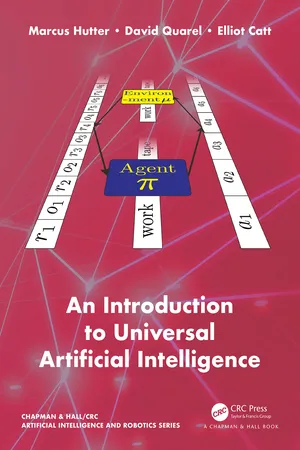
An Introduction to Universal Artificial Intelligence provides the formal underpinning of what it means for an agent to act intelligently in an unknown environment. First presented in Universal Algorithmic Intelligence (Hutter, 2000), UAI offers a framework in which virtually all AI problems can be formulated, and a theory of how to solve them. UAI unifies ideas from sequential decision theory, Bayesian inference, and algorithmic information theory to construct AIXI, an optimal reinforcement learning agent that learns to act optimally in unknown environments. AIXI is the theoretical gold standard for intelligent behavior.

The book covers both the theoretical and practical aspects of UAI. Bayesian updating can be done efficiently with context tree weighting, and planning can be approximated by sampling with Monte Carlo tree search. It provides algorithms for the reader to implement, and experimental results to compare against. These algorithms are used to approximate AIXI. The book ends with a philosophical discussion of Artificial General Intelligence: Can super-intelligent agents even be constructed? Is it inevitable that they will be constructed, and what are the potential consequences?

This text is suitable for late undergraduate students. It provides an extensive chapter to fill in the required mathematics, probability, information, and computability theory background. You can also visit the author website: http://www.hutter1.net/ai/uaibook2.htm.

Frequently asked questions

Yes, you can cancel anytime from the Subscription tab in your account settings on the Perlego website. Your subscription will stay active until the end of your current billing period. Learn how to cancel your subscription.
At the moment all of our mobile-responsive ePub books are available to download via the app. Most of our PDFs are also available to download and we're working on making the final remaining ones downloadable now. Learn more here.
Perlego offers two plans: Essential and Complete
  • Essential is ideal for learners and professionals who enjoy exploring a wide range of subjects. Access the Essential Library with 800,000+ trusted titles and best-sellers across business, personal growth, and the humanities. Includes unlimited reading time and Standard Read Aloud voice.
  • Complete: Perfect for advanced learners and researchers needing full, unrestricted access. Unlock 1.4M+ books across hundreds of subjects, including academic and specialized titles. The Complete Plan also includes advanced features like Premium Read Aloud and Research Assistant.
Both plans are available with monthly, semester, or annual billing cycles.
We are an online textbook subscription service, where you can get access to an entire online library for less than the price of a single book per month. With over 1 million books across 1000+ topics, we’ve got you covered! Learn more here.
Look out for the read-aloud symbol on your next book to see if you can listen to it. The read-aloud tool reads text aloud for you, highlighting the text as it is being read. You can pause it, speed it up and slow it down. Learn more here.
Yes! You can use the Perlego app on both iOS or Android devices to read anytime, anywhere — even offline. Perfect for commutes or when you’re on the go.
Please note we cannot support devices running on iOS 13 and Android 7 or earlier. Learn more about using the app.
Yes, you can access An Introduction to Universal Artificial Intelligence by Marcus Hutter,David Quarel,Elliot Catt in PDF and/or ePUB format, as well as other popular books in Computer Science & Computer Science General. We have over one million books available in our catalogue for you to explore.

Table of contents

  1. Cover Page
  2. Half-Title Page
  3. Series Page
  4. Title Page
  5. Copyright Page
  6. Endorsements Page
  7. Dedication Page
  8. Preface
  9. Table of Contents
  10. List of Figures and Tables
  11. List of Algorithms
  12. I Introduction & Background
  13. II Algorithmic Prediction
  14. III A Family of Universal Agents
  15. IV Approximating Universal Agents
  16. V Alternative Approaches
  17. VI Safety and Discussion
  18. Bibliography
  19. Table of Notation
  20. Index