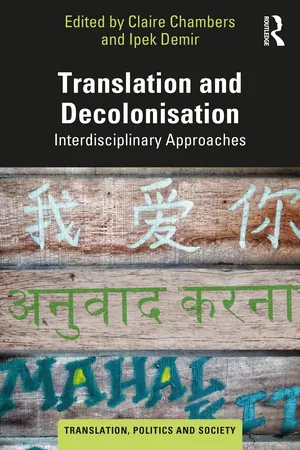
Translation and Decolonisation: Interdisciplinary Approaches offers compelling explorations of the pivotal role that translation plays in the complex and necessarily incomplete process of decolonisation. In a world where translation has historically been a tool of empire and colonisation, this collection shines the spotlight on the potential for translation to be a driving force in decolonial resistance. The book bridges the divide between translation studies and the decolonial turn in the social sciences and humanities, revealing the ways in which translation can challenge colonial imaginaries, institutions, and practice, and how translation opens up South-to-South conversations. It brings together scholars from diverse disciplines and fields, including sociology, literature, languages, migration, politics, anthropology, and more, offering interdisciplinary approaches and perspectives. By examining both the theoretical and practical aspects of this intersection, the chapters of this agenda-setting collection explore the impact of translation on decolonisation and highlight the need to decolonise translation studies itself. The book illuminates the transformative power of translation in transcending linguistic, cultural, and political boundaries.
- 244 pages
- English
- ePUB (mobile friendly)
- Available on iOS & Android
eBook - ePub
About this book
Information
Table of contents
- Cover Page
- Half Title page
- Translation, Politics and Society
- Title Page
- Copyright Page
- Dedication
- Contents
- List of Contributors
- Acknowledgements
- Introduction: Translation in the Service of (De)colonisation
- 1 Translating into English
- 2 Decolonial and Postcolonial Perspectives on Translation: Compatibilities and Contradictions
- 3 Reparative Translation, Decoloniality, Metacoloniality
- 4 Feminism and Translation in India: Why We Need to Think About Language in Feminist Activism
- 5 On Translation Ideology
- 6 Forked Tongues: Translation and (De)colonisation in Two Global Novels by Contemporary Women Writers
- 7 Armed with Words: (De)colonising Translation in the US-led NATO War in Afghanistan (2001–2021)
- 8 Translation as Decolonial Method: On the (Un)translatability of Human Rights Demands and the Coloniality of Migration in Refugee Protest in Germany
- 9 Fahmida Riaz's Āwāz: Translation and Solidarities in the Global South
- 10 Translating the Other: Ghassan Kanafani's Travelogue … Then Rose Asia
- 11 Writing Diasporic In-Betweenness: South Asians in Colonial and Postcolonial East Africa in the Novels of M. G. Vassanji
- 12 Translation as Activism, Translators as Activists
- 13 Finding Our Way: Dialogue Among Our Languages Is the Way to the Unity of African Peoples
- Index
Trusted by 375,005 students
Access to over 1.5 million titles for a fair monthly price.
Study more efficiently using our study tools.
Frequently asked questions
Yes, you can cancel anytime from the Subscription tab in your account settings on the Perlego website. Your subscription will stay active until the end of your current billing period. Learn how to cancel your subscription
No, books cannot be downloaded as external files, such as PDFs, for use outside of Perlego. However, you can download books within the Perlego app for offline reading on mobile or tablet. Learn how to download books offline
Perlego offers two plans: Essential and Complete
- Essential is ideal for learners and professionals who enjoy exploring a wide range of subjects. Access the Essential Library with 800,000+ trusted titles and best-sellers across business, personal growth, and the humanities. Includes unlimited reading time and Standard Read Aloud voice.
- Complete: Perfect for advanced learners and researchers needing full, unrestricted access. Unlock 1.5M+ books across hundreds of subjects, including academic and specialized titles. The Complete Plan also includes advanced features like Premium Read Aloud and Research Assistant.
We are an online textbook subscription service, where you can get access to an entire online library for less than the price of a single book per month. With over 1.5 million books across 990+ topics, we’ve got you covered! Learn about our mission
Look out for the read-aloud symbol on your next book to see if you can listen to it. The read-aloud tool reads text aloud for you, highlighting the text as it is being read. You can pause it, speed it up and slow it down. Learn more about Read Aloud
Yes! You can use the Perlego app on both iOS and Android devices to read anytime, anywhere — even offline. Perfect for commutes or when you’re on the go.
Please note we cannot support devices running on iOS 13 and Android 7 or earlier. Learn more about using the app
Please note we cannot support devices running on iOS 13 and Android 7 or earlier. Learn more about using the app
Yes, you can access Translation and Decolonisation by Claire Chambers,Ipek Demir in PDF and/or ePUB format, as well as other popular books in Languages & Linguistics & Linguistics. We have over 1.5 million books available in our catalogue for you to explore.