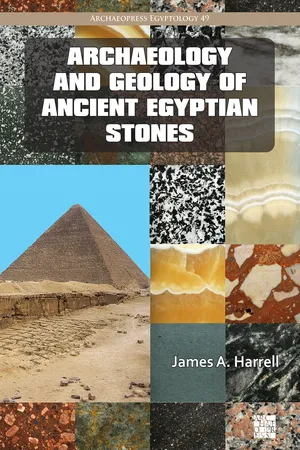
Archaeology and Geology of Ancient Egyptian Stones
eBook - PDF

Archaeology and Geology of Ancient Egyptian Stones

  1. 1,098 pages
  2. English
  3. PDF
  4. Available on iOS & Android
eBook - PDF

Archaeology and Geology of Ancient Egyptian Stones

About this book

The ancient Egyptian Civilization dominated the northeast corner of Africa—including modern-day Egypt and, at times, northern Sudan—from about 3000 BC at the beginning of the Dynastic period to AD 642 at the end of the Roman period. Most of what it left behind consists of stones of many kinds. There were building stones for temples, pyramids, mastaba tombs, and other monumental constructions; and utilitarian stones for tools, weapons, and a wide array of mundane applications, including the raw materials for faience, glass, medicines, paint pigments, and pottery. There were also ornamental stones for decorative and structural elements in buildings, obelisks, statues, sarcophagi, stelae, vessels, shrines, offering tables, mace heads, cosmetic palettes, and other sculpted objects; and gemstones for jewellery, amulets, seals, and other small decorative items. Still more stones were processed to extract their metals, including gold, copper, iron, and lead.


Two persistent problems in Egyptology have been the geological identification of these stones, and the recognition of their sources. Archaeology and Geology of Ancient Egyptian Stones seeks to identify and describe all the rocks and minerals employed by the ancient Egyptians using proper geological nomenclature, and to give an account of their sources in so far as they are known. A secondary objective is to describe the multitudinous uses of the stones as well as the technologies employed to extract, transport, carve, and thermally treat them.

Frequently asked questions

Yes, you can cancel anytime from the Subscription tab in your account settings on the Perlego website. Your subscription will stay active until the end of your current billing period. Learn how to cancel your subscription.
No, books cannot be downloaded as external files, such as PDFs, for use outside of Perlego. However, you can download books within the Perlego app for offline reading on mobile or tablet. Learn more here.
Perlego offers two plans: Essential and Complete
  • Essential is ideal for learners and professionals who enjoy exploring a wide range of subjects. Access the Essential Library with 800,000+ trusted titles and best-sellers across business, personal growth, and the humanities. Includes unlimited reading time and Standard Read Aloud voice.
  • Complete: Perfect for advanced learners and researchers needing full, unrestricted access. Unlock 1.4M+ books across hundreds of subjects, including academic and specialized titles. The Complete Plan also includes advanced features like Premium Read Aloud and Research Assistant.
Both plans are available with monthly, semester, or annual billing cycles.
We are an online textbook subscription service, where you can get access to an entire online library for less than the price of a single book per month. With over 1 million books across 1000+ topics, we’ve got you covered! Learn more here.
Look out for the read-aloud symbol on your next book to see if you can listen to it. The read-aloud tool reads text aloud for you, highlighting the text as it is being read. You can pause it, speed it up and slow it down. Learn more here.
Yes! You can use the Perlego app on both iOS or Android devices to read anytime, anywhere — even offline. Perfect for commutes or when you’re on the go.
Please note we cannot support devices running on iOS 13 and Android 7 or earlier. Learn more about using the app.
Yes, you can access Archaeology and Geology of Ancient Egyptian Stones by James A. Harrell in PDF and/or ePUB format, as well as other popular books in History & Geology & Earth Sciences. We have over one million books available in our catalogue for you to explore.

Table of contents

  1. Cover
  2. Title Page
  3. Copyright page
  4. On Writing a Reference Work
  5. Contents Page
  6. List of Figures and Tables
  7. Preface
  8. Chapter 1 Introduction
  9. Part I. Archaeological and Geological Background
  10. Part II. Building Stones
  11. Part III. Utilitarian Stones
  12. Part IV. Ornamental Stones
  13. Part V. Gemstones
  14. Part VI. Metals
  15. Epilogue (and a Poem)
  16. Bibliography
  17. Index