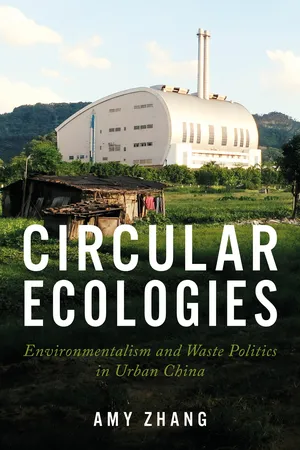
Circular Ecologies
eBook - PDF

Circular Ecologies

Environmentalism and Waste Politics in Urban China

  1. 224 pages
  2. English
  3. PDF
  4. Available on iOS & Android
eBook - PDF

Circular Ecologies

Environmentalism and Waste Politics in Urban China

About this book

After four decades of reform and development, China is confronting a domestic waste crisis. As the world's largest waste-generating nation, the World Economic Forum projects that by 2030, the volume of household waste in China will be double that of the United States. Starting in the early 2000s, Chinese policymakers came to see waste management as an object of environmental governance central to the creation of "modern" cities, and experimented with the circular economy, in which technology and policy could convert all forms of waste back into resources. Based on long-term research in Guangzhou, Circular Ecologies critically analyzes the implementation of technologies and infrastructures to modernize a mega-city's waste management system, and the grassroots ecological politics that emerged in response. In Guangzhou, waste's transformation revealed uncomfortable truths about China's environmental governance: a preference for technology over labor, the aestheticization of order, and the expropriation of value in service of an ecological vision.

Amy Zhang argues that in post-reform China, waste—the material vestige of decades of growth and increasing consumption—is a systemic irritant that troubles China's technocratic governance. Waste provoked an unlikely coalition of urban communities, from the middle class to precarious migrant workers, that came to constitute a nascent, bottom-up environmental politics, and offers a model for conceptualizing ecological action under authoritarian conditions.

Frequently asked questions

Yes, you can cancel anytime from the Subscription tab in your account settings on the Perlego website. Your subscription will stay active until the end of your current billing period. Learn how to cancel your subscription.
At the moment all of our mobile-responsive ePub books are available to download via the app. Most of our PDFs are also available to download and we're working on making the final remaining ones downloadable now. Learn more here.
Perlego offers two plans: Essential and Complete
  • Essential is ideal for learners and professionals who enjoy exploring a wide range of subjects. Access the Essential Library with 800,000+ trusted titles and best-sellers across business, personal growth, and the humanities. Includes unlimited reading time and Standard Read Aloud voice.
  • Complete: Perfect for advanced learners and researchers needing full, unrestricted access. Unlock 1.4M+ books across hundreds of subjects, including academic and specialized titles. The Complete Plan also includes advanced features like Premium Read Aloud and Research Assistant.
Both plans are available with monthly, semester, or annual billing cycles.
We are an online textbook subscription service, where you can get access to an entire online library for less than the price of a single book per month. With over 1 million books across 1000+ topics, we’ve got you covered! Learn more here.
Look out for the read-aloud symbol on your next book to see if you can listen to it. The read-aloud tool reads text aloud for you, highlighting the text as it is being read. You can pause it, speed it up and slow it down. Learn more here.
Yes! You can use the Perlego app on both iOS or Android devices to read anytime, anywhere — even offline. Perfect for commutes or when you’re on the go.
Please note we cannot support devices running on iOS 13 and Android 7 or earlier. Learn more about using the app.
Yes, you can access Circular Ecologies by Amy Zhang in PDF and/or ePUB format, as well as other popular books in Social Sciences & Chinese History. We have over one million books available in our catalogue for you to explore.

Table of contents

  1. Cover
  2. Title Page
  3. Copyright
  4. Dedication
  5. Contents
  6. List of Maps and Illustrations
  7. Acknowledgments
  8. Introduction
  9. Part 1: Circulations
  10. Part 2: Collectives
  11. Epilogue: Politics at the End of Nature
  12. Glossary
  13. Notes
  14. Bibliography
  15. Index
  16. Back Cover