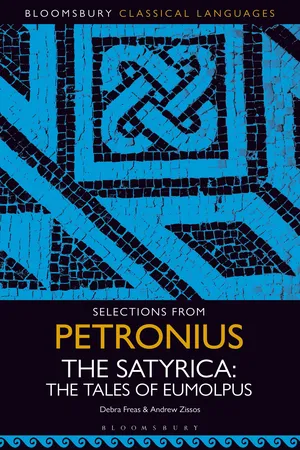
Taking the reader through the fragmentary text of Petronius' Satyrica in a coherent sequence, this book gives a deeper understanding of the fascinating aesthetic, literary and social issues raised within the text. Petronius' Satyrica has long been popular with readers of Latin: it is one of the few texts that offers a glimpse into non-elite society in the early Roman imperial period. It is also one of only a handful of ancient novels to survive in any form, and certainly the most racy and controversial. Supported by a detailed contextualising introduction and companion website resources, these selections from the Latin text are carefully annotated for students and a full vocabulary can be found at the end of the book.
The selections in this edition put at centre stage the figure of Eumolpus: poet, storyteller and would-be critic, as well as charlatan, swindler and lecher. He is one of the major characters in what survives of the Satyrica; he serves as an internal narrator for many of the longer embedded poems and stories; and he meditates on topics of great interest, not the least being the perceived decline of art, science and culture in the contemporary Graeco-Roman world. In this way,students are introduced to some of the best-known myths and tales of antiquity, including the Capture of Troy and the Widow of Ephesus, while affording the opportunity to translate both prose and verse passages, and to consider and evaluate the Satyrica's relationship to the literary tradition.
- 217 pages
- English
- PDF
- Available on iOS & Android
eBook - PDF
About this book
Information
Table of contents
- Cover
- Halftitle page
- Series page
- Title page
- Copyright page
- Contents
- Illustrations
- Preface
- Abbreviations and Symbols
- Map
- Introduction
- Text
- Commentary Notes
- Glossary of Literary Terms
- Latin Vocabulary
Trusted by 375,005 students
Access to over 1.5 million titles for a fair monthly price.
Study more efficiently using our study tools.
Frequently asked questions
Yes, you can cancel anytime from the Subscription tab in your account settings on the Perlego website. Your subscription will stay active until the end of your current billing period. Learn how to cancel your subscription
No, books cannot be downloaded as external files, such as PDFs, for use outside of Perlego. However, you can download books within the Perlego app for offline reading on mobile or tablet. Learn how to download books offline
Perlego offers two plans: Essential and Complete
- Essential is ideal for learners and professionals who enjoy exploring a wide range of subjects. Access the Essential Library with 800,000+ trusted titles and best-sellers across business, personal growth, and the humanities. Includes unlimited reading time and Standard Read Aloud voice.
- Complete: Perfect for advanced learners and researchers needing full, unrestricted access. Unlock 1.5M+ books across hundreds of subjects, including academic and specialized titles. The Complete Plan also includes advanced features like Premium Read Aloud and Research Assistant.
We are an online textbook subscription service, where you can get access to an entire online library for less than the price of a single book per month. With over 1.5 million books across 990+ topics, we’ve got you covered! Learn about our mission
Look out for the read-aloud symbol on your next book to see if you can listen to it. The read-aloud tool reads text aloud for you, highlighting the text as it is being read. You can pause it, speed it up and slow it down. Learn more about Read Aloud
Yes! You can use the Perlego app on both iOS and Android devices to read anytime, anywhere — even offline. Perfect for commutes or when you’re on the go.
Please note we cannot support devices running on iOS 13 and Android 7 or earlier. Learn more about using the app
Please note we cannot support devices running on iOS 13 and Android 7 or earlier. Learn more about using the app
Yes, you can access Selections from Petronius, The Satyrica by Debra Freas,Andrew Zissos in PDF and/or ePUB format, as well as other popular books in History & Roman Ancient History. We have over 1.5 million books available in our catalogue for you to explore.