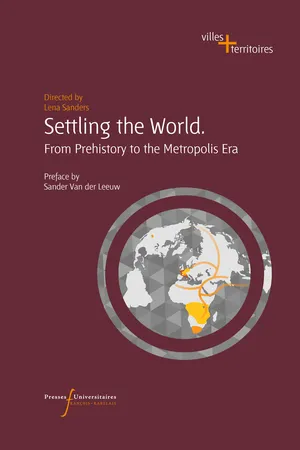
70 000 years ago, Homo sapiens left Africa to colonize the world. 6,000 years ago, he founded the first cities. Today, in the era of city networks, he is creating increasingly wide and complex metropolitan regions. From prehistory to the era of metropolises, man has occupied the earth's space in an infinite variety of ways, under the influence of a multitude of factors. How did the Bantu populate a space already occupied by the Pygmies in equatorial Africa? How were cities born in the Bronze Age? How did the pueblo society develop and then disappear in the United States? What were the effects of Romanization on the settlement of southern Gaul? How did the village system emerge around the year 1000 in Europe? This book addresses twelve major changes in global settlement formalized as "transitions". What is a transition? How can it be identified in the empirical field? Archaeologists, historians, linguists, and geographers combine their efforts to construct, analyze, and compare models of settlement transition in world history. Observing the particular, they seek the universal. This book proposes a method for understanding the laws of human settlement in the very long term.
- English
- ePUB (mobile friendly)
- Available on iOS & Android
eBook - ePub
About this book
Information
Topic
HistoireSubtopic
Histoire de l'EuropeTable of contents
- Introductory pages
- Table of contents
- Preface
- Introduction
- Chapter 1: Disciplinary convergences on the concept of transition
- Chapter 2: A generic conceptual framework for describing transitions in settlement systems
- Chapter 3: Simulating transition: an introduction to spatio-temporel models
- Chapter 4: Transition 1: Modelling the migrations and peopling of new geographic areas by Homo sapiens
- Chapter 5: Transition 2: Modelling the peopling of an already inhabited territory: the case of expanding Bantu populations and Central African forest foragers
- Chapter 6: Transition 3: Village and Polity Formation in Pueblo Societies: How Population Growth Channels Social Processes in Neolithic Societies. The «Village» model
- Chapter 7: Transition 4: Modelling the emergence of cities
- Chapter 8: Transition 5: Modelling the territorial mutations of the Iron Age in southern Gaul (6th-5th centuries BC)
- Chapter 9: Transition 6: ‘romanisation’ (2nd century BCE – 1st century CE): power games between Romans and southern Gauls after the Conquest
- Chapter 10: Transition 7: From the ancient to the medieval world (4th-8th centuries)
- Chapter 11: Transition 8: 800-1200. Emergence of enduring, concentrated and hierarchised settlement patterns in rural regions of North-Western Europe
- Chapter 12: Towards integrated systems of cities (France, 18th-19th centuries)
- Chapter 13: Transition 12: From urban sprawl to polycentric metropolitan regions: forms of functioning and forms of governance
- Chapter 14: Between models and narratives: transitions in settlement systems
- Chapter 15: Towards reproducible research in an interdisciplinary framework: issues and propositions regarding the transfer of the conceptual framework and the replication of models
- Chapter 16: Ontological points of view on the transitions of settlement systems
- Chapter 17: From the conceptualisation of the transition to its modelling: interdisciplinary feedback on the TransMonDyn experiment
Trusted by 375,005 students
Access to over 1.5 million titles for a fair monthly price.
Study more efficiently using our study tools.
Frequently asked questions
Yes, you can cancel anytime from the Subscription tab in your account settings on the Perlego website. Your subscription will stay active until the end of your current billing period. Learn how to cancel your subscription
No, books cannot be downloaded as external files, such as PDFs, for use outside of Perlego. However, you can download books within the Perlego app for offline reading on mobile or tablet. Learn how to download books offline
Perlego offers two plans: Essential and Complete
- Essential is ideal for learners and professionals who enjoy exploring a wide range of subjects. Access the Essential Library with 800,000+ trusted titles and best-sellers across business, personal growth, and the humanities. Includes unlimited reading time and Standard Read Aloud voice.
- Complete: Perfect for advanced learners and researchers needing full, unrestricted access. Unlock 1.5M+ books across hundreds of subjects, including academic and specialized titles. The Complete Plan also includes advanced features like Premium Read Aloud and Research Assistant.
We are an online textbook subscription service, where you can get access to an entire online library for less than the price of a single book per month. With over 1.5 million books across 990+ topics, we’ve got you covered! Learn about our mission
Look out for the read-aloud symbol on your next book to see if you can listen to it. The read-aloud tool reads text aloud for you, highlighting the text as it is being read. You can pause it, speed it up and slow it down. Learn more about Read Aloud
Yes! You can use the Perlego app on both iOS and Android devices to read anytime, anywhere — even offline. Perfect for commutes or when you’re on the go.
Please note we cannot support devices running on iOS 13 and Android 7 or earlier. Learn more about using the app
Please note we cannot support devices running on iOS 13 and Android 7 or earlier. Learn more about using the app
Yes, you can access Settling the World by Léna Sanders in PDF and/or ePUB format, as well as other popular books in Histoire & Histoire de l'Europe. We have over 1.5 million books available in our catalogue for you to explore.