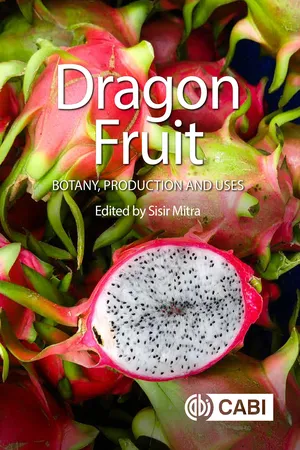
Dragon fruit (pitaya) is a perennial climbing cactus, native to the tropical areas of North, Central and South America. It is suited to tropical and subtropical regions and is commercially grown in an increasing number of countries, including Israel, Australia and the USA. Dragon fruit generates considerable consumer interest because of its exotic appearance and potential health benefits. The fruit is rich in nutrients and phytochemical compounds. It can be eaten fresh or used in the preparation of juices, jellies, jams, etc. The natural bioactive compounds in pitaya have the potential to be exploited in food, pharmaceutical and cosmetic industries. Increasingly cultivated worldwide, the plant is drought-resistant, easily adapts to light intensity and high temperatures, and has a tolerance to a wide range of soil salinities. With ongoing global warming, dragon fruit has great potential as a new crop for many more countries. This book is a compilation of the current state of knowledge on dragon fruit physiology, cultivation, production technology, postharvest management and processing, and is written by leading international authors.
- 264 pages
- English
- ePUB (mobile friendly)
- Available on iOS & Android
eBook - ePub
About this book
Information
Table of contents
- Cover
- Title Page
- Copyright
- Contents
- Contributors
- Preface
- Acknowledgements
- 1 Selenicereus (A. Berger) Britt. & Rose (Cactaceae) (including Hylocereus (A. Berger) Britt. & Rose)
- 2 Origin, Production and History
- 3 Composition and Uses
- 4 Processing and Products
- 5 Breeding and Varieties
- 6 Biotechnology
- 7 Propagation
- 8 Orchard Management
- 9 Flowering, Fruit Set and Fruit Development
- 10 Pests and Nematodes
- 11 Diseases
- 12 Greenhouse Cultivation
- 13 Postharvest Management
- Index
- Back Cover
Trusted by 375,005 students
Access to over 1.5 million titles for a fair monthly price.
Study more efficiently using our study tools.
Frequently asked questions
Yes, you can cancel anytime from the Subscription tab in your account settings on the Perlego website. Your subscription will stay active until the end of your current billing period. Learn how to cancel your subscription
No, books cannot be downloaded as external files, such as PDFs, for use outside of Perlego. However, you can download books within the Perlego app for offline reading on mobile or tablet. Learn how to download books offline
Perlego offers two plans: Essential and Complete
- Essential is ideal for learners and professionals who enjoy exploring a wide range of subjects. Access the Essential Library with 800,000+ trusted titles and best-sellers across business, personal growth, and the humanities. Includes unlimited reading time and Standard Read Aloud voice.
- Complete: Perfect for advanced learners and researchers needing full, unrestricted access. Unlock 1.5M+ books across hundreds of subjects, including academic and specialized titles. The Complete Plan also includes advanced features like Premium Read Aloud and Research Assistant.
We are an online textbook subscription service, where you can get access to an entire online library for less than the price of a single book per month. With over 1.5 million books across 990+ topics, we’ve got you covered! Learn about our mission
Look out for the read-aloud symbol on your next book to see if you can listen to it. The read-aloud tool reads text aloud for you, highlighting the text as it is being read. You can pause it, speed it up and slow it down. Learn more about Read Aloud
Yes! You can use the Perlego app on both iOS and Android devices to read anytime, anywhere — even offline. Perfect for commutes or when you’re on the go.
Please note we cannot support devices running on iOS 13 and Android 7 or earlier. Learn more about using the app
Please note we cannot support devices running on iOS 13 and Android 7 or earlier. Learn more about using the app
Yes, you can access Dragon Fruit by Sisir Mitra in PDF and/or ePUB format, as well as other popular books in Biological Sciences & Botany. We have over 1.5 million books available in our catalogue for you to explore.