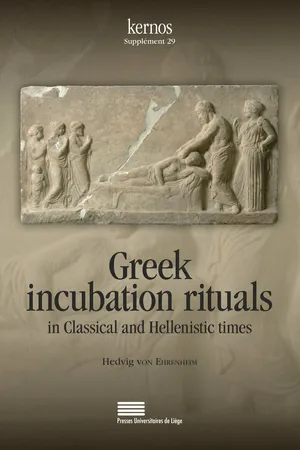
This study documents and analyses the structure and function of Greek incubation rituals in Classical and Hellenistic times addressing all relevant and extant literary and epigraphical testimonial concerning the rites and rules surrounding incubation. It shows that previous approaches, which treated incubation as a Chthonian phenomenon, as a rite of passage, or as comparable to initiation in mystery cults are not supported by the available testimonia on these rites. An analysis of the social context of the rites surrounding incubation shows they differed surprisingly little from the rites performed by other worshippers at these sanctuaries. Various ritual factors are explored in order to explain why ordinary, or low-intensity, rites could create a high-intensity experience for the worshipper. Further, the structure of incubation rituals is examined in the light of the origins and development of the practice in Greece. Contrary to previous theories on the origins of incubation, it is argued that the phenomenon began as an exclusive consultation technique for priests, magistrates and select worshippers and was a natural variant of oracular techniques in Archaic and Early Classical Greece. When incubation became accessible to everyone in Classical society as a part of the cult of Asklepios, rituals for the masses were then created. The ritual did not have one, coherent structure across all the sanctuaries which offered it ; rather, the ritual practice adapted to local customs and factors such as the size of the cult. Some rites for intermediaries were kept, but new motivational factors were added, which resulted in very popular cults.
- English
- ePUB (mobile friendly)
- Available on iOS & Android
eBook - ePub
Greek Incubation Rituals in Classical and Hellenistic Times
About this book
Information
Topic
HistoireSubtopic
Histoire de la Grèce antiqueTable of contents
- Cover
- Bibliographic informations
- First pages
- Table of contents
- Acknowledgements
- Abbreviations
- Introduction
- Chapter 1. The rites and rules
- Chapter 2. Making sense of the rituals
- Chapter 3. Origins and developments
- Concluding remarks
- Appendix. Collection of texts
- List of Figures
- Bibliography
- Index of literary texts
- Index of inscriptions
- General index
Trusted by 375,005 students
Access to over 1.5 million titles for a fair monthly price.
Study more efficiently using our study tools.
Frequently asked questions
Yes, you can cancel anytime from the Subscription tab in your account settings on the Perlego website. Your subscription will stay active until the end of your current billing period. Learn how to cancel your subscription
No, books cannot be downloaded as external files, such as PDFs, for use outside of Perlego. However, you can download books within the Perlego app for offline reading on mobile or tablet. Learn how to download books offline
Perlego offers two plans: Essential and Complete
- Essential is ideal for learners and professionals who enjoy exploring a wide range of subjects. Access the Essential Library with 800,000+ trusted titles and best-sellers across business, personal growth, and the humanities. Includes unlimited reading time and Standard Read Aloud voice.
- Complete: Perfect for advanced learners and researchers needing full, unrestricted access. Unlock 1.5M+ books across hundreds of subjects, including academic and specialized titles. The Complete Plan also includes advanced features like Premium Read Aloud and Research Assistant.
We are an online textbook subscription service, where you can get access to an entire online library for less than the price of a single book per month. With over 1.5 million books across 990+ topics, we’ve got you covered! Learn about our mission
Look out for the read-aloud symbol on your next book to see if you can listen to it. The read-aloud tool reads text aloud for you, highlighting the text as it is being read. You can pause it, speed it up and slow it down. Learn more about Read Aloud
Yes! You can use the Perlego app on both iOS and Android devices to read anytime, anywhere — even offline. Perfect for commutes or when you’re on the go.
Please note we cannot support devices running on iOS 13 and Android 7 or earlier. Learn more about using the app
Please note we cannot support devices running on iOS 13 and Android 7 or earlier. Learn more about using the app
Yes, you can access Greek Incubation Rituals in Classical and Hellenistic Times by Hedvig von Ehrenheim in PDF and/or ePUB format, as well as other popular books in Histoire & Histoire de la Grèce antique. We have over 1.5 million books available in our catalogue for you to explore.