A free open access ebook is available upon publication. Learn more at www.luminosoa.org.
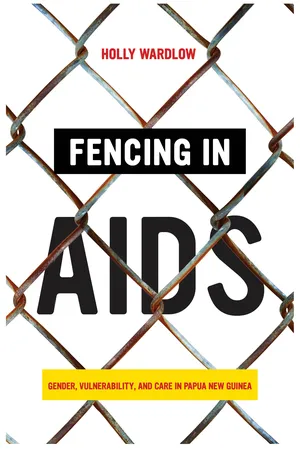
In this vitally important book, medical anthropologist Holly Wardlow takes readers through a ten-year history of the AIDS epidemic in Tari, Papua New Guinea, focusing on the political and economic factors that make women vulnerable to HIV and on their experiences with antiretroviral therapy. Alive with the women’s stories about being trafficked to gold mines, resisting polygynous marriages, and struggling to be perceived as morally upright, Fencing in AIDS demonstrates that being female shapes every aspect of the AIDS epidemic. Offering crucial insights into the anthropologies of mining, ethics, and gender, this is essential reading for scholars and professionals addressing the global AIDS crisis today.
- 212 pages
- English
- ePUB (mobile friendly)
- Available on iOS & Android
eBook - ePub
About this book
Information
Publisher
University of California PressYear
2020Print ISBN
9780520355514
Edition
1eBook ISBN
9780520975941
Table of contents
- Cover
- Title
- Copyright
- Contents
- List of Illustrations
- Acknowledgments
- Introduction: “We Are No Longer Fenced In”
- 1. “Rural Development Enclaves”: Commuter Mining, Landowners, and Trafficked Women
- 2. State Abandonment, Sexual Violence, and Transactional Sex
- 3. Love, Polygyny, and HIV
- 4. Teaching Gender to Prevent AIDS
- 5. Caring for the Self: HIV and Emotional Regulation
- 6. “Like Normal”: The Ethics of Living with HIV
- Epilogue
- Notes
- References
Trusted by 375,005 students
Access to over 1.5 million titles for a fair monthly price.
Study more efficiently using our study tools.
Frequently asked questions
Yes, you can cancel anytime from the Subscription tab in your account settings on the Perlego website. Your subscription will stay active until the end of your current billing period. Learn how to cancel your subscription
No, books cannot be downloaded as external files, such as PDFs, for use outside of Perlego. However, you can download books within the Perlego app for offline reading on mobile or tablet. Learn how to download books offline
Perlego offers two plans: Essential and Complete
- Essential is ideal for learners and professionals who enjoy exploring a wide range of subjects. Access the Essential Library with 800,000+ trusted titles and best-sellers across business, personal growth, and the humanities. Includes unlimited reading time and Standard Read Aloud voice.
- Complete: Perfect for advanced learners and researchers needing full, unrestricted access. Unlock 1.5M+ books across hundreds of subjects, including academic and specialized titles. The Complete Plan also includes advanced features like Premium Read Aloud and Research Assistant.
We are an online textbook subscription service, where you can get access to an entire online library for less than the price of a single book per month. With over 1.5 million books across 990+ topics, we’ve got you covered! Learn about our mission
Look out for the read-aloud symbol on your next book to see if you can listen to it. The read-aloud tool reads text aloud for you, highlighting the text as it is being read. You can pause it, speed it up and slow it down. Learn more about Read Aloud
Yes! You can use the Perlego app on both iOS and Android devices to read anytime, anywhere — even offline. Perfect for commutes or when you’re on the go.
Please note we cannot support devices running on iOS 13 and Android 7 or earlier. Learn more about using the app
Please note we cannot support devices running on iOS 13 and Android 7 or earlier. Learn more about using the app
Yes, you can access Fencing in AIDS by Holly Wardlow in PDF and/or ePUB format, as well as other popular books in Social Sciences & Diseases & Allergies. We have over 1.5 million books available in our catalogue for you to explore.