The first comprehensive treatment in seventy years of the American Art-Union's remarkable rise and fall
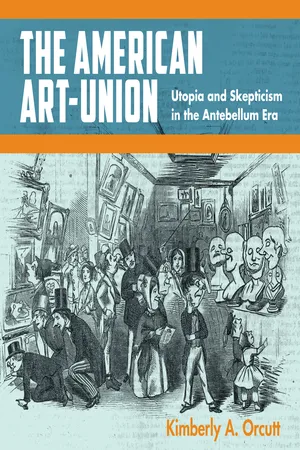
For over a decade, the New York–based American Art-Union shaped art creation, display, and patronage nationwide. Boasting as many as 19,000 members from almost every state, its meteoric rise and its sudden and spectacular collapse still raise a crucial question: Why did such a successful and influential institution fail? The American Art-Union reveals a sprawling and fascinating account of the country's first nationwide artistic phenomenon, creating a shared experience of visual culture, art news and criticism, and a direct experience with original works.
For an annual fee of five dollars, members of the American Art-Union received an engraving after a painting by a notable US artist and the annual publication Transactions (1839–49) and later the monthly Bulletin (1848–53). Most importantly, members' names were entered in a drawing for hundreds of original paintings and sculptures by most of the era's best-known artists. Those artworks were displayed in its immensely popular Free Gallery. Unfortunately, the experiment was short-lived. Opposition grew, and a cascade of events led to an 1852 court case that proved to be the Art-Union's downfall. Illuminating the workings of the American art market, this study fills a gaping lacuna in the history of nineteenth-century US art. Kimberly A. Orcutt draws from the American Art-Union's records as well as in-depth contextual research to track the organization's decisive impact that set the direction of the country's paintings, sculpture, and engravings for well over a decade.
Forged in cultural crosscurrents of utopianism and skepticism, the American Art-Union's demise can be traced to its nature as an attempt to create and control the complex system that the early nineteenth-century art world represented. This study breaks the organization's activities into their major components to offer a structural rather than chronological narrative that follows mounting tensions to their inevitable end. The institution was undone not by dramatic outward events or the character of its leadership but by the character of its utopianist plan.
- 291 pages
- English
- PDF
- Available on iOS & Android
eBook - PDF
About this book
Information
Table of contents
- Cover
- Title Page
- Copyright
- Dedication
- Contents
- Introduction. The Dream of Art for the People
- 1. Engravings: To Lead Taste or to Follow?
- 2. Selecting Artworks for Distribution: From Democracy to Oligarchy
- 3. The Free Gallery: Art, Anxiety, and Revolution
- 4. Distributions and Membership: "Messengers and Missionaries of Art"?
- 5. The Bulletin: From Education to Provocation
- 6. Slowly, Then All at Once: The Demise of the American Art-Union
- Acknowledgments
- Appendix A: American Art-Union Resources
- Appendix B: American Art-Union Officers and Committee of Management, 1839–51
- Appendix C: American Art-Union Engravings Distributed to All Members
- Notes
- Sources Cited
- Index
- About the Author
Trusted by 375,005 students
Access to over 1.5 million titles for a fair monthly price.
Study more efficiently using our study tools.
Frequently asked questions
Yes, you can cancel anytime from the Subscription tab in your account settings on the Perlego website. Your subscription will stay active until the end of your current billing period. Learn how to cancel your subscription
No, books cannot be downloaded as external files, such as PDFs, for use outside of Perlego. However, you can download books within the Perlego app for offline reading on mobile or tablet. Learn how to download books offline
Perlego offers two plans: Essential and Complete
- Essential is ideal for learners and professionals who enjoy exploring a wide range of subjects. Access the Essential Library with 800,000+ trusted titles and best-sellers across business, personal growth, and the humanities. Includes unlimited reading time and Standard Read Aloud voice.
- Complete: Perfect for advanced learners and researchers needing full, unrestricted access. Unlock 1.5M+ books across hundreds of subjects, including academic and specialized titles. The Complete Plan also includes advanced features like Premium Read Aloud and Research Assistant.
We are an online textbook subscription service, where you can get access to an entire online library for less than the price of a single book per month. With over 1.5 million books across 990+ topics, we’ve got you covered! Learn about our mission
Look out for the read-aloud symbol on your next book to see if you can listen to it. The read-aloud tool reads text aloud for you, highlighting the text as it is being read. You can pause it, speed it up and slow it down. Learn more about Read Aloud
Yes! You can use the Perlego app on both iOS and Android devices to read anytime, anywhere — even offline. Perfect for commutes or when you’re on the go.
Please note we cannot support devices running on iOS 13 and Android 7 or earlier. Learn more about using the app
Please note we cannot support devices running on iOS 13 and Android 7 or earlier. Learn more about using the app
Yes, you can access The American Art-Union by Kimberly A. Orcutt in PDF and/or ePUB format, as well as other popular books in Art & History of Modern Art. We have over 1.5 million books available in our catalogue for you to explore.