In occupational therapy, creative thinking and problem-solving skills are critical aspects of delivering appropriate intervention programs. These professional characteristics are essential components in the clinical reasoning process that facilitate meaningful therapy.
Creative Engagement in Occupation: Building Professional Skills is a comprehensive text on the recognition and development of creative thinking as a primary tool in occupational therapy.
Margaret S. Coffey, Nancy K. Lamport, Gayle I. Hersch, and their contributors, guide occupational therapy students and clinicians in identifying their creative potential for designing activities to address client goals. By actively engaging in the creative process, readers can enlist the creative potential of their clients to overcome or compensate for limitations in occupational performance.
The skillful application of activity analysis is advanced through the reader's use of their own creativity in developing meaningful intervention programs for clients. References to the AOTA's Occupational Therapy Practice Framework further support this aspect of the text as readers begin to sense and use their own and the client's creativity in developing collaborative therapist-client partnerships.
Experience these creative opportunities inside Creative Engagement in Occupation: Building Professional Skills through the use of case studies, discussion and individual activities, role playing, and worksheets. Each chapter offers didactic and experiential applications to develop and practice using creativity as it applies to occupational therapy practice.
Included with the text are online supplemental materials for faculty use in the classroom.
Creative Engagement in Occupation: Building Professional Skills offers a unique opportunity for occupational therapy students, faculty, and clinicians to develop their potential in delivering creative occupational therapy intervention.
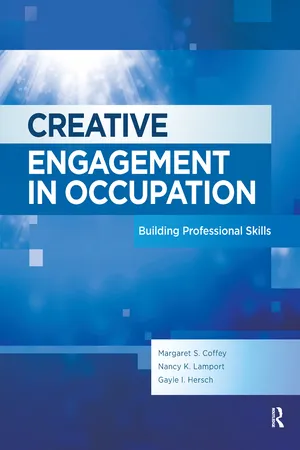
eBook - ePub
Creative Engagement in Occupation
Building Professional Skills
- 158 pages
- English
- ePUB (mobile friendly)
- Available on iOS & Android
eBook - ePub
Creative Engagement in Occupation
Building Professional Skills
About this book
Information
Table of contents
- Cover Page
- Half Title Page
- Title Page
- Copyright Page
- Dedication
- Contents
- Acknowledgments
- About the Authors
- Contributing Authors
- Preface
- Introduction
- 1 Perceptions of Creativity
- 2 Expressions of Creativity in Occupational Therapy
- 3 Relationship of Cognition to Creativity
- 4 Neurological Implications of Creativity
- 5 Experiencing Creativity in the Learning Environment
- 6 Experiencing Creativity in Client Intervention
- 7 Implications of Creativity in Occupational Therapy Research
- Epilogue
- Appendix A: Diagrams for the Occupational Therapy Practice Framework
- Appendix B: Literature Review on Creativity and Occupational Therapy
- Appendix C: Table of Quantitative Assessment Methods
- Appendix D: Suggested Resources
- Financial Disclosures
- Index
Trusted by 375,005 students
Access to over 1.5 million titles for a fair monthly price.
Study more efficiently using our study tools.
Frequently asked questions
Yes, you can cancel anytime from the Subscription tab in your account settings on the Perlego website. Your subscription will stay active until the end of your current billing period. Learn how to cancel your subscription
No, books cannot be downloaded as external files, such as PDFs, for use outside of Perlego. However, you can download books within the Perlego app for offline reading on mobile or tablet. Learn how to download books offline
Perlego offers two plans: Essential and Complete
- Essential is ideal for learners and professionals who enjoy exploring a wide range of subjects. Access the Essential Library with 800,000+ trusted titles and best-sellers across business, personal growth, and the humanities. Includes unlimited reading time and Standard Read Aloud voice.
- Complete: Perfect for advanced learners and researchers needing full, unrestricted access. Unlock 1.5M+ books across hundreds of subjects, including academic and specialized titles. The Complete Plan also includes advanced features like Premium Read Aloud and Research Assistant.
We are an online textbook subscription service, where you can get access to an entire online library for less than the price of a single book per month. With over 1.5 million books across 990+ topics, we’ve got you covered! Learn about our mission
Look out for the read-aloud symbol on your next book to see if you can listen to it. The read-aloud tool reads text aloud for you, highlighting the text as it is being read. You can pause it, speed it up and slow it down. Learn more about Read Aloud
Yes! You can use the Perlego app on both iOS and Android devices to read anytime, anywhere — even offline. Perfect for commutes or when you’re on the go.
Please note we cannot support devices running on iOS 13 and Android 7 or earlier. Learn more about using the app
Please note we cannot support devices running on iOS 13 and Android 7 or earlier. Learn more about using the app
Yes, you can access Creative Engagement in Occupation by Margaret Coffey,Nancy Lamport,Gayle Hersch in PDF and/or ePUB format, as well as other popular books in Medicine & Occupational Therapy. We have over 1.5 million books available in our catalogue for you to explore.