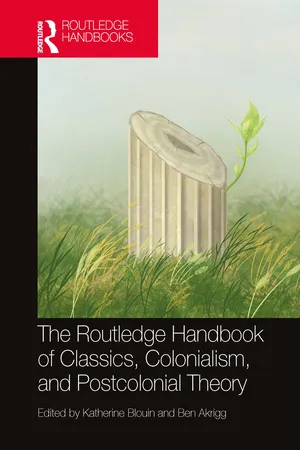
The Routledge Handbook of Classics, Colonialism, and Postcolonial Theory
eBook - ePub

The Routledge Handbook of Classics, Colonialism, and Postcolonial Theory

  1. 700 pages
  2. English
  3. ePUB (mobile friendly)
  4. Available on iOS & Android
eBook - ePub

The Routledge Handbook of Classics, Colonialism, and Postcolonial Theory

About this book

This handbook explores the ways in which histories of colonialism and postcolonial thought and theory cast light on our understanding of the ancient Mediterranean world and the discipline of Classics, utilizing a wide body of case studies and providing avenues for future research and discussion.

It brings together chapters by a wide, international, and intersectional range of scholars coming from a variety of backgrounds and sub-disciplinary perspectives, and from across the chronological and geographical scope of Classics. Chapters cover the state of current research into ancient Mediterranean and South, Central, and West Asian histories. They provide case studies to illustrate both how postcolonial thought has already illuminated our understanding of the ancient Mediterranean world and beyond, as well as its potential for the future. Chapters also provide opportunities for reflection on the current state of the discipline. An introduction by the volume editors offers a survey of the development of postcolonial theory, its relationship to other bodies of theory, and its connections to Classics. Toward the end of the book, three scholars with different career and disciplinary perspectives provide short reflections on the themes of the volume and the directions of future research.

The Routledge Handbook of Classics, Colonialism, and Postcolonial Theory offers an impressive collection of current research and thought on the subject for students and scholars in classical studies understood in its larger sense as well as in related disciplines such as Archaeology, Ancient History, Imperial History and the History of Colonialism, Reception Studies, and Museum Studies. For anyone interested in classical antiquity, it provides an engaging introduction to a potentially bewildering, but ultimately vital and enriching, body of thought and theory.

Trusted by 375,005 students

Access to over 1.5 million titles for a fair monthly price.

Study more efficiently using our study tools.

Information

Publisher
Routledge
Year
2024
Print ISBN
9780367555481
eBook ISBN
9781040022405

Table of contents

  1. Cover
  2. Half Title
  3. Series Page
  4. Title Page
  5. Copyright Page
  6. Dedication
  7. Table of Contents
  8. List of Figures
  9. List of Map
  10. List of Contributors
  11. Acknowledgments
  12. 1 Introduction
  13. 2 Edward Said’s Orientalism: a reappraisal
  14. 3 Classics at the borderlands: decolonising with Gloria AnzaldĂșa
  15. 4 Classics between epistemicides and hauntologies: a Caribbean reading
  16. 5 Placefulness and classical topoi in the writing of Ishion Hutchinson
  17. 6 Indigenous writers of North America and Greco-Roman antiquity: postcolonialism without the post?
  18. 7 The ancient past in the historical present: postcolonial theory and ancient Indian history
  19. 8 Subalternity in the Roman metropole
  20. 9 Rape and race: intersectional perspectives on Aeschylus’ Suppliants, with a coda on Charles Mee’s Big Love
  21. 10 Resistant receptions: a postcolonial approach to receptions of Greek tragedy
  22. 11 “Two-Eyed Seeing” and teaching classical literature
  23. 12 Postcolonial feminisms and colonial encounters in the Hellenistic period
  24. 13 Periplus, periplum, periphery: how to map classics from the edges
  25. 14 Time and the other Greeks
  26. 15 Our terms and theirs: some reflections on recent approaches to Greek religion
  27. 16 (Post-)colonialism and ancient magic
  28. 17 Haec de Africa. Rome’s imagined Africa and the limits of fiction
  29. 18 A colonialist trick of the eye: Valerius Maximus’ Memorable Deeds and Sayings as a tool of imperial education
  30. 19 “They look white, but they’re not”: nationality, race, and classical tradition in Brazil
  31. 20 Res Diversissimas: a postcolonial reading of Hannibal’s reception
  32. 21 “Perhaps it matters little to what race Terence belonged”: historicizing the life of Publius Terentius Afer
  33. 22 Alexander the Great studies and Hellenism in Uzbekistan: a postcolonial and decolonial discourse within a Central Asian archaeology stalled between post-Soviet myths, centre-periphery tensions, and non-recognition of Russian colonialism
  34. 23 Locating Indo-Iranian borderlands between Central Asia and South Asia: a reading of the past connected history (third century BCE to sixth century CE)
  35. 24 “Ê Faraó!”: the reception of ancient Egypt in Brazilian carnival
  36. 25 The long, winding, and bumpy road: seeing museum antiquities as colonial legacies
  37. 26 Thucydides on colonialism and hegemonic discourse
  38. 27 Forgery as decolonisation: Constantine Simonides in Liverpool
  39. 28 Those who tell their stories never die: on being an ‘Indigenous’ Egyptian researcher in the current increasing ‘local’ inclusion turn
  40. 29 Troubled archive: (de)coloniality and Egypt’s papyri
  41. 30 The materiality of papyri and the decolonization of Papyrology
  42. 31 “Many strange and impossible views”: the curious career of Frederic Cope Whitehouse (1842–1911)
  43. 32 Teaching classics in South Africa—a hopeful act: reflections on a decolonising teaching experience
  44. 33 Colonizing the past: the case of Argos in the late eighteenth and early nineteenth centuries
  45. 34 Examinations at the founding of the University of Toronto: the place of classics in the institutionalisation of Canadian education
  46. 35 “The ancient Romans conquered all Syria and Egypt”: encounters between Arabic and the Classics in the nineteenth century
  47. 36 Claiming authority: the Antiquities Act and the legacy of classical archaeology in America
  48. 37 Where Next?
  49. 38 Where Next? 2: reflections on my struggle with theory
  50. 39 Where Next? 3
  51. Index

Frequently asked questions

Yes, you can cancel anytime from the Subscription tab in your account settings on the Perlego website. Your subscription will stay active until the end of your current billing period. Learn how to cancel your subscription
No, books cannot be downloaded as external files, such as PDFs, for use outside of Perlego. However, you can download books within the Perlego app for offline reading on mobile or tablet. Learn how to download books offline
Perlego offers two plans: Essential and Complete
  • Essential is ideal for learners and professionals who enjoy exploring a wide range of subjects. Access the Essential Library with 800,000+ trusted titles and best-sellers across business, personal growth, and the humanities. Includes unlimited reading time and Standard Read Aloud voice.
  • Complete: Perfect for advanced learners and researchers needing full, unrestricted access. Unlock 1.5M+ books across hundreds of subjects, including academic and specialized titles. The Complete Plan also includes advanced features like Premium Read Aloud and Research Assistant.
Both plans are available with monthly, semester, or annual billing cycles.
We are an online textbook subscription service, where you can get access to an entire online library for less than the price of a single book per month. With over 1.5 million books across 990+ topics, we’ve got you covered! Learn about our mission
Look out for the read-aloud symbol on your next book to see if you can listen to it. The read-aloud tool reads text aloud for you, highlighting the text as it is being read. You can pause it, speed it up and slow it down. Learn more about Read Aloud
Yes! You can use the Perlego app on both iOS and Android devices to read anytime, anywhere — even offline. Perfect for commutes or when you’re on the go.
Please note we cannot support devices running on iOS 13 and Android 7 or earlier. Learn more about using the app
Yes, you can access The Routledge Handbook of Classics, Colonialism, and Postcolonial Theory by Katherine Blouin, Ben Akrigg, Katherine Blouin,Ben Akrigg in PDF and/or ePUB format, as well as other popular books in Politics & International Relations & Ancient History. We have over 1.5 million books available in our catalogue for you to explore.