These proceedings document the various presentations at the Fourth Resilience Engineering Symposium held on June 8-10, 2011, in Sophia-Antipolis, France. The Symposium gathered participants from five continents and provided them with a forum to exchange experiences and problems, and to learn about Resilience Engineering from the latest scientific achievements to recent practical applications. The First Resilience Engineering Symposium was held in Söderköping, Sweden, on October 25-29 2004. The Second Resilience Engineering Symposium was held in Juan-les-Pins, France, on November 8-10 2006, The Third Resilience Engineering Symposium was held in Juan-les-Pins, France, on October 28-30 2008. Since the first Symposium, resilience engineering has fast become recognised as a valuable complement to the established approaches to safety. Both industry and academia have recognised that resilience engineering offers valuable conceptual and practical basis that can be used to attack the problems of interconnectedness and intractability of complex socio-technical systems. The concepts and principles of resilience engineering have been tested and refined by applications in such fields as air traffic management, offshore production, patient safety, and commercial fishing. Continued work has also made it clear that resilience is neither limited to handling threats and disturbances, nor confined to situations where something can go wrong. Today, resilience is understood as the intrinsic ability of a system to adjust its functioning prior to, during, or following changes and disturbances, so that it can sustain required operations under both expected and unexpected conditions. This definition emphasizes the ability to continue functioning, rather than simply to react and recover from disturbances and the ability to deal with diverse conditions of functioning, expected as well as unexpected. For anyone who is interested in learning more about Resilience Engineering, the books published in the Ashgate Studies in Resilience Engineering provide an excellent starting point. Another sign that Resilience Engineering is coming of age is the establishment of the Resilience Engineering Association. The goal of this association is to provide a forum for coordination and exchange of experiences, by bringing together researchers and professionals working in the Resilience Engineering domain and organisations applying or willing to apply Resilience Engineering principles in their operations. The Resilience Engineering Association held its first General Assembly during the Fourth Symposium, and will in the future play an active role in the organisation of symposia and other activities related to Resilience Engineering.
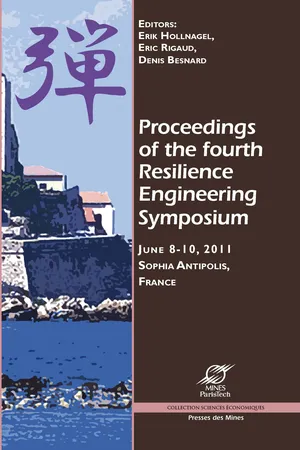
eBook - ePub
Proceedings of the fourth Resilience Engineering Symposium
June 8-10, 2011, Sophia Antipolis, France
- English
- ePUB (mobile friendly)
- Available on iOS & Android
eBook - ePub
Proceedings of the fourth Resilience Engineering Symposium
June 8-10, 2011, Sophia Antipolis, France
About this book
Information
Subtopic
ManagementIndex
BusinessTable of contents
- Introductory pages
- Table of contents
- Preface
- Resilient Peer Communities
- Resilience Abilities In Recent Blowouts In The Petroleum Industry
- From Hazards To Resilience In Socio-Technical Healthcare Systems
- Responsibility Modelling For Resilience
- An Emergent Means To Assurgent Ends: Community Resilience For Societal Safety And Sustainability
- From Crew Resource Management To Operational Resilience
- Improving Resilience Through Practitioners’ Well-being: An Experience In Italian Health-care
- Evaluation Of Organizational Resilience: Application In Quebec
- Challenges in Designing Resilient Socio-technical Systems: A Case Study of Railway Tunnel Projects
- Resilience and Ergonomics in aviation
- Resilience As Resource-based Design Of Anticipated Situations
- A Neuro-Fuzzy System to Improve the Resilience in Nuclear Power Plant Operation
- Critical Decision Method To Access Resilience And Brittleness In Heavy Rainfall Forecast
- Unwritten Rules For Safety And Performance In An Oncology Day Care Unit: Testing The Resilience Markers Framework
- The Stratified And Dialectical Anatomy Of Organizational Resilience
- Learning From Experience: Maintaining Flexibility In The Production Of Training Materials To Support Breast Cancer Screening
- Risk Assessment of Critical Communication Infrastructure in Railways in Norway
- New Balanced Scorecard leading indicators to monitor performance variability in OHS management systems
- Modeling And Simulation Of A Service System In A Disaster To Assess Its Resilience
- A Simulation-based Analysis of “Resilience” in Enroute Air Traffic Control Tasks
- Extraction of Lessons from the Fukushima Daiichi Accident based on a Resilience Engineering Perspective
- Resilience Management System And Development Of Resilience Capability On Site Workers
- Generating Resilience: Handling Extraordinarily High Work Load in High Three (Intensity, Technology, Reliability) Maintenance Work
- Observing Resilience Within A Large Technical System
- From technical resilience toward urban services resilience
- DISC model as a conceptual tool for engineering organisational resilience: Two case studies in nuclear and healthcare domains
- Engineering Naval Resilience: Expeditionary Command and Control
- Managing Safety In Subcontractor Networks: The Case Of Olkiluoto3 Nuclear Power Plant Construction Project
- Engineering Resilience Into Intensive Care Units
- Exploring Safe Work Method Statements In The Australian Construction Industry: A Prospective Study In Resilience Engineering
- Bridging Professional Silos In Radiation Medicine: The Ottawa Hospital Experience
- Mapping Resilience through Automatic Safety Data Gathering
- Learning From The Past For Pro-activity – A Re-analysis Of The Accident Of The MV Herald Of Free Enterprise
- Scenario Design For Training Systems In Crisis Management: Training Resilience Capabilities
- A Framework For Identifying And Analyzing Sources Of Resilience And Brittleness: A Case Study Of An Air Taxi Carrier
- Principles For Designing H&S Performance Measurement Systems: Insights From Resilience Engineering
- Patient Safety: A Wakeup Call And Resilient Response
- Colliding Dilemmas: Interactions Of Locally Adaptive Strategies In A Hospital Setting
- Images Of Resilience: The Resilience Analysis Grid Applicable At Several Organizational Levels?
- Fundamental On Situational Surprise: A Case Study With Implications For Resilience
- How Human Adaptive Systems Balance Fundamental Trade-offs: Implications For Polycentric Governance Architectures
- Safety In Numbers? Using Graphs Or Gut Feelings When It Comes To Safety
Trusted by 375,005 students
Access to over 1.5 million titles for a fair monthly price.
Study more efficiently using our study tools.
Frequently asked questions
Yes, you can cancel anytime from the Subscription tab in your account settings on the Perlego website. Your subscription will stay active until the end of your current billing period. Learn how to cancel your subscription
No, books cannot be downloaded as external files, such as PDFs, for use outside of Perlego. However, you can download books within the Perlego app for offline reading on mobile or tablet. Learn how to download books offline
Perlego offers two plans: Essential and Complete
- Essential is ideal for learners and professionals who enjoy exploring a wide range of subjects. Access the Essential Library with 800,000+ trusted titles and best-sellers across business, personal growth, and the humanities. Includes unlimited reading time and Standard Read Aloud voice.
- Complete: Perfect for advanced learners and researchers needing full, unrestricted access. Unlock 1.5M+ books across hundreds of subjects, including academic and specialized titles. The Complete Plan also includes advanced features like Premium Read Aloud and Research Assistant.
We are an online textbook subscription service, where you can get access to an entire online library for less than the price of a single book per month. With over 1.5 million books across 990+ topics, we’ve got you covered! Learn about our mission
Look out for the read-aloud symbol on your next book to see if you can listen to it. The read-aloud tool reads text aloud for you, highlighting the text as it is being read. You can pause it, speed it up and slow it down. Learn more about Read Aloud
Yes! You can use the Perlego app on both iOS and Android devices to read anytime, anywhere — even offline. Perfect for commutes or when you’re on the go.
Please note we cannot support devices running on iOS 13 and Android 7 or earlier. Learn more about using the app
Please note we cannot support devices running on iOS 13 and Android 7 or earlier. Learn more about using the app
Yes, you can access Proceedings of the fourth Resilience Engineering Symposium by Erik Hollnagel,Éric Rigaud,Denis Besnard in PDF and/or ePUB format, as well as other popular books in Business & Management. We have over 1.5 million books available in our catalogue for you to explore.