The appearance and development of a "Four Nations" slant on British history over the last two decades has in many ways pointed up "the Union" as an essential component of the national history or histories of the British Isles. "Four Nations" historians, however, have tended to focus exclusively on the United Kingdom as the core of either a nascent or a now defunct Empire. History is variously invoked to account for the emergence of the British dynastic state, explain its (to some) puzzling endurance, and not infrequently to assert or at least suggest its necessary demise in a world of nation states. By stressing the need for a multi-contextual approach, and casting union strictly as a process—something that is either in the making, or unravelling—"Four Nations" historians have thus paradoxically obscured the fact that union has served for several centuries to conceptualise and accommodate diversity in unity, not just in Britain, but in the wider British world. The essays in this volume, originally presented in June 2003 at a conference hosted by the University of Tours, therefore seek to move beyond the simplistic historiographical and political alternatives of union and dis-union to treat both the Union and union more generally as cultural as well as constitutional and historical constructs, well calculated to articulate separateness and help people make sense both of themselves and of their differences. Union is here approached from three key directions—the Churches, the Nation and the Constitution, all central since the seventeenth century to the question of unity and regional/national identities in the British metropole and Empire—and from three complementary angles—historical, legal and literary. From this perspective, it is hoped that union will be seen to provide a key to a fuller and more balanced, if not uncritical, understanding of a metropolitan and imperial British world of overlapping and sometimes conflicting national self-perceptions.
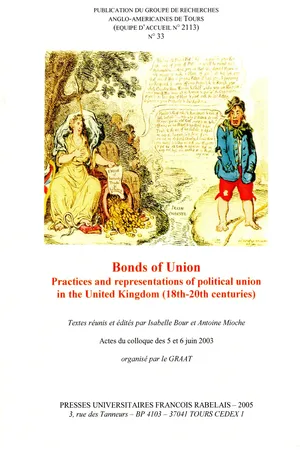
eBook - ePub
Bonds of Union
Practices and Representations of Political Union in the United Kingdom (18th-20th centuries)
- English
- ePUB (mobile friendly)
- Available on iOS & Android
eBook - ePub
Bonds of Union
Practices and Representations of Political Union in the United Kingdom (18th-20th centuries)
About this book
Information
Subtopic
British HistoryIndex
HistoryTable of contents
- Cover
- Bibliographic informations
- First pages
- Table of contents
- Remerciements
- Foreword
- Préface
- The changing fortunes of union: the Federalist, state formation, and the origins of a united Europe
- The national churches and the Union in nineteenth-century Britain and Ireland
- “No Nationality without Literature”
- Union displaced? The 1798 rebellion in the national tale (1809-1828)
- Recolonising Irish Literature? Bringing Yeats back to Dublin
- Contemporary northern Irish Theatre: challenging the Union?
- Union and Partition: the uses of Union in the British Empire
- The United Kingdom between Unitary State and Union State: a geopolitical analysis
- Spectre at the feast: Parliamentary Sovereignty and the Union Settlement of 1998
- Notices Biographiques/Notes on Contributors
Trusted by 375,005 students
Access to over 1.5 million titles for a fair monthly price.
Study more efficiently using our study tools.
Frequently asked questions
Yes, you can cancel anytime from the Subscription tab in your account settings on the Perlego website. Your subscription will stay active until the end of your current billing period. Learn how to cancel your subscription
No, books cannot be downloaded as external files, such as PDFs, for use outside of Perlego. However, you can download books within the Perlego app for offline reading on mobile or tablet. Learn how to download books offline
Perlego offers two plans: Essential and Complete
- Essential is ideal for learners and professionals who enjoy exploring a wide range of subjects. Access the Essential Library with 800,000+ trusted titles and best-sellers across business, personal growth, and the humanities. Includes unlimited reading time and Standard Read Aloud voice.
- Complete: Perfect for advanced learners and researchers needing full, unrestricted access. Unlock 1.5M+ books across hundreds of subjects, including academic and specialized titles. The Complete Plan also includes advanced features like Premium Read Aloud and Research Assistant.
We are an online textbook subscription service, where you can get access to an entire online library for less than the price of a single book per month. With over 1.5 million books across 990+ topics, we’ve got you covered! Learn about our mission
Look out for the read-aloud symbol on your next book to see if you can listen to it. The read-aloud tool reads text aloud for you, highlighting the text as it is being read. You can pause it, speed it up and slow it down. Learn more about Read Aloud
Yes! You can use the Perlego app on both iOS and Android devices to read anytime, anywhere — even offline. Perfect for commutes or when you’re on the go.
Please note we cannot support devices running on iOS 13 and Android 7 or earlier. Learn more about using the app
Please note we cannot support devices running on iOS 13 and Android 7 or earlier. Learn more about using the app
Yes, you can access Bonds of Union by Isabelle Bour,Antoine Mioche in PDF and/or ePUB format, as well as other popular books in History & British History. We have over 1.5 million books available in our catalogue for you to explore.