Modern education in Thailand started at the end of the nineteenth century under the impulse of King Chulalongkorn. Many scholars tracing back the evolution from traditional education to a modern education system emphasized the feeling of necessity that motivated this transformation. Wyatt (1969), Mead (2004) and Watson (1982) underlined the need for a modern administration, to handle the Siamese nation-state "as" the Western states, and in that respect, the key role played by education to structure the new Siam and to appear to the eyes of the world as civilized (Peleggi 2002). The shaping of a new education took place amidst strong political struggles. Siam needed to stand firm within the regional arena, swept by the winds of Western colonialism. Internally, King Chulalongkorn had to legitimize his power and to unify the kingdom by integrating satellite kingdoms into a wider space, the Siamese nation state. Education was vital for this mission as it would contribute not only to bringing state power into the provinces through state-paid teachers and government officials, but also to transmitting a whole nation-related imagery to the young generations. Giving rise to Thai-ness among the populations located at the margins of the kingdom was a tremendous ordeal. In the Southern part of the kingdom, population was mainly Muslim, spoke Malay and felt culturally closer to the Malay state (Dulyakasem 1991). In the Northern part, incorporating the Lanna kingdom and hill tribe populations into Siam proved not to be easy. Ideological, social and national values were introduced into education delivered to students, and with the implementation of the Compulsory Education Act of 1921, school attendance tied children and parents to the nation state and made them liable to it.
eBook - ePub
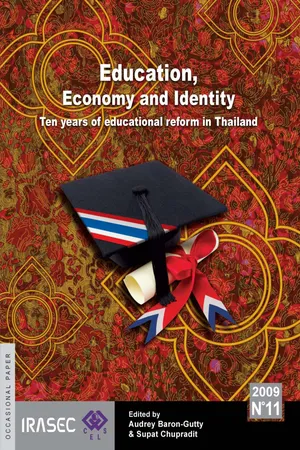
Education, Economy and Identity
Ten years of Educational Reform in Thailand
- English
- ePUB (mobile friendly)
- Available on iOS & Android
eBook - ePub
Education, Economy and Identity
Ten years of Educational Reform in Thailand
About this book
Information
Year
2009eBook ISBN
9782355960000
Subtopic
Asian PoliticsTable of contents
- Cover
- Bibliographic informations
- First pages
- Notes
- Table of contents
- Contributors
- Note on Transliteration
- Acronyms
- Glossary
- Introduction. Understanding the Challenges of the Educational Reform in Thailand
- Chapter 1. Reinforcing Thai wisdom with local curriculum at school
- Chapter 2. Modern education systems and impact on ethnic minorities
- Chapter 3. Vocational and cooperative education in Thailand: A Presentation
- Chapter 4. Fix-it centres: Adaptation and outcomes of the “clusters of the poor”. A case study in Chiang Mai
- Chapter 5. Strengthening university-industry links through co-op education: Case studies in Thailand
- Conclusion. The Need for a Real Educational Reform
- References
Trusted by 375,005 students
Access to over 1.5 million titles for a fair monthly price.
Study more efficiently using our study tools.
Frequently asked questions
Yes, you can cancel anytime from the Subscription tab in your account settings on the Perlego website. Your subscription will stay active until the end of your current billing period. Learn how to cancel your subscription
No, books cannot be downloaded as external files, such as PDFs, for use outside of Perlego. However, you can download books within the Perlego app for offline reading on mobile or tablet. Learn how to download books offline
Perlego offers two plans: Essential and Complete
- Essential is ideal for learners and professionals who enjoy exploring a wide range of subjects. Access the Essential Library with 800,000+ trusted titles and best-sellers across business, personal growth, and the humanities. Includes unlimited reading time and Standard Read Aloud voice.
- Complete: Perfect for advanced learners and researchers needing full, unrestricted access. Unlock 1.5M+ books across hundreds of subjects, including academic and specialized titles. The Complete Plan also includes advanced features like Premium Read Aloud and Research Assistant.
We are an online textbook subscription service, where you can get access to an entire online library for less than the price of a single book per month. With over 1.5 million books across 990+ topics, we’ve got you covered! Learn about our mission
Look out for the read-aloud symbol on your next book to see if you can listen to it. The read-aloud tool reads text aloud for you, highlighting the text as it is being read. You can pause it, speed it up and slow it down. Learn more about Read Aloud
Yes! You can use the Perlego app on both iOS and Android devices to read anytime, anywhere — even offline. Perfect for commutes or when you’re on the go.
Please note we cannot support devices running on iOS 13 and Android 7 or earlier. Learn more about using the app
Please note we cannot support devices running on iOS 13 and Android 7 or earlier. Learn more about using the app
Yes, you can access Education, Economy and Identity by Supat Chupradit,Audrey Baron-Gutty in PDF and/or ePUB format, as well as other popular books in Politics & International Relations & Asian Politics. We have over 1.5 million books available in our catalogue for you to explore.