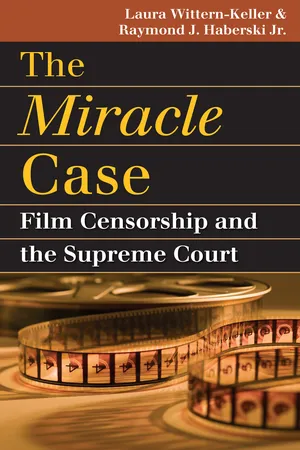
The Miracle Case
eBook - ePub

The Miracle Case

Film Censorship and the Supreme Court

  1. 248 pages
  2. English
  3. ePUB (mobile friendly)
  4. Available on iOS & Android
eBook - ePub

The Miracle Case

Film Censorship and the Supreme Court

About this book

It was only a forty-minute foreign film, but it sparked a legal confrontation that has left its mark on America for more than half a century. Roberto Rossellini’s Il Miracolo (The Miracle) is deceptively simple: a demented peasant woman is seduced by a stranger she believes to be Saint Joseph, is socially ostracized for becoming pregnant out of wedlock, but is finally redeemed through motherhood.

Although initially approved by state censors for screening in New York, the film was attacked as sacrilegious by the Catholic establishment, which convinced state officials to revoke distributor Joseph Burstyn’s license. In response, Burstyn fought back through the courts and won.

Laura Wittern-Keller and Raymond Haberski show how the Supreme Court’s unanimous 1952 ruling in Burstyn’s favor sparked a chain of litigation that eventually brought filmmaking under the protective umbrella of the First Amendment, overturning its long-outdated decision in Mutual v. Ohio (1915). Their story features a more formidable cast than did the film itself, with the charismatic Francis Cardinal Spellman decrying the film as a Communist plot, while outspoken film critic Bosley Crowther vigorously advocated “freedom of the screen.” Meanwhile, movie producers stood by silently for fear of alienating the Church and its large movie-going membership, leaving Burstyn to muster his own defense.

More than the inside story of one case, this book explores the unique place that the movies occupy in American culture and the way that culture continues to be shaped by anxiety over the social power of movies. The Burstyn decision weakened the ability of state censorship boards and the Catholic Church to influence the types of films Americans were allowed to see. Consequently, the case signaled the rise of a new era in which films would be more mature and more controversial than ever before.

Focusing on this single most important case in the jurisprudence surrounding motion picture expression, Wittern-Keller and Haberski add a significant new dimension to the story of cinema, censorship, and the history of First Amendment protections.

Frequently asked questions

Yes, you can cancel anytime from the Subscription tab in your account settings on the Perlego website. Your subscription will stay active until the end of your current billing period. Learn how to cancel your subscription.
No, books cannot be downloaded as external files, such as PDFs, for use outside of Perlego. However, you can download books within the Perlego app for offline reading on mobile or tablet. Learn more here.
Perlego offers two plans: Essential and Complete
  • Essential is ideal for learners and professionals who enjoy exploring a wide range of subjects. Access the Essential Library with 800,000+ trusted titles and best-sellers across business, personal growth, and the humanities. Includes unlimited reading time and Standard Read Aloud voice.
  • Complete: Perfect for advanced learners and researchers needing full, unrestricted access. Unlock 1.4M+ books across hundreds of subjects, including academic and specialized titles. The Complete Plan also includes advanced features like Premium Read Aloud and Research Assistant.
Both plans are available with monthly, semester, or annual billing cycles.
We are an online textbook subscription service, where you can get access to an entire online library for less than the price of a single book per month. With over 1 million books across 1000+ topics, we’ve got you covered! Learn more here.
Look out for the read-aloud symbol on your next book to see if you can listen to it. The read-aloud tool reads text aloud for you, highlighting the text as it is being read. You can pause it, speed it up and slow it down. Learn more here.
Yes! You can use the Perlego app on both iOS or Android devices to read anytime, anywhere — even offline. Perfect for commutes or when you’re on the go.
Please note we cannot support devices running on iOS 13 and Android 7 or earlier. Learn more about using the app.
Yes, you can access The Miracle Case by Laura Wittern-Keller,Raymond J. Haberski, Jr. in PDF and/or ePUB format, as well as other popular books in Law & Legal History. We have over one million books available in our catalogue for you to explore.

Information

Topic
Law
Index
Law

Table of contents

  1. Front Cover
  2. Half Title
  3. Series Page
  4. Title Page
  5. Copyright Page
  6. Table of Contents
  7. Editors’ Preface
  8. Preface
  9. Introduction
  10. 1. Movie Censorship: Origins and Early Challengers
  11. 2. Origins of Movies as Art
  12. 3. The Miracle on West 58th Street
  13. 4. The Supreme Court and The Miracle
  14. 5. Burstyn’s Progeny
  15. 6. The Legion of Decency after Burstyn
  16. 7. Film Freedom and Sexual Content
  17. 8. The Era of Ratings and Violence
  18. Relevant Cases
  19. Chronology
  20. Bibliographical Essay
  21. Index
  22. Back Cover