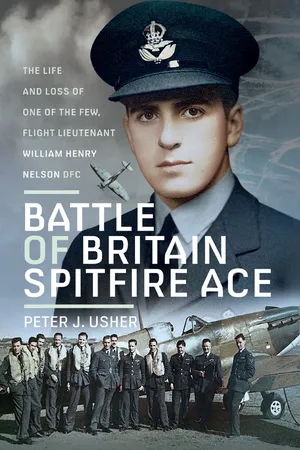
At 11.20 hours on the morning of Friday, 1 November 1940, nine Spitfires from 74 Squadron, the famous 'Tiger Squadron', were scrambled from Biggin to carry out an interception patrol I the Dover area. One of the pilots, at the Spitfire Mk.IIa P7312, was the Canadian Flying Officer William Henry Nelson DFC. At around midday, the Tigers encountered a formation of enemy aircraft – Messerschmitt Bf 109s. In the ensuing dogfights, two of the Spitfire pilots were wounded. But for 'Willie' Nelson, it was his last combat. Spitfire P7312 failed to return to Biggin Hill, and Nelson, believed to have crashed into the Channel, is listed as 'Missing' to this day. From Montreal, Canada, Willie Nelson had been fascinated by aviation from childhood and went to work in Montreal's aircraft industry after high school. In 1936, at the age of nineteen, he traveled to the UK to join the Royal Air Force. He was among the few Canadians to be commissioned as a pilot long before the Second World War, joining Bomber Command's 10 Squadron at Dishforth on 27 November 1937. Within days of the outbreak of the war, the squadron was in action, with eight of its Armstrong Whitworth Whitleys undertaking a reconnaissance of north-west Germany along with a leaflet drop on the night of 8/9 September 1939. Nelson was awarded a DFC for his actions in the Norwegian campaign. It was during the desperate situation of June 1940 that Nelson volunteered to retrain as a fighter pilot. He duly joined 74 Squadron at Hornchurch on 20 July 1940, ten days after the official start of the Battle of Britain. An experienced pilot, Nelson was thrust straight into Britain's struggle for survival. Within weeks he destroyed five enemy aircraft and damaged two more. His first claim was of damaging a Bf 109 and a Bf 110, as well as destroying a Bf 110 on 11 August. Two days later, Nelson was able to claim damaging a Dornier Do 17, and he claimed three more Bf109s destroyed during the last two weeks of October, earning him the accolade of being a Spitfire Ace – the only Canadian to do so in the Battle of Britain. Drawing heavily on his own diary, logbook and many letters home, Battle of Britain Spitfire Ace describes Nelson's flying career from bomber pilot to fighter pilot, his captaincy of his bomber squadron's team in Britain's Modern Pentathlon competitions in 1938 and 1939, and even his squadron's activities during the Phoney War. All his combat sorties are detailed as, of course, is his final flight that fateful autumn day over the South Coast. Willie Nelson had married and had a young son when he died. The final chapter describes the voyage of discovery that his son, Bill Mcalister, took in an effort to learn about the life of the father he never knew.
eBook - PDF
Battle of Britain Spitfire Ace
The Life and Loss of One of The Few, Flight Lieutenant William Henry Nelson DFC
- 250 pages
- English
- PDF
- Available on iOS & Android
eBook - PDF
Battle of Britain Spitfire Ace
The Life and Loss of One of The Few, Flight Lieutenant William Henry Nelson DFC
About this book
Information
Subtopic
Military BiographiesIndex
HistoryTable of contents
- Cover
- Book Title
- Copyright
- Contents
- List of Illustrations
- Introduction
- PART ONE: MONTREAL
- PART TWO: ENGLAND
- PART THREE: THE WAR
- PART FOUR: AFTERLIFE
- Epilogue: In Remembrance
- Acknowledgements
- Endnotes
- Bibliography and Sources
- Index
- Back Cover
Trusted by 375,005 students
Access to over 1.5 million titles for a fair monthly price.
Study more efficiently using our study tools.
Frequently asked questions
Yes, you can cancel anytime from the Subscription tab in your account settings on the Perlego website. Your subscription will stay active until the end of your current billing period. Learn how to cancel your subscription
No, books cannot be downloaded as external files, such as PDFs, for use outside of Perlego. However, you can download books within the Perlego app for offline reading on mobile or tablet. Learn how to download books offline
Perlego offers two plans: Essential and Complete
- Essential is ideal for learners and professionals who enjoy exploring a wide range of subjects. Access the Essential Library with 800,000+ trusted titles and best-sellers across business, personal growth, and the humanities. Includes unlimited reading time and Standard Read Aloud voice.
- Complete: Perfect for advanced learners and researchers needing full, unrestricted access. Unlock 1.5M+ books across hundreds of subjects, including academic and specialized titles. The Complete Plan also includes advanced features like Premium Read Aloud and Research Assistant.
We are an online textbook subscription service, where you can get access to an entire online library for less than the price of a single book per month. With over 1.5 million books across 990+ topics, we’ve got you covered! Learn about our mission
Look out for the read-aloud symbol on your next book to see if you can listen to it. The read-aloud tool reads text aloud for you, highlighting the text as it is being read. You can pause it, speed it up and slow it down. Learn more about Read Aloud
Yes! You can use the Perlego app on both iOS and Android devices to read anytime, anywhere — even offline. Perfect for commutes or when you’re on the go.
Please note we cannot support devices running on iOS 13 and Android 7 or earlier. Learn more about using the app
Please note we cannot support devices running on iOS 13 and Android 7 or earlier. Learn more about using the app
Yes, you can access Battle of Britain Spitfire Ace by Peter J Usher in PDF and/or ePUB format, as well as other popular books in History & Military Biographies. We have over 1.5 million books available in our catalogue for you to explore.