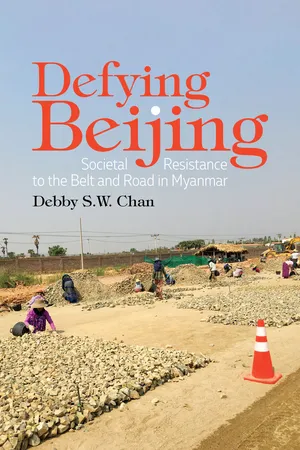
The Belt and Road Initiative (BRI) aims to construct a Sino-centric transcontinental infrastructure network in Asia, Europe, Africa and beyond. Within this initiative, the China–Myanmar Economic Corridor (CMEC) is a vital strategic component. The shortcut to the Indian Ocean seeks to improve China's energy security and facilitate trade. Defying Beijing: Societal Resistance to the Belt and Road in Myanmar shows how Myanmar was able to capitalise on Chinese BRI ambitions to achieve its own desired outcomes during the country's political liberalisation in the 2010s. Belying the asymmetrical relationship between these two nations, the Myitsone hydropower dam was suspended, the Letpadaung copper mine's contract was renegotiated, and the Kyaukphyu deep seaport project was downsized. China offered concessions to Myanmar instead of pressuring it to honour those signed agreements. Contrasting a common proposition that US-Myanmar rapprochement disrupted the BRI projects in Myanmar, Defying Beijing argues that the rise of new foreign policy actors – citizens – made project continuation costlier for Naypyidaw in the course of political liberalisation in the 2010s. Naypyidaw was pressured to renegotiate terms with Beijing in the wake of social outcry in the country. Defying Beijing advances our understanding of Chinese–Myanmar BRI relations and demonstrates how citizens can change the course of events of BRI cooperation despite oppressive political environments and an imbalanced bargaining structure. In post-coup Myanmar, Naypyidaw's policy options were not conditioned by public opinion or protests; nonetheless, armed resistance has posed new domestic constraints in the CMEC's implementation. Clearly, bilateral economic agreements without citizens' endorsement are fraught with legitimacy problems and instabilities.
- 296 pages
- English
- PDF
- Available on iOS & Android
eBook - PDF
About this book
Information
Table of contents
- Acknowledgements
- Introduction: Pushing Back State-Coordinated Belt and Road Projects in Myanmar
- 1. Myanmar’s Societal Actors in Paukphaw Relations
- 2. Audience Cost Dilemma in Sino–Myanmar Economic Cooperation
- 3. Myitsone Dam: Social Opposition Became Naypyidaw’s Bargaining Leverage
- 4. Letpadaung Copper Mine: Protest Repression in Exchange for Profit Redistribution
- 5. China–Myanmar Pipelines: Business Operated as Usual with Weak Opposition
- 6. Belt and Road Projects’ Implementation under the Aung San Suu Kyi-Led Government
- 7. Conclusion
- Appendix: List of Interviewees
- References
- Index
Trusted by 375,005 students
Access to over 1.5 million titles for a fair monthly price.
Study more efficiently using our study tools.
Frequently asked questions
Yes, you can cancel anytime from the Subscription tab in your account settings on the Perlego website. Your subscription will stay active until the end of your current billing period. Learn how to cancel your subscription
No, books cannot be downloaded as external files, such as PDFs, for use outside of Perlego. However, you can download books within the Perlego app for offline reading on mobile or tablet. Learn how to download books offline
Perlego offers two plans: Essential and Complete
- Essential is ideal for learners and professionals who enjoy exploring a wide range of subjects. Access the Essential Library with 800,000+ trusted titles and best-sellers across business, personal growth, and the humanities. Includes unlimited reading time and Standard Read Aloud voice.
- Complete: Perfect for advanced learners and researchers needing full, unrestricted access. Unlock 1.5M+ books across hundreds of subjects, including academic and specialized titles. The Complete Plan also includes advanced features like Premium Read Aloud and Research Assistant.
We are an online textbook subscription service, where you can get access to an entire online library for less than the price of a single book per month. With over 1.5 million books across 990+ topics, we’ve got you covered! Learn about our mission
Look out for the read-aloud symbol on your next book to see if you can listen to it. The read-aloud tool reads text aloud for you, highlighting the text as it is being read. You can pause it, speed it up and slow it down. Learn more about Read Aloud
Yes! You can use the Perlego app on both iOS and Android devices to read anytime, anywhere — even offline. Perfect for commutes or when you’re on the go.
Please note we cannot support devices running on iOS 13 and Android 7 or earlier. Learn more about using the app
Please note we cannot support devices running on iOS 13 and Android 7 or earlier. Learn more about using the app
Yes, you can access Defying Beijing by Debby Chan in PDF and/or ePUB format, as well as other popular books in Politics & International Relations & Asian Politics. We have over 1.5 million books available in our catalogue for you to explore.