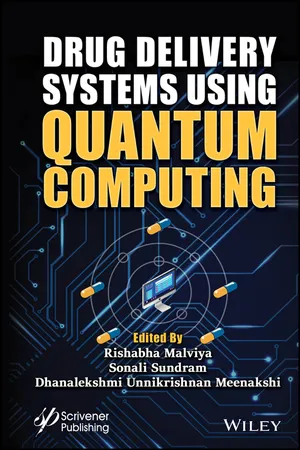
Drug Delivery Systems using Quantum Computing
eBook - PDF

Drug Delivery Systems using Quantum Computing

  1. English
  2. PDF
  3. Available on iOS & Android
eBook - PDF

Drug Delivery Systems using Quantum Computing

About this book

The first book of its kind to show the potential of quantum computing in drug delivery.

Drug delivery systems (DDS) are defined as methods by which drugs are delivered to desired tissues, organs, cells, and subcellular organs for drug release and absorption through a variety of drug carriers. By controlling the precise level and/or location of a given drug in the body, side effects are reduced, doses are lowered, and new therapies are possible. Nevertheless, there are still significant obstacles to delivering certain medications to particular cells. Drug delivery methods change pharmacokinetic, pharmacodynamic, and drug release patterns to enhance product efficacy and safety, as well as patient convenience and compliance. Computational approaches in drug development enable quick screening of a vast chemical library and identification of possible binders by using modeling, simulation, and visualization tools. Quantum computing (QC) is a fundamentally new computing paradigm based on quantum mechanics rules that enables certain computations to be conducted significantly more rapidly and effectively than regular computing, and hence this has huge promise for the pharmaceutical sector.

Significant advances in computational simulation are making it easier to comprehend the process of drug delivery. This book explores an important biophysical component of DDSs, and how computer modeling may help with the logical design of DDSs with enhanced and optimized characteristics. The book concentrates on computational research for various important types of nanocarriers, including dendrimers and dendrons, polymers, peptides, nucleic acids, lipids, carbon-based DDSs, and gold nanoparticles.

Audience

Researchers and industry scientists working in clinical research and disease management; pharmacists, formulation and pharmaceutical scientists working in R&D; computer science engineers applying deep learning and quantum computing in healthcare.

Frequently asked questions

Yes, you can cancel anytime from the Subscription tab in your account settings on the Perlego website. Your subscription will stay active until the end of your current billing period. Learn how to cancel your subscription.
No, books cannot be downloaded as external files, such as PDFs, for use outside of Perlego. However, you can download books within the Perlego app for offline reading on mobile or tablet. Learn more here.
Perlego offers two plans: Essential and Complete
  • Essential is ideal for learners and professionals who enjoy exploring a wide range of subjects. Access the Essential Library with 800,000+ trusted titles and best-sellers across business, personal growth, and the humanities. Includes unlimited reading time and Standard Read Aloud voice.
  • Complete: Perfect for advanced learners and researchers needing full, unrestricted access. Unlock 1.4M+ books across hundreds of subjects, including academic and specialized titles. The Complete Plan also includes advanced features like Premium Read Aloud and Research Assistant.
Both plans are available with monthly, semester, or annual billing cycles.
We are an online textbook subscription service, where you can get access to an entire online library for less than the price of a single book per month. With over 1 million books across 1000+ topics, we’ve got you covered! Learn more here.
Look out for the read-aloud symbol on your next book to see if you can listen to it. The read-aloud tool reads text aloud for you, highlighting the text as it is being read. You can pause it, speed it up and slow it down. Learn more here.
Yes! You can use the Perlego app on both iOS or Android devices to read anytime, anywhere — even offline. Perfect for commutes or when you’re on the go.
Please note we cannot support devices running on iOS 13 and Android 7 or earlier. Learn more about using the app.
Yes, you can access Drug Delivery Systems using Quantum Computing by Rishabha Malviya,Sonali Sundram,Dhanalekshmi Unnikrishnan Meenakshi in PDF and/or ePUB format, as well as other popular books in Physical Sciences & Organic Chemistry. We have over one million books available in our catalogue for you to explore.

Information

Table of contents

  1. Cover
  2. Series Page
  3. Title Page
  4. Copyright Page
  5. Dedication Page
  6. Contents
  7. Foreword
  8. Preface
  9. Acknowledgments
  10. Chapter 1 Quantum Computational Concepts and Approaches in Drug Discovery, Development and Delivery
  11. Chapter 2 Quantum-Enabled Drug Discovery Process
  12. Chapter 3 Quantum Computing and Its Promise in Drug Discovery
  13. Chapter 4 Exploring Nano-Based Therapeutics by Quantum Computational Modeling
  14. Chapter 5 Application of Quantum Computational Simulation in Drug Delivery Strategies with Carbon Nanotubes
  15. Chapter 6 Quantum Computation Approach for Nanotechnology-Based Targeted Drug Delivery Systems
  16. Chapter 7 Role of Quantum Computing Simulations in Targeted Drug Delivery of Liposomes
  17. Chapter 8 Quantum Computational Methods and Computer-Aided Drug Design in Transdermal Drug Delivery of Nanoparticles
  18. Chapter 9 Computational Approaches for Drug Delivery of Nanoparticles
  19. Chapter 10 Utilization of Computational Methods for Rational Development of Nanoemulsions, Polymeric Micelles, and Dendrimers Drug Delivery Systems
  20. Chapter 11 Molecular Simulation: A Promising Tool for In Silico Design of Drug Delivery Formulations
  21. Chapter 12 Controlling the Drug Release Rate and Targeted Drug Delivery to the Desired Site by Molecular Simulation
  22. Chapter 13 Molecular Docking: An Essential Step in Computer-Aided Drug Design
  23. Chapter 14 Challenges and Emerging Problems in CADD
  24. Index
  25. EULA