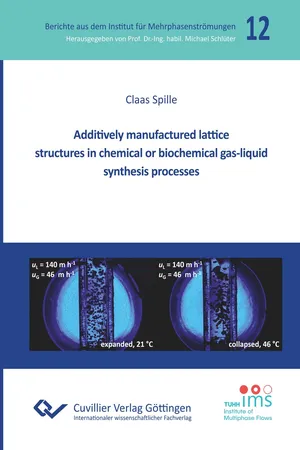
The technological development of additive manufacturing increasingly allows new possibilities in the production and design of new reactor concepts, which were previously not realizable with conventional manufacturing methods. The use of 3D-printed structures for process intensification and precise reaction control offers many new opportunities to respond to new challenges with regard to climate change and the scarcity or finiteness of raw materials with customized and adaptive solutions. In this work, Additively Manufactured Lattice Structures (AMLS) are designed, characterized and optimized as internals for gas-liquid reactors and potentials are identified by their use for future multiphase applications in chemical and biochemical synthesis processes.Die technologische Entwicklung der additiven Fertigung erlaubt zunehmend neue Möglichkeiten in der Herstellung und dem Design neuer Reaktorkonzepte, die mit gängigen Herstellungsverfahren bisweilen nicht realisierbar waren. Der Einsatz 3D-gedruckter Strukturen zur Prozessintensivierung und gezielten Reaktionsführung bietet viele neue Möglichkeiten auf neue Herausforderungen hinsichtlich des Klimawandels und der Rohstoffknappheit bzw. –endlichkeit mit maßgeschneiderten und adaptiven Lösungen zu reagieren. Im Rahmen der Arbeit wurden Additively Manufactured Lattice Structures (AMLS) als Einbauten für Gas-Flüssig-Reaktoren designt, charakterisiert und optimiert und Potenziale durch deren Einsatz für zukünftige Mehrphasenanwendungen in chemischen und biochemischen Syntheseprozessen identifiziert.
- 157 pages
- English
- PDF
- Available on iOS & Android
eBook - PDF
About this book
Information
Print ISBN
9783736979970
Edition
1Table of contents
- List of figures
- List of tables
- Nomenclature
- 1 Introduction
- 2 State of knowledge
- 2.1 Bubble column reactors
- 2.2 State of the Art: Additively Manufactured Lattice Structures
- 2.3 Mass transport in gas- liquid systems
- 3 Experimental setups and procedures
- 3.1 30x30 mm2 square flow channel setup
- 3.2 DN 110 flow tube setup
- 4 Results and discussion
- 4.1 Influence of AMLS on gas holdup and bubble size distribution
- 4.2 Influence of AMLS on bubble velocity and residence time
- 4.3 Influence of AMLS on the two-phasic pressure drop
- 4.4 Influence of AMLS on transport properties (kLa)
- 5 Smart Structures
- 5.1 Stimuli-Responsive Polymers
- 5.2 Stimuli-Responsive Hydrogels
- 5.3 Additively Manufactured Hydrogels
- 6 Conclusion and outlook
- Bibliography
- Appendix
Trusted by 375,005 students
Access to over 1.5 million titles for a fair monthly price.
Study more efficiently using our study tools.