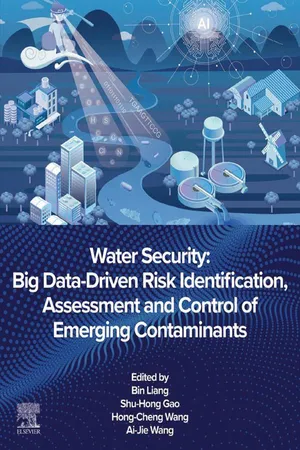
eBook - ePub
Water Security: Big Data-Driven Risk Identification, Assessment and Control of Emerging Contaminants
- 380 pages
- English
- ePUB (mobile friendly)
- Available on iOS & Android
eBook - ePub
Water Security: Big Data-Driven Risk Identification, Assessment and Control of Emerging Contaminants
About this book
Water Security: Big Data-Driven Risk Identification, Assessment and Control of Emerging Contaminants contains the latest information on big data-driven risk detection and analysis, risk assessment and environmental health effect, intelligent risk control technologies, and global control strategy of emerging contaminants. First, this book highlights advances and challenges throughout the detection of emerging chemical contaminants (e.g., antimicrobials, microplastics) by sensors or mass spectrometry, as well as emerging biological contaminant (e.g., ARGs, pathogens) by a combination of next- and third-generation sequencing technologies in aquatic environment. Second, it discusses in depth the ecological risk assessment and environmental health effects of emerging contaminants. Lastly, it presents the most up-to-date intelligent risk management technologies.This book shares instrumental global strategy and policy analysis on how to control emerging contaminants. Offering interdisciplinary and global perspectives from experts in environmental sciences and engineering, environmental microbiology and microbiome, environmental informatics and bioinformatics, intelligent systems, and knowledge engineering, this book provides an accessible and flexible resource for researchers and upper level students working in these fields.
- Covers the detection, high-throughput analyses, and environmental behavior of the typical emerging chemical and biological contaminants
- Focuses on chemical and biological big data driven aquatic ecological risk assessment models and techniques
- Highlights the intelligent management and control technologies and policies for emerging contaminants in water environments
Information
Table of contents
- Water Security: Big Data-Driven Risk Identification, Assessment and Control of Emerging Contaminants
- Cover
- Title Page
- Copyright Page
- Table of Contents
- List of contributors
- About the editors
- Foreword
- Acknowledgments
- Chapter 1 Pollution distribution characteristics and ecological risks of typical emerging chemical contaminants in aquatic environments
- Chapter 2 Micro(nano)plastic-mediated water ecological risks and control technologies
- Chapter 3 Environmental DNA and toxicogenomics in ecological health risk assessment
- Chapter 4 Dissemination mechanism of antibiotic resistance genes in water environment
- Chapter 5 Environmental behavior and risk of antibiotic resistance genes in water environments
- Chapter 6 Pathogens in engineered water systems
- Chapter 7 Environmental ecology and health risk assessment of pathogens in the environment
- Chapter 8 Ecological health assessment of natural water bodies by plankton
- Chapter 9 Analytical approaches, occurrence, migration, and transformation mechanisms of emerging contaminants in multiple media
- Chapter 10 Biosensors and biodegradation for emerging contaminants based on synthetic biology
- Chapter 11 Advanced detection technologies for emerging contaminants based on sensors
- Chapter 12 Optical real-time online sensing technologies and challenges for emerging contaminants
- Chapter 13 Suspect and nontarget screening technologies for emerging contaminants
- Chapter 14 Detection methods for emerging microplastics
- Chapter 15 High-throughput sequencing-based bioinformatics identification technologies for emerging biological risk factors
- Chapter 16 Mining technologies for functional gene markers of emerging contaminants
- Chapter 17 Statistical analyses and visualization of biological sequencing big data
- Chapter 18 Association of antimicrobial biodegradation with the evolution of antimicrobial resistance in ecosystems
- Chapter 19 Microbial transformation of per- and polyfluoroalkyl substances
- Chapter 20 Microbial dehalogenation mechanisms and prospects of bioremediation of persistent halogenated organic contaminants
- Chapter 21 Bacterial and genetic resources for typical emerging pharmaceuticals and personal care products degradation
- Chapter 22 Plastic contaminants in water and recent advances in bioremediation
- Chapter 23 Fate of emerging chemical contaminants in wastewater treatment system
- Chapter 24 Fate and risk management of antibiotic resistance genes in anaerobic digestion
- Chapter 25 Electron transfer regulation-based biotechnology for emerging contaminants treatment
- Chapter 26 Physicochemical control technologies for emerging contaminants in sewage treatment plants
- Chapter 27 Nature-based solutions for emerging contaminants removal
- Chapter 28 Leveraging weak electrical stimulation and artificial intelligence for sustainable microbial dehalogenation in groundwater remediation
- Chapter 29 Using isotope tracers to elucidate the fate of organic micropollutants in the environment
- Chapter 30 Modeling processes and sensitivity analysis of machine learning methods for environmental data
- Chapter 31 Advances in pollution source identification in the integrated drainage system
- Chapter 32 Data-driven management strategies for carbon emissions and emerging contaminants control in wastewater treatment plants
- Chapter 33 A Julia-based activated sludge modeling program for emerging contaminants management
- Chapter 34 Modeling removal of emerging contaminants during wastewater treatment processes
- Chapter 35 Current developments in machine learning models with boosting algorithms for the prediction of water quality
- Chapter 36 New situation of water resources management and water pollution control
- Chapter 37 The value of water resources and the emerging contaminants management
- Index
- Index - Continued
- Index - Continued
- Index - Continued
Trusted by 375,005 students
Access to over 1.5 million titles for a fair monthly price.
Study more efficiently using our study tools.
Frequently asked questions
Yes, you can cancel anytime from the Subscription tab in your account settings on the Perlego website. Your subscription will stay active until the end of your current billing period. Learn how to cancel your subscription
No, books cannot be downloaded as external files, such as PDFs, for use outside of Perlego. However, you can download books within the Perlego app for offline reading on mobile or tablet. Learn how to download books offline
Perlego offers two plans: Essential and Complete
- Essential is ideal for learners and professionals who enjoy exploring a wide range of subjects. Access the Essential Library with 800,000+ trusted titles and best-sellers across business, personal growth, and the humanities. Includes unlimited reading time and Standard Read Aloud voice.
- Complete: Perfect for advanced learners and researchers needing full, unrestricted access. Unlock 1.5M+ books across hundreds of subjects, including academic and specialized titles. The Complete Plan also includes advanced features like Premium Read Aloud and Research Assistant.
We are an online textbook subscription service, where you can get access to an entire online library for less than the price of a single book per month. With over 1.5 million books across 990+ topics, we’ve got you covered! Learn about our mission
Look out for the read-aloud symbol on your next book to see if you can listen to it. The read-aloud tool reads text aloud for you, highlighting the text as it is being read. You can pause it, speed it up and slow it down. Learn more about Read Aloud
Yes! You can use the Perlego app on both iOS and Android devices to read anytime, anywhere — even offline. Perfect for commutes or when you’re on the go.
Please note we cannot support devices running on iOS 13 and Android 7 or earlier. Learn more about using the app
Please note we cannot support devices running on iOS 13 and Android 7 or earlier. Learn more about using the app
Yes, you can access Water Security: Big Data-Driven Risk Identification, Assessment and Control of Emerging Contaminants by Bin Liang, Shu-Hong Gao, Hongcheng Wang, Bin Liang,Shu-Hong Gao,Hongcheng Wang in PDF and/or ePUB format, as well as other popular books in Biological Sciences & Environmental Science. We have over 1.5 million books available in our catalogue for you to explore.