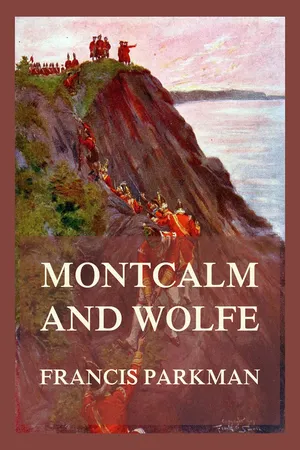
On the 13th September, 1759, there lay upon the bloody Plains of Abraham two men. Hearing an officer cry. "They run! They run!" one of these dying men raised his head and asked, "Who runs?" "The enemy, " replied the officer. "Then God be praised; I shall die happy." This man was John Wolfe, commander of the English army before Quebec. The other of these two men on being told that his wounds were mortal, and that right speedily, replied, "So much the better, I shall not live to see the surrender of Quebec." This man was the Marquis of Montcalm, the commander of the French army then in possession of Quebec. From the names of these two brave Generals, Mr. Francis Parkman has taken the name of his new history. Montcalm and Wolfe. For many years this learned scholar has been engaged in writing a series of histories illustrative of the struggle between these two nations, the English and French, for the ascendency on this continent. Most volumes hitherto published bring the history of the struggle down to 1700. The present work begins with 1748. Thus there is an interim of half a century not The events yet covered by Mr. Parkman. covered in the present volume are the conflict for Acadia, the land now known as Nova Scotia. The great Indian battle known as Brad dock's defeat, with the events before and after, in which Washington was so active. The defeat of the Baron Dieskau, and the capture of Crown Point. The coming of Montcalm to America as the French Commander, and the capture of Fort William Henry, by the French under Montcalm, in 1757. With this event and the frightful massacre of the English by the Indians, as the former left the surrendered fortifications, the volume is brought to a close. So far as history is concerned there has been nothing yet produced in America superior to these books of Mr. Parkman's. The style is vigorous, full of spirit, even brilliant on occasions when the author warms to his work. The sketches of character are positively excellent. They betray the skill of an Indian in tracing the crooked paths which, when unraveled, dis pay the human character. And in the delineation of that character even Scott himself was not greater with old Monkbarns. Are you incredulous? Then turn to the picture of Gen. Braddock. That gentleman instantly stands before you. You will see him as you look to - day upon living men, walking and talking before you. But you will see more. You will see just why he was beaten; just why Washington, albeit he were the incarnation of human bravery, was unable to pluck the flower, Victory, from the poisonous nettle, Defeat. The picture of Montcalm is only less valuable because it is less piquant, it is more matter of fact. But when you come to Sir William John son you will be again edified, as you look into his fortified house at Albany, and upon his Dutch houskeeper, whom subsequently he married, and when she was dead, upon the young Mohawk squaw, who did the honors and other things of the house. We might go on in just these specifications, for the book is full of them, but we must stop somewhere. And we simply say that this history has never taken hitherto anything like so attractive a guise as Mr. Parkman has here given them. The admirable style in which the volume appears is equal to anything issued in this country.
- 936 pages
- English
- ePUB (mobile friendly)
- Available on iOS & Android
eBook - ePub
Montcalm and Wolfe
About this book
Information
Subtopic
North American HistoryIndex
HistoryTable of contents
- PREFACE.
- INTRODUCTION.
- CHAPTER I. 1745-1755. THE COMBATANTS.
- CHAPTER II. 1749-1752. CÉLORON DE BIENVILLE.
- CHAPTER III. 1749-1753. CONFLICT FOR THE WEST.
- CHAPTER IV. 1710-1754. CONFLICT FOR ACADIA.
- CHAPTER V. 1753, 1754. WASHINGTON.
- CHAPTER VI. 1754, 1755. THE SIGNAL OF BATTLE.
- CHAPTER VII. 1755. BRADDOCK.
- CHAPTER VIII. 1755-1763. REMOVAL OF THE ACADIANS.
- CHAPTER IX. 1755. DIESKAU.
- CHAPTER X. 1755, 1756. SHIRLEY. BORDER WAR.
- CHAPTER XI. 1712-1756. MONTCALM.
- CHAPTER XII. 1756. OSWEGO.
- CHAPTER XIII. 1756, 1757. PARTISAN WAR.
- CHAPTER XIV. 1757. MONTCALM AND VAUDREUIL.
- CHAPTER XV. 1757. FORT WILLIAM HENRY.
- CHAPTER XVI. 1757, 1758. A WINTER OF DISCONTENT.
- CHAPTER XVII. 1753-1760. BIGOT.
- CHAPTER XVIII. 1757, 1758. PITT.
- CHAPTER XIX. 1758. LOUISBOURG.
- CHAPTER XX. 1758. TICONDEROGA.
- CHAPTER XXI. 1758. FORT FRONTENAC.
- CHAPTER XXII. 1758. FORT DUQUESNE.
- CHAPTER XXIII. 1758, 1759. THE BRINK OF RUIN.
- CHAPTER XXIV. 1758, 1759. WOLFE.
- CHAPTER XXV. 1759. WOLFE AT QUEBEC.
- CHAPTER XXVI. 1759. AMHERST. NIAGARA.
- CHAPTER XXVII. 1759. THE HEIGHTS OF ABRAHAM.
- CHAPTER XXVIII. 1759. FALL OF QUEBEC.
- CHAPTER XXIX. 1759, 1760. SAINTE-FOY.
- CHAPTER XXX. 1760. FALL OF CANADA.
- CHAPTER XXXI. 1758-1763. THE PEACE OF PARIS.
- CHAPTER XXXII. 1763-1884. CONCLUSION.
- APPENDIX.
Trusted by 375,005 students
Access to over 1.5 million titles for a fair monthly price.
Study more efficiently using our study tools.
Frequently asked questions
Yes, you can cancel anytime from the Subscription tab in your account settings on the Perlego website. Your subscription will stay active until the end of your current billing period. Learn how to cancel your subscription
No, books cannot be downloaded as external files, such as PDFs, for use outside of Perlego. However, you can download books within the Perlego app for offline reading on mobile or tablet. Learn how to download books offline
Perlego offers two plans: Essential and Complete
- Essential is ideal for learners and professionals who enjoy exploring a wide range of subjects. Access the Essential Library with 800,000+ trusted titles and best-sellers across business, personal growth, and the humanities. Includes unlimited reading time and Standard Read Aloud voice.
- Complete: Perfect for advanced learners and researchers needing full, unrestricted access. Unlock 1.5M+ books across hundreds of subjects, including academic and specialized titles. The Complete Plan also includes advanced features like Premium Read Aloud and Research Assistant.
We are an online textbook subscription service, where you can get access to an entire online library for less than the price of a single book per month. With over 1.5 million books across 990+ topics, we’ve got you covered! Learn about our mission
Look out for the read-aloud symbol on your next book to see if you can listen to it. The read-aloud tool reads text aloud for you, highlighting the text as it is being read. You can pause it, speed it up and slow it down. Learn more about Read Aloud
Yes! You can use the Perlego app on both iOS and Android devices to read anytime, anywhere — even offline. Perfect for commutes or when you’re on the go.
Please note we cannot support devices running on iOS 13 and Android 7 or earlier. Learn more about using the app
Please note we cannot support devices running on iOS 13 and Android 7 or earlier. Learn more about using the app
Yes, you can access Montcalm and Wolfe by Francis Parkman in PDF and/or ePUB format, as well as other popular books in History & North American History. We have over 1.5 million books available in our catalogue for you to explore.