- 350 pages
- English
- ePUB (mobile friendly)
- Available on iOS & Android
eBook - ePub
About this book
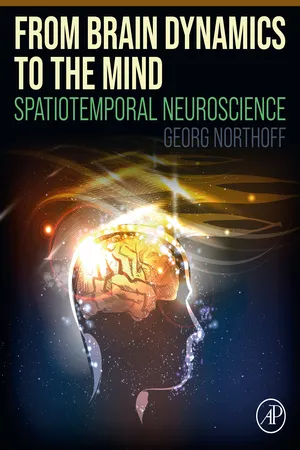
From Brain Dynamics to the Mind: Spatiotemporal Neuroscience explores how the self and consciousness is related to neural events. Sections in the book cover existing models used to describe the mind/brain problem, recent research on brain mechanisms and processes and what they tell us about the self, consciousness and psychiatric disorders. The book presents a spatiotemporal approach to understanding the brain and the implications for artificial intelligence, novel therapies for psychiatric disorders, and for ethical, societal and philosophical issues.
Pulling concepts from neuroscience, psychology and philosophy, the book presents a modern and complete look at what we know, what we can surmise, and what we may never know about the distinction between brain and mind.
- Reviews models of understanding the mind/brain problem
- Identifies neural processes involved in consciousness, sense of self and brain function
- Includes concepts and research from neuroscience, psychology, cognitive science and philosophy
- Discusses implications for AI, novel therapies for psychiatric disorders and issues of ethics
- Suggests experimental designs and data analyses for future research on the mind/brain issue
Information
Table of contents
- Cover
- Front Matter
- Table of Contents
- Copyright
- Preface
- Introduction
- List of Illustrations
- List of Tables
- Chapter 1 : The fluctuating brain—essentials of neural variability
- Chapter 2 : Neural variability in rest and task states
- Chapter 3 : Neural variability shapes perception and cognition
- Chapter 4 : Neurodynamic mechanisms of neural variability
- Chapter 5 : From broccoli to the brain—Scale-free activity
- Chapter 6 : From scale-free activity to temporo-spatial nestedness
- Chapter 7 : Scale-free dynamic shapes perception and cognition
- Chapter 8 : Scale-free activity—bridge between environment and brain
- Chapter 9 : The brain's inner time—intrinsic neural timescales
- Chapter 10 : Intrinsic neural timescales mediate input processing
- Chapter 11 : From Chronos and Kairos to the brain's temporal receptive windows
- Chapter 12 : Lessons from geology—from the timescales of the human brain to artificial agents
- Chapter 13 : Synchrony in nature and brain
- Chapter 14 : Entrainment—How the brain synchronizes with its environment
- Chapter 15 : Brain—global synchronization and its topography
- Chapter 16 : Neural synchronization in fMRI and EEG/MEG—a methodological guide
- Chapter 17 : Dynamic layer model of brain (DLB)—An introduction
- Chapter 18 : Background and foreground layers I: Scale-free stability versus oscillatory flexibility
- Chapter 19 : Background and foreground layers II—nonlinear and asymmetric relationship
- Chapter 20 : Baseline model of cognition I: Distinction from dual model of cognition
- Chapter 21 : Baseline model of cognition II: Spatiotemporal shaping of cognition and input processing
- Chapter 22 : Dynamic capacities and cognition
- Chapter 23 : Cognitive model and predictive coding
- Chapter 24 : Intrinsic and inside-out models of brain
- Chapter 25 : Brain and world—converging free energy principle and dynamic layer model of brain
- Chapter 26 : The self and its intrinsic topography
- Chapter 27 : The dynamic of self and its semantics
- Chapter 28 : The self—psychological baseline or default
- Chapter 29 : From icebergs to the self—point of view
- Chapter 30 : Topographic reorganization model of meditation
- Chapter 31 : Topographic reorganization of the self during meditation
- Chapter 32 : Dynamic reorganization of the brain during meditation
- Chapter 33 : From Salvador Dali to dreams—topographic reorganization model of dreams
- Chapter 34 : From falling keys to dreams—Dynamic reorganization
- Chapter 35 : How dynamics shape our thoughts
- Chapter 36 : Baseline model of thought
- Chapter 37 : The jungle of consciousness—current neuroscientific theories
- Chapter 38 : Order in the jungle of consciousness—convergence of theories
- Chapter 39 : Temporo-spatial theory of consciousness I—form and level/state
- Chapter 40 : Temporo-spatial theory of consciousness (TTC) II: Contents of consciousness
- Chapter 41 : From brain to consciousness—“common currency hypothesis”
- Chapter 42 : Dynamic shapes perception and behavior in autism
- Chapter 43 : Hierarchical model of autistic self
- Conclusion
- Index
- A
Trusted by 375,005 students
Access to over 1.5 million titles for a fair monthly price.
Study more efficiently using our study tools.
Frequently asked questions
Yes, you can cancel anytime from the Subscription tab in your account settings on the Perlego website. Your subscription will stay active until the end of your current billing period. Learn how to cancel your subscription
No, books cannot be downloaded as external files, such as PDFs, for use outside of Perlego. However, you can download books within the Perlego app for offline reading on mobile or tablet. Learn how to download books offline
Perlego offers two plans: Essential and Complete
- Essential is ideal for learners and professionals who enjoy exploring a wide range of subjects. Access the Essential Library with 800,000+ trusted titles and best-sellers across business, personal growth, and the humanities. Includes unlimited reading time and Standard Read Aloud voice.
- Complete: Perfect for advanced learners and researchers needing full, unrestricted access. Unlock 1.5M+ books across hundreds of subjects, including academic and specialized titles. The Complete Plan also includes advanced features like Premium Read Aloud and Research Assistant.
We are an online textbook subscription service, where you can get access to an entire online library for less than the price of a single book per month. With over 1.5 million books across 990+ topics, we’ve got you covered! Learn about our mission
Look out for the read-aloud symbol on your next book to see if you can listen to it. The read-aloud tool reads text aloud for you, highlighting the text as it is being read. You can pause it, speed it up and slow it down. Learn more about Read Aloud
Yes! You can use the Perlego app on both iOS and Android devices to read anytime, anywhere — even offline. Perfect for commutes or when you’re on the go.
Please note we cannot support devices running on iOS 13 and Android 7 or earlier. Learn more about using the app
Please note we cannot support devices running on iOS 13 and Android 7 or earlier. Learn more about using the app
Yes, you can access From Brain Dynamics to the Mind by Georg Northoff in PDF and/or ePUB format, as well as other popular books in Biological Sciences & Developmental Psychology. We have over 1.5 million books available in our catalogue for you to explore.