eBook - ePub
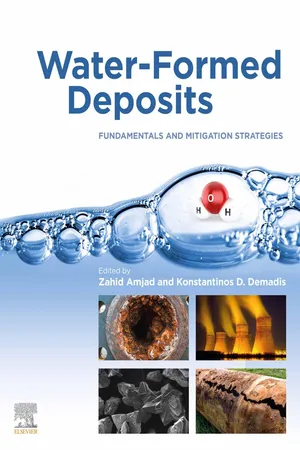
Water-Formed Deposits
Fundamentals and Mitigation Strategies
- 856 pages
- English
- ePUB (mobile friendly)
- Available on iOS & Android
eBook - ePub
About this book
Water-Formed Deposits: Fundamentals and Mitigation Strategies wholly presents the important issue of deposits in aqueous systems, both industrial and biological. By analyzing causes, mechanisms and mitigation strategies, the book helps researchers/engineers/end-users gain a fundamental understanding of the issues underlying deposit formation and mitigation. It covers numerous, fundamental aspects of water-formed deposits, while also giving an applications' perspective. The book's goal is to assist the reader in his/her understanding of the important issues of scale formation, while also helping with potential solutions.
- Provides a fundamental understanding of deposit formation by presenting basic science and mechanisms
- Presents an "applications perspective
- Reveals a systematic overview of deposit-related challenges and their mitigation
- Correlates structure to performance in mitigation strategies
- Analyzes current legal aspects and regulations
- Includes case studies from the "real industrial world for the industrial reader/end user
Information
Table of contents
- Cover
- Front Matter
- Table of Contents
- Copyright
- Contributors
- Editors Biography
- Preface
- Acknowledgments
- List of Illustrations
- List of Tables
- Chapter 1 : Water chemistry and its role in industrial water systems
- Chapter 2 : Mechanisms of scale formation and inhibition
- Chapter 3 : History of phosphorus-containing corrosion inhibitors: From the beginning till the present time
- Chapter 4 : Biomineralization: Applied to biodeterioration and bioremediation
- Chapter 5 : Microfouling in industrial cooling water systems
- Chapter 6 : Particulate matter: Interfacial properties, fouling, and its mitigation
- Chapter 7 : Calcium phosphates in geological, biological, and industrial systems
- Chapter 8 : Nonchemical methods to control scale and deposit formation
- Chapter 9 : Silica and metal silicate deposits
- Chapter 10 : Reverse osmosis: Fundamental causes of membrane deposition and approaches to mitigation
- Chapter 11 : Cooling water systems: An overview
- Chapter 12 : Formation and mitigation of mineral scaling in geothermal power plants
- Chapter 13 : Gypsum scale control by phosphonate additives
- Chapter 14 : Recent developments in oilfield scale control
- Chapter 15 : Oilfield iron sulfide scale formation and mitigation
- Chapter 16 : Oilfield scale inhibitors: Synthetic and performance aspects
- Chapter 17 : Control of composite oilfield scales and deposits
- Chapter 18 : Polymers for industrial water systems: Synthesis, characterization, and applications
- Chapter 19 : Polymeric supports for water treatment applications
- Chapter 20 : Scale in sugar juice evaporators: Types, cases, and prevention
- Chapter 21 : Scale control in thermal desalination☆
- Chapter 22 : Scale control in home care applications
- Chapter 23 : Calcification of biomaterials
- Chapter 24 : Kidney stone formation—Thermodynamic, kinetic, and clinical aspects
- Chapter 25 : Novel technologies to prevent dental plaque and calculus
- Chapter 26 : Biofouling (macro-fouling) in seawater intake systems
- Chapter 27 : Sewer solids affecting microbiologically induced corrosion and/or hydrogen sulfide formation
- Chapter 28 : Legionella: Causes, cases, and mitigation
- Chapter 29 : Global water treatment trends and issues
- Chapter 30 : Simulation tools for membrane scaling in reverse osmosis desalination plants
- Chapter 31 : Synthesis, properties, and applications of novel fluorescent-tagged scale inhibitors in water treatment
- Chapter 32 : Phosphonate inhibitors: Types, solution chemistry, and applications
- Chapter 33 : Introducing X-ray photoelectron spectroscopy for corrosion studies: A tool for elucidating interfacial composition and chemistry
- Chapter 34 : Polyelectrolyte polymers—Types, forms, and function
- Chapter 35 : Mechanisms of scale inhibition derived from a fluorescent-tagged antiscalant visualization
- Chapter 36 : Mineral scale deposits—Analysis and interpretation
- Chapter 37 : Regulatory and compliance issues faced by the water treatment industry
- Index
- A
Trusted by 375,005 students
Access to over 1.5 million titles for a fair monthly price.
Study more efficiently using our study tools.
Frequently asked questions
Yes, you can cancel anytime from the Subscription tab in your account settings on the Perlego website. Your subscription will stay active until the end of your current billing period. Learn how to cancel your subscription
No, books cannot be downloaded as external files, such as PDFs, for use outside of Perlego. However, you can download books within the Perlego app for offline reading on mobile or tablet. Learn how to download books offline
Perlego offers two plans: Essential and Complete
- Essential is ideal for learners and professionals who enjoy exploring a wide range of subjects. Access the Essential Library with 800,000+ trusted titles and best-sellers across business, personal growth, and the humanities. Includes unlimited reading time and Standard Read Aloud voice.
- Complete: Perfect for advanced learners and researchers needing full, unrestricted access. Unlock 1.5M+ books across hundreds of subjects, including academic and specialized titles. The Complete Plan also includes advanced features like Premium Read Aloud and Research Assistant.
We are an online textbook subscription service, where you can get access to an entire online library for less than the price of a single book per month. With over 1.5 million books across 990+ topics, we’ve got you covered! Learn about our mission
Look out for the read-aloud symbol on your next book to see if you can listen to it. The read-aloud tool reads text aloud for you, highlighting the text as it is being read. You can pause it, speed it up and slow it down. Learn more about Read Aloud
Yes! You can use the Perlego app on both iOS and Android devices to read anytime, anywhere — even offline. Perfect for commutes or when you’re on the go.
Please note we cannot support devices running on iOS 13 and Android 7 or earlier. Learn more about using the app
Please note we cannot support devices running on iOS 13 and Android 7 or earlier. Learn more about using the app
Yes, you can access Water-Formed Deposits by Zahid Amjad,Konstantinos D. Demadis in PDF and/or ePUB format, as well as other popular books in Technology & Engineering & Chemical & Biochemical Engineering. We have over 1.5 million books available in our catalogue for you to explore.