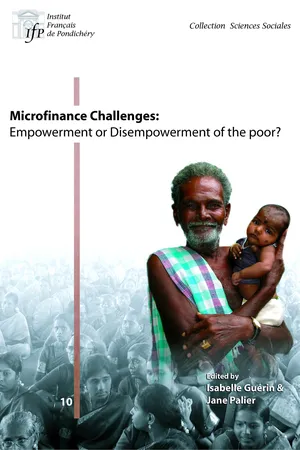
Microfinance is often presented, not only as an efficient tool to fight against poverty, but also as a means of promoting the empowerment of the most marginalized sections of the population, especially women. However, reality has shown that the causal relation between microfinance and empowerment is neither linear, nor unequivocal and that it is even less systematic. This book is an attempt to nourish the debate, on the one hand, by combining theoretical reflections and case studies, and on the other hand, by engaging practitioners and researchers from various backgrounds (mainly economists, sociologists and anthropologists). First of all, we consider the question of definitions. Even if everyone agrees that the concept of 'empowerment' refers to notions of choice, of power and of change, the diversity of definitions suggested here confirms that under no circumstances does a universal conception of it exist. The second part insists on the central role of the environment. The link between microfinance and empowerment is all the more subtle, and sometimes unforeseeable, as microfinance projects take place within an economic, socio-cultural and political context that is itself complex, evolutionary and which partially conditions the results obtained. Microfinance projects - as any development projects - should therefore be understood and analyzed as endogenous processes. Finally, a third part relates to the crucial question of evaluation. Here still, the diversity of the results is striking: certain experiments are very positive while elsewhere the results are very mixed and sometimes even worrying. One does not speak any more of empowerment, but of "disempowerment" or even "overempowerment". This heterogeneity of results is due as much to the diversity of the projects, their methods of action, the target population, and the context of intervention as to the methodologies of evaluation. The conclusion leads us to go beyond a certain number of contradictions evoked throughout the book while proposing to think of empowerment using the French concept of "solidarity-based economy". This concept of solidarity-based economy, which is theoretical as well as normative, is a framework for analysis and action, which, according to us, must make it possible to guard against the risks of failures and perverse effects mentioned throughout the book.
eBook - ePub
Microfinance challenges: empowerment or disempowerment of the poor?
- English
- ePUB (mobile friendly)
- Available on iOS & Android
eBook - ePub
Microfinance challenges: empowerment or disempowerment of the poor?
About this book
Information
Subtopic
SociologyIndex
Social SciencesTable of contents
- Cover
- Bibliographic informations
- First pages
- Table of contents
- Editors and Scientific Advisory Committee
- List of Authors
- Acknowledgements
- General Introduction
- Part I - Questions as to definition: what is understood by empowerment?
- Part II - Microfinance in its environment
- Part III - Assessing microfinance
- By way of a conclusion: microfinance, empowerment and solidarity-based economy
Trusted by 375,005 students
Access to over 1.5 million titles for a fair monthly price.
Study more efficiently using our study tools.
Frequently asked questions
Yes, you can cancel anytime from the Subscription tab in your account settings on the Perlego website. Your subscription will stay active until the end of your current billing period. Learn how to cancel your subscription
No, books cannot be downloaded as external files, such as PDFs, for use outside of Perlego. However, you can download books within the Perlego app for offline reading on mobile or tablet. Learn how to download books offline
Perlego offers two plans: Essential and Complete
- Essential is ideal for learners and professionals who enjoy exploring a wide range of subjects. Access the Essential Library with 800,000+ trusted titles and best-sellers across business, personal growth, and the humanities. Includes unlimited reading time and Standard Read Aloud voice.
- Complete: Perfect for advanced learners and researchers needing full, unrestricted access. Unlock 1.5M+ books across hundreds of subjects, including academic and specialized titles. The Complete Plan also includes advanced features like Premium Read Aloud and Research Assistant.
We are an online textbook subscription service, where you can get access to an entire online library for less than the price of a single book per month. With over 1.5 million books across 990+ topics, we’ve got you covered! Learn about our mission
Look out for the read-aloud symbol on your next book to see if you can listen to it. The read-aloud tool reads text aloud for you, highlighting the text as it is being read. You can pause it, speed it up and slow it down. Learn more about Read Aloud
Yes! You can use the Perlego app on both iOS and Android devices to read anytime, anywhere — even offline. Perfect for commutes or when you’re on the go.
Please note we cannot support devices running on iOS 13 and Android 7 or earlier. Learn more about using the app
Please note we cannot support devices running on iOS 13 and Android 7 or earlier. Learn more about using the app
Yes, you can access Microfinance challenges: empowerment or disempowerment of the poor? by Isabelle Guérin,Jane Palier in PDF and/or ePUB format, as well as other popular books in Social Sciences & Sociology. We have over 1.5 million books available in our catalogue for you to explore.