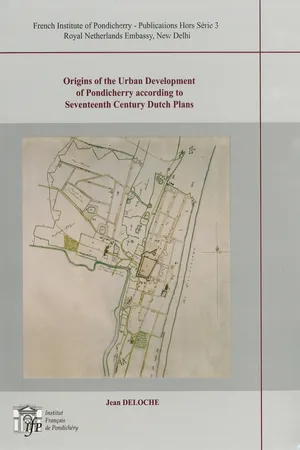
The modem plan of Pondicherry shows a large town in gridiron plan which obviously was extended to its present form through controlled urban development. Some Indian scholars consider that the town was built according to the principles of the ancient Hindu treatises of architecture, particularly the Silpa Sastra. French historians, on the other hand, feel that the plan should be considered as an achievement of «the French mind». In fact, the Dutch plans of Pondicherry dated 1693-1694, preserved at the National Archives at The Hague, show that the orthogonal street pattern of the town is a creation of the Dutch. The plans of 1693 show that, in François Martin's settlement, the streets or lanes were following an irregular pattern, without any shape or symmetry, whereas, in the plans drafted in 1694, during the Dutch occupation, one finds the design of a large new town, with a very regular geometric layout, rectangular blocks of houses, separated by straight streets, intersecting at right angles. This great urban project of the Dutch Company was adopted by the French who systematically carried out the extensive straightening out of streets into a planned grid, during the the first half of the 18th century.
eBook - ePub
Origins of the Urban Development of Pondicherry according to Seventeenth Century Dutch Plans
- English
- ePUB (mobile friendly)
- Available on iOS & Android
eBook - ePub
Origins of the Urban Development of Pondicherry according to Seventeenth Century Dutch Plans
About this book
Information
Subtopic
Indian & South Asian HistoryIndex
HistoryTable of contents
- Cover
- Bibliographic informations
- First pages
- Table of contents
- List of figures and plates
- Acknowledgments
- Introduction
- I. Pondicherry in 1693
- II. Pondichery under the Dutch (1693-1699)
- Conclusion
- Plates. Photographs of original plans
- Works cited
- Index
Trusted by 375,005 students
Access to over 1.5 million titles for a fair monthly price.
Study more efficiently using our study tools.
Frequently asked questions
Yes, you can cancel anytime from the Subscription tab in your account settings on the Perlego website. Your subscription will stay active until the end of your current billing period. Learn how to cancel your subscription
No, books cannot be downloaded as external files, such as PDFs, for use outside of Perlego. However, you can download books within the Perlego app for offline reading on mobile or tablet. Learn how to download books offline
Perlego offers two plans: Essential and Complete
- Essential is ideal for learners and professionals who enjoy exploring a wide range of subjects. Access the Essential Library with 800,000+ trusted titles and best-sellers across business, personal growth, and the humanities. Includes unlimited reading time and Standard Read Aloud voice.
- Complete: Perfect for advanced learners and researchers needing full, unrestricted access. Unlock 1.5M+ books across hundreds of subjects, including academic and specialized titles. The Complete Plan also includes advanced features like Premium Read Aloud and Research Assistant.
We are an online textbook subscription service, where you can get access to an entire online library for less than the price of a single book per month. With over 1.5 million books across 990+ topics, we’ve got you covered! Learn about our mission
Look out for the read-aloud symbol on your next book to see if you can listen to it. The read-aloud tool reads text aloud for you, highlighting the text as it is being read. You can pause it, speed it up and slow it down. Learn more about Read Aloud
Yes! You can use the Perlego app on both iOS and Android devices to read anytime, anywhere — even offline. Perfect for commutes or when you’re on the go.
Please note we cannot support devices running on iOS 13 and Android 7 or earlier. Learn more about using the app
Please note we cannot support devices running on iOS 13 and Android 7 or earlier. Learn more about using the app
Yes, you can access Origins of the Urban Development of Pondicherry according to Seventeenth Century Dutch Plans by Jean Deloche in PDF and/or ePUB format, as well as other popular books in History & Indian & South Asian History. We have over 1.5 million books available in our catalogue for you to explore.