The World Health Organization defines infertility as the inability to conceive after 12 months of regular and unprotected sex (WHO, 1975). Despite research that has shown that 50 per cent of infertility cases can be attributed to the male partner, in many societies the blame is cast on the woman, her voice silenced, and any action taken by the man deemed justifiable. Infertility affects millions of people across Sub-Saharan Africa, and in a socio-cultural context where children are valued as a source of wealth for the family, perceived infertility can result in neglect, abuse, marital instability, banishment, discrimination and social stigma (Barden-O'Fallon, 2005). The topic of infertility is often considered to be a taboo subject, with women being accused of witchcraft, prior abortions or prostitution. Malawi is a small country in Central-East Africa, bordered by Tanzania and Mozambique, with a population of 18 million, 85 percent of which resides in rural areas. Similarly to other countries in the region, fertility is highly desired and valued. Malawi's total fertility rate (TFR) has declined over the years, but still sits relatively high, at 5.49 children per woman as of 2017 (Index Mundi, 2018). In demographic discourse, this declining fertility rate is often celebrated as a sign of the country moving towards a more industrialized economic system. However, this rhetoric on demographic transition invisibilizes the social and psychological consequences of infertility, experienced in varying contexts. This thesis will examine the social stigmatization and feminization of infertility in Malawi, and specifically how stigma is understood and managed in the context of socio-cultural perceptions of infertility, within the local ecology of Malawi, as well as its effect on lived experiences and gender identities. Data was collected from four participant groups – infertile women, religious leaders, health workers, and community members through interviews, discussion groups, and informal conversation. The empirical findings demonstrate that infertility does not exist solely as a biological or physiological condition, requiring a biomedical approach, but rather encompasses emotional, social, cultural, religious and economic spheres. As such, the approach to infertility response must also include these spheres, focusing not only on preventive measures but also addressing stigma, patriarchal structures, gender inequality, poverty, and sexual and reproductive health knowledge. We extend our heartfelt thanks to the Vahabzadeh Foundation for financially supporting the publication of best works by young researchers of the Graduate Institute, giving a priority to those who have been awarded academic prizes for their master's dissertations.
- English
- ePUB (mobile friendly)
- Available on iOS & Android
eBook - ePub
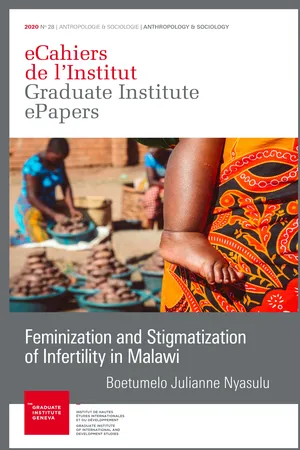
Feminization and Stigmatization of Infertility in Malawi
About this book
Information
Subtopic
AnthropologyIndex
Social SciencesTable of contents
- Introductory pages
- Table of contents
- Acknowledgements
- 1. Introduction
- 2. Literature Review
- 3. Theoretical Framework
- 4. Methodology
- 5. Perceived Causes and Treatments
- 6. Experiences of Stigma
- 7. Consequences and Delegitimation
- 8. Concluding Remarks
- References
Trusted by 375,005 students
Access to over 1.5 million titles for a fair monthly price.
Study more efficiently using our study tools.
Frequently asked questions
Yes, you can cancel anytime from the Subscription tab in your account settings on the Perlego website. Your subscription will stay active until the end of your current billing period. Learn how to cancel your subscription
No, books cannot be downloaded as external files, such as PDFs, for use outside of Perlego. However, you can download books within the Perlego app for offline reading on mobile or tablet. Learn how to download books offline
Perlego offers two plans: Essential and Complete
- Essential is ideal for learners and professionals who enjoy exploring a wide range of subjects. Access the Essential Library with 800,000+ trusted titles and best-sellers across business, personal growth, and the humanities. Includes unlimited reading time and Standard Read Aloud voice.
- Complete: Perfect for advanced learners and researchers needing full, unrestricted access. Unlock 1.5M+ books across hundreds of subjects, including academic and specialized titles. The Complete Plan also includes advanced features like Premium Read Aloud and Research Assistant.
We are an online textbook subscription service, where you can get access to an entire online library for less than the price of a single book per month. With over 1.5 million books across 990+ topics, we’ve got you covered! Learn about our mission
Look out for the read-aloud symbol on your next book to see if you can listen to it. The read-aloud tool reads text aloud for you, highlighting the text as it is being read. You can pause it, speed it up and slow it down. Learn more about Read Aloud
Yes! You can use the Perlego app on both iOS and Android devices to read anytime, anywhere — even offline. Perfect for commutes or when you’re on the go.
Please note we cannot support devices running on iOS 13 and Android 7 or earlier. Learn more about using the app
Please note we cannot support devices running on iOS 13 and Android 7 or earlier. Learn more about using the app
Yes, you can access Feminization and Stigmatization of Infertility in Malawi by Julianne Boetumelo Nyasulu in PDF and/or ePUB format, as well as other popular books in Social Sciences & Anthropology. We have over 1.5 million books available in our catalogue for you to explore.