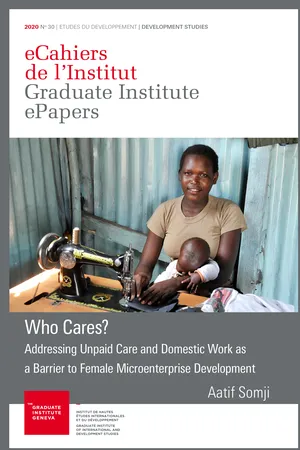
Gender gaps present themselves in a number of different ways across labour markets, consistently to the detriment of females. Gender gaps are well documented in the returns to capital of microenterprises, which provide substantial employment opportunities for those in low- and middle-income countries. The puzzle for academics and policymakers concerned with issues of gender, labour and development is to understand why these gender gaps exist across microenterprises and what can be done to address them. This ePaper seeks to contribute to these academic and policy debates, using a feminist framework to explore unpaid care and domestic work as one potential explanatory factor. Analyses of primary data collected from women micro-entrepreneurs in Uganda suggest that unpaid care and domestic work is a significant constraint to female microenterprise development. The key implication of this finding is that gender gaps in microenterprise could potentially be narrowed by addressing gender inequality in unpaid work. This requires investing in social and physical infrastructure to reduce the total time spent on unpaid work, and addressing the social norms around its gendered distribution – redistributing unpaid work more equitably between males and females. We extend our heartfelt thanks to the Vahabzadeh Foundation for financially supporting the publication of best works by young researchers of the Graduate Institute, giving a priority to those who have been awarded academic prizes for their master's dissertations.
eBook - ePub
Who Cares?
Addressing Unpaid Care and Domestic Work as a Barrier to Female Microenterprise Development
- English
- ePUB (mobile friendly)
- Available on iOS & Android
eBook - ePub
Who Cares?
Addressing Unpaid Care and Domestic Work as a Barrier to Female Microenterprise Development
About this book
Information
Subtopic
Gender StudiesIndex
Social SciencesTable of contents
- Introductory pages
- Table of contents
- Acknowledgements
- 1. Introduction
- 2. Literature Review
- 3. Case Study – Luwero District, Uganda
- 4. Methodology
- 5. Results and Analysis
- 5. Conclusion
- References
- Appendices
Trusted by 375,005 students
Access to over 1.5 million titles for a fair monthly price.
Study more efficiently using our study tools.
Frequently asked questions
Yes, you can cancel anytime from the Subscription tab in your account settings on the Perlego website. Your subscription will stay active until the end of your current billing period. Learn how to cancel your subscription
No, books cannot be downloaded as external files, such as PDFs, for use outside of Perlego. However, you can download books within the Perlego app for offline reading on mobile or tablet. Learn how to download books offline
Perlego offers two plans: Essential and Complete
- Essential is ideal for learners and professionals who enjoy exploring a wide range of subjects. Access the Essential Library with 800,000+ trusted titles and best-sellers across business, personal growth, and the humanities. Includes unlimited reading time and Standard Read Aloud voice.
- Complete: Perfect for advanced learners and researchers needing full, unrestricted access. Unlock 1.5M+ books across hundreds of subjects, including academic and specialized titles. The Complete Plan also includes advanced features like Premium Read Aloud and Research Assistant.
We are an online textbook subscription service, where you can get access to an entire online library for less than the price of a single book per month. With over 1.5 million books across 990+ topics, we’ve got you covered! Learn about our mission
Look out for the read-aloud symbol on your next book to see if you can listen to it. The read-aloud tool reads text aloud for you, highlighting the text as it is being read. You can pause it, speed it up and slow it down. Learn more about Read Aloud
Yes! You can use the Perlego app on both iOS and Android devices to read anytime, anywhere — even offline. Perfect for commutes or when you’re on the go.
Please note we cannot support devices running on iOS 13 and Android 7 or earlier. Learn more about using the app
Please note we cannot support devices running on iOS 13 and Android 7 or earlier. Learn more about using the app
Yes, you can access Who Cares? by Aatif Somji in PDF and/or ePUB format, as well as other popular books in Social Sciences & Gender Studies. We have over 1.5 million books available in our catalogue for you to explore.