eBook - ePub
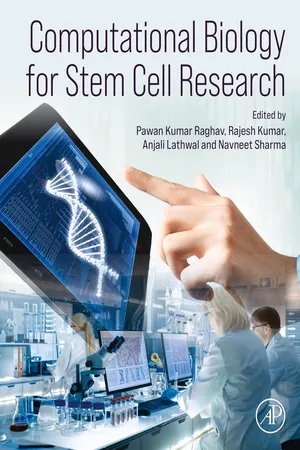
Computational Biology for Stem Cell Research
- 750 pages
- English
- ePUB (mobile friendly)
- Available on iOS & Android
eBook - ePub
Computational Biology for Stem Cell Research
About this book
Computational Biology for Stem Cell Research is an invaluable guide for researchers as they explore HSCs and MSCs in computational biology. With the growing advancement of technology in the field of biomedical sciences, computational approaches have reduced the financial and experimental burden of the experimental process. In the shortest span, it has established itself as an integral component of any biological research activity. HSC informatics (in silico) techniques such as machine learning, genome network analysis, data mining, complex genome structures, docking, system biology, mathematical modeling, programming (R, Python, Perl, etc.) help to analyze, visualize, network constructions, and protein-ligand or protein-protein interactions.
This book is aimed at beginners with an exact correlation between the biomedical sciences and in silico computational methods for HSCs transplantation and translational research and provides insights into methods targeting HSCs properties like proliferation, self-renewal, differentiation, and apoptosis.
- Modeling Stem Cell Behavior: Explore stem cell behavior through animal models, bridging laboratory studies to real-world clinical allogeneic HSC transplantation (HSCT) scenarios.
- Bioinformatics-Driven Translational Research: Navigate a path from bench to bedside with cutting-edge bioinformatics approaches, translating computational insights into tangible advancements in stem cell research and medical applications.
- Interdisciplinary Resource: Discover a single comprehensive resource catering to biomedical sciences, life sciences, and chemistry fields, offering essential insights into computational tools vital for modern research.
Information
Table of contents
- Cover
- Front Matter
- Table of Contents
- Copyright
- Dedication
- Abbreviations
- List of figures
- List of tables
- Contributors
- Biographies
- Preface
- Acknowledgments
- Introduction
- List of Illustrations
- List of Tables
- Chapter 1 : Advancement of in silico tools for stem cell research
- Chapter 2 : Paradigm shift in stem cell research with computational tools, techniques, and databases
- Chapter 3 : Stem cell informatics: Web resources aiding in stem cell research
- Chapter 4 : Stem cell based informatics development and approaches
- Chapter 5 : Exploring imaging technologies and computational resources in stem cell research for regenerative medicine: A comprehensive review
- Chapter 6 : Application of machine learning–based approaches in stem cell research
- Chapter 7 : Stem cell therapy in the era of machine learning
- Chapter 8 : Computational and stem cell biology: Challenges and future perspectives
- Chapter 9 : Single-cell transcriptome profiling in unraveling distinct molecular signatures from cancer stem cells
- Chapter 10 : The single-cell big data analytics: A game changer in bioscience
- Chapter 11 : Unravelling the genomics and proteomics aspects of the stemness phenotype in stem cells
- Chapter 12 : Cutting-edge proteogenomics approaches to analyze stem cells at the therapeutic level
- Chapter 13 : Cheminformatics, metabolomics, and stem cell tissue engineering: A transformative insight
- Chapter 14 : Advances in regenerative medicines based on mesenchymal stem cell secretome
- Chapter 15 : Paradigms of omics in bioinformatics for accelerating current trends and prospects of stem cell research
- Chapter 16 : Transcriptomic profiling–based identification of biomarkers of stem cells
- Chapter 17 : Genomic and transcriptomic applications in neural stem cell therapeutics
- Chapter 18 : Integration of multi-omic data to identify transcriptional targets during human hematopoietic stem cell erythroid differentiation
- Chapter 19 : Computational approaches to determine stem cell fate
- Chapter 20 : Stem cell databases and tools: challenges and opportunities of computational biology
- Chapter 21 : Deciphering the complexities of stem cells through network biology approaches for their application in regenerative medicine
- Chapter 22 : Bioinformatics approaches to the understanding of Notch signaling in the biology of stem cells
- Chapter 23 : In silico approaches for the analysis of developmental fate of stem cells
- Chapter 24 : Computational approaches for hematopoietic stem cells: Advancing regenerative therapeutics
- Chapter 25 : Approaches to construct and analyze stem cells regulatory networks
- Chapter 26 : Tissue engineering in chondral defect
- Chapter 27 : Recent advances in computational modeling: An appraisal of stem cell and tissue engineering research
- Chapter 28 : Computational approaches for bioengineering of cornea
- Chapter 29 : Targeting cancer stem cells and harnessing of computational tools offer new strategies for cancer therapy
- Chapter 30 : Introduction to machine learning and its applications in stem cell research
- Chapter 31 : Multiscale computational and machine learning models for designing stem cell-based regenerative medicine therapies
- Chapter 32 : Computational analysis in epithelial tissue regeneration
- Author index
- Index
Trusted by 375,005 students
Access to over 1.5 million titles for a fair monthly price.
Study more efficiently using our study tools.
Frequently asked questions
Yes, you can cancel anytime from the Subscription tab in your account settings on the Perlego website. Your subscription will stay active until the end of your current billing period. Learn how to cancel your subscription
No, books cannot be downloaded as external files, such as PDFs, for use outside of Perlego. However, you can download books within the Perlego app for offline reading on mobile or tablet. Learn how to download books offline
Perlego offers two plans: Essential and Complete
- Essential is ideal for learners and professionals who enjoy exploring a wide range of subjects. Access the Essential Library with 800,000+ trusted titles and best-sellers across business, personal growth, and the humanities. Includes unlimited reading time and Standard Read Aloud voice.
- Complete: Perfect for advanced learners and researchers needing full, unrestricted access. Unlock 1.5M+ books across hundreds of subjects, including academic and specialized titles. The Complete Plan also includes advanced features like Premium Read Aloud and Research Assistant.
We are an online textbook subscription service, where you can get access to an entire online library for less than the price of a single book per month. With over 1.5 million books across 990+ topics, we’ve got you covered! Learn about our mission
Look out for the read-aloud symbol on your next book to see if you can listen to it. The read-aloud tool reads text aloud for you, highlighting the text as it is being read. You can pause it, speed it up and slow it down. Learn more about Read Aloud
Yes! You can use the Perlego app on both iOS and Android devices to read anytime, anywhere — even offline. Perfect for commutes or when you’re on the go.
Please note we cannot support devices running on iOS 13 and Android 7 or earlier. Learn more about using the app
Please note we cannot support devices running on iOS 13 and Android 7 or earlier. Learn more about using the app
Yes, you can access Computational Biology for Stem Cell Research by Pawan Raghav, Rajesh Kumar, Anjali Lathwal, Navneet Sharma, Pawan Raghav,Rajesh Kumar,Anjali Lathwal,Navneet Sharma in PDF and/or ePUB format, as well as other popular books in Biological Sciences & Bioinformatics. We have over 1.5 million books available in our catalogue for you to explore.