eBook - ePub
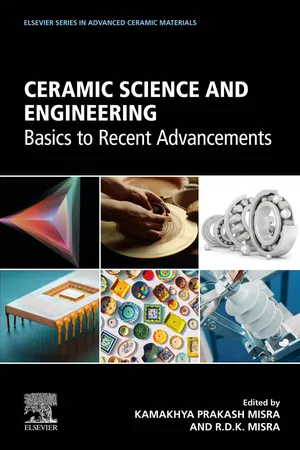
Ceramic Science and Engineering
Basics to Recent Advancements
- 616 pages
- English
- ePUB (mobile friendly)
- Available on iOS & Android
eBook - ePub
About this book
Ceramic Science and Engineering: Basics to Recent Advancements covers the fundamentals, classification and applications surrounding ceramic engineering. In addition, the book contains an extensive review of the current published literature on established ceramic materials. Other sections present an extensive review of up-to-date research on new innovative ceramic materials and reviews recently published articles, case studies and the latest research outputs. The book will be an essential reference resource for materials scientists, physicists, chemists and engineers, postgraduate students, early career researchers, and industrial researchers working in R&D in the development of ceramic materials.
Ceramic engineering deals with the science and technology of creating objects from inorganic and non-metallic materials. It combines the principles of chemistry, physics and engineering. Fiber-optic devices, microprocessors and solar panels are just a few examples of ceramic engineering being applied in everyday life. Advanced ceramics such as alumina, aluminum nitride, zirconia, ZnO, silicon carbide, silicon nitride and titania-based materials, each of which have their own specific characteristics and offer an economic and high-performance alternative to more conventional materials such as glass, metals and plastics are also discussed.
- Covers environmental barrier ceramic coatings, advanced ceramic conductive fuel cells, processing and machining technology in ceramic and composite materials, photoluminescent ceramic materials, perovskite ceramics and bioinspired ceramic materials
- Reviews both conventional, established ceramics and new, innovative advanced ceramics
- Contains an extensive review of the current published literature on established ceramic materials
Information
Table of contents
- Ceramic Science and Engineering
- Cover
- Title Page
- Copyright
- Tabel of Contents
- List of Contributors
- Preface
- 1 Fundamentals of ceramics: introduction, classification, and applications
- 2 Advanced ceramics
- 3 Silica optical fibers and their applications in SPR/LMR-based refractive index sensing
- 4 Bioceramics: materials, properties, and applications
- 5 Bioinspired ceramics for bone tissue applications
- 6 Bioinspired design: lessons from hierarchical structures and local properties of natural ceramics and their composites
- 7 Physics of ferrite ceramics
- 8 Nanostructured boron nitride fiber/matrix interphase in carbon-carbon composites
- 9 Rare earth–doped TiO2 nanoparticles for photocatalytic dye remediation
- 10 Zinc oxide nanostructures
- 11 Luminescence and photodetection characteristics of rare earth–doped zinc oxide nanostructures
- 12 Ferroelectric ceramics and glass ceramics for photocatalysis
- 13 Energy storage batteries: basic feature and applications
- 14 Design and developments in ceramic materials for electrochemical applications
- 15 Environmental degradation of ceramic materials in nuclear energy systems
- 16 Resistive switching characteristics of TiO2 thin films for nonvolatile memory applications
- 17 Ceramic-conducting polymer composites for sensing applications
- 18 Multiphase ultra-high temperature ceramic barrier coatings on fibers in extreme environments
- 19 Nanostructured ceramics
- Index
- Index - Continued
Trusted by 375,005 students
Access to over 1.5 million titles for a fair monthly price.
Study more efficiently using our study tools.
Frequently asked questions
Yes, you can cancel anytime from the Subscription tab in your account settings on the Perlego website. Your subscription will stay active until the end of your current billing period. Learn how to cancel your subscription
No, books cannot be downloaded as external files, such as PDFs, for use outside of Perlego. However, you can download books within the Perlego app for offline reading on mobile or tablet. Learn how to download books offline
Perlego offers two plans: Essential and Complete
- Essential is ideal for learners and professionals who enjoy exploring a wide range of subjects. Access the Essential Library with 800,000+ trusted titles and best-sellers across business, personal growth, and the humanities. Includes unlimited reading time and Standard Read Aloud voice.
- Complete: Perfect for advanced learners and researchers needing full, unrestricted access. Unlock 1.5M+ books across hundreds of subjects, including academic and specialized titles. The Complete Plan also includes advanced features like Premium Read Aloud and Research Assistant.
We are an online textbook subscription service, where you can get access to an entire online library for less than the price of a single book per month. With over 1.5 million books across 990+ topics, we’ve got you covered! Learn about our mission
Look out for the read-aloud symbol on your next book to see if you can listen to it. The read-aloud tool reads text aloud for you, highlighting the text as it is being read. You can pause it, speed it up and slow it down. Learn more about Read Aloud
Yes! You can use the Perlego app on both iOS and Android devices to read anytime, anywhere — even offline. Perfect for commutes or when you’re on the go.
Please note we cannot support devices running on iOS 13 and Android 7 or earlier. Learn more about using the app
Please note we cannot support devices running on iOS 13 and Android 7 or earlier. Learn more about using the app
Yes, you can access Ceramic Science and Engineering by Kamakhya Prakash Misra,R.D.K. Misra in PDF and/or ePUB format, as well as other popular books in Technology & Engineering & Materials Science. We have over 1.5 million books available in our catalogue for you to explore.